Written By
  Published
  Last Updated
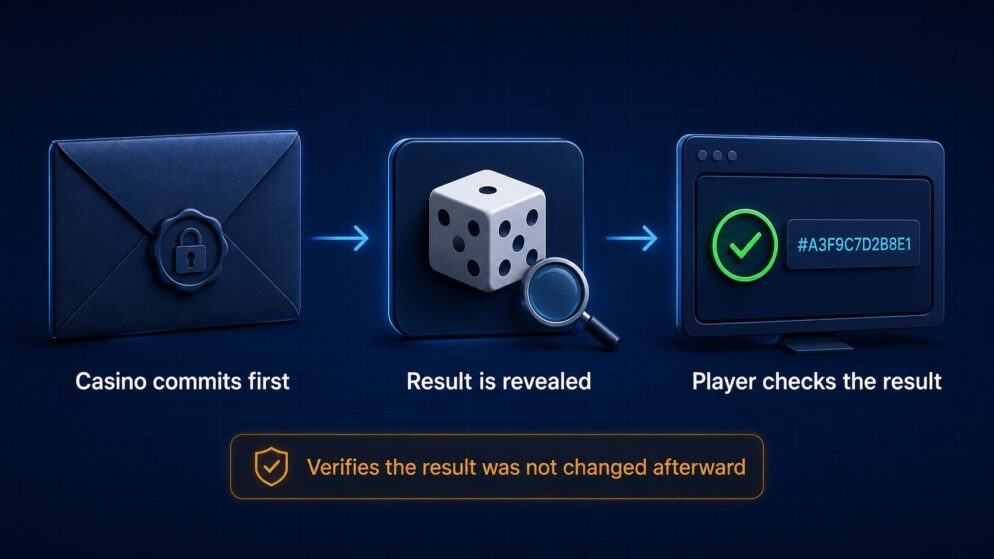
Provably fair is a cryptographic method that lets a player confirm a casino result was decided before the bet and not changed afterwards. The player runs the check personally, using free tools, without trusting the operator’s word. It is a real improvement over blind trust. It is also a much narrower guarantee than most casinos imply.
Key Takeaways
- Provably fair proves one thing: that a completed result matched the inputs the casino committed to beforehand.
- Verification uses two different functions. SHA-256 locks in the commitment. HMAC-SHA256 produces the outcome.
- It proves nothing about the house edge, the payout process, or whether the operator is licensed.
- Provably fair carries no legal weight. No US state regulator issues, audits, or recognises it.
What Provably Fair means
Provably fair means the casino commits to a result before the bet and lets the player verify that commitment afterwards.
The Commit and Reveal Principle
The casino generates a secret string called the server seed. It runs SHA-256 on that seed, producing a 64-character hash, and shows the player the hash before any bet is placed.
SHA-256 is a one-way function. The player cannot work backwards from the hash to the seed. The casino cannot find a different seed that produces the same hash.
That single property does the work. Once the hash is published, the casino is locked into its seed, and any later substitution would break the match.
The Three Inputs
Three values combine to produce every result.
| Input | Who Controls It | Visible When |
|---|---|---|
| Server seed | Casino | After seed rotation |
| Client seed | Player, or auto-generated on the player’s device | Immediately |
| Nonce | System, increments by one per bet | Immediately |
Each input blocks a different failure. The committed server seed stops the casino from changing the outcome. The hidden server seed stops the player from predicting it. The nonce makes every bet unique without requiring a new seed pair.
How Verification Works Step by Step
Verification takes five steps and requires no programming skill.
Before the Bet
The casino publishes the SHA-256 hash of its server seed. The player sets a client seed or accepts the one generated in the browser.
At that moment the outcome is mathematically locked. Neither side can move it.
After the Bet
The player rotates the seed pair, which prompts the casino to reveal the original server seed.
The player hashes that revealed seed with any free SHA-256 tool and compares the output to the hash published earlier. A match confirms the casino used the seed it committed to.
The player then recomputes the result itself using HMAC-SHA256, with the server seed as the key and the client seed plus nonce as the message. Applying the casino’s published conversion formula produces the game outcome, which should match the game history exactly.
A Dice Example
The standard formula across most implementations is:
HMAC-SHA256(server_seed, client_seed:nonce)
That produces a 64-character hexadecimal string. The casino’s published conversion turns the first bytes of that string into a number inside the game’s range, such as 0 to 99.99 for dice.
Two functions do two different jobs here, and most explanations blur them. SHA-256 handles the pre-bet commitment. HMAC-SHA256 derives the outcome. Confusing the two makes the verification impossible to reproduce.
Some games work differently. Crash titles often use a hash chain, where the casino generates a long sequence of linked hashes in advance and works backwards through it, so every round in the cycle is fixed before the first bet.
What Provably Fair Does Not Prove
Verification confirms one thing: that a specific completed result matched its inputs. It confirms nothing else.
It does not prove the house edge
The mathematics of the game sits entirely outside the cryptography.
A dice game can pass every fairness check and still carry a 5% house edge. Verification tells a player the number was generated honestly. It says nothing about whether the payout table favours them.
It does not prove you will get paid
The check covers the outcome, not the withdrawal.
An operator can run flawless provably fair games and still freeze an account, apply an undisclosed wagering condition, or refuse a payout. Every dispute of that kind sits outside what the cryptography can settle.
It does not cover every game on the site
Provably fair works on in-house originals such as dice, crash, mines, and plinko, where the casino controls the outcome generation.
Third-party slots from external game studios run on the studio’s own random number generator. Those games are not verifiable through the casino’s fairness tool, even on a site that advertises provably fair prominently.
Provably Fair Compared with Certified RNG
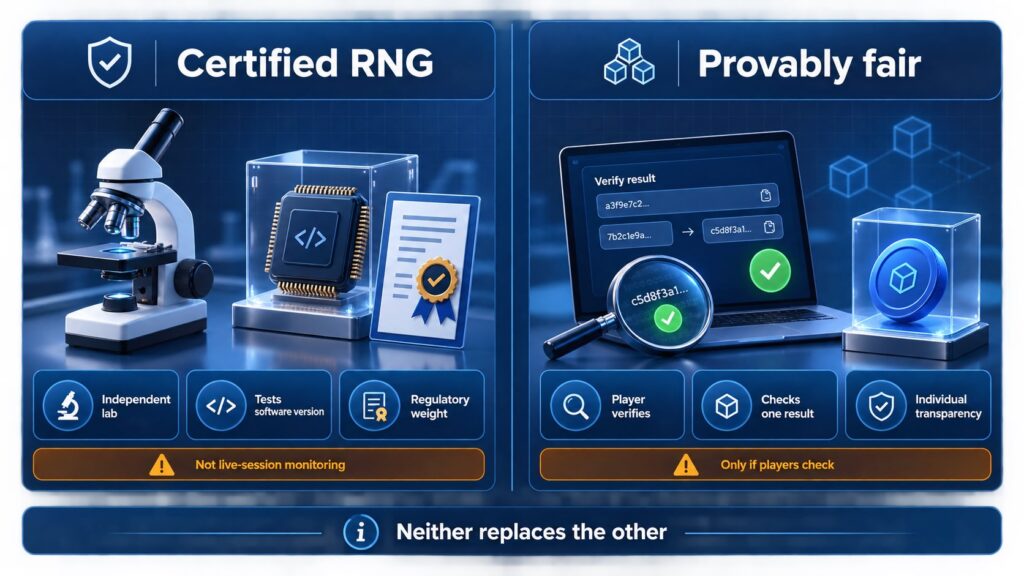
Certified RNG asks a player to trust a laboratory. Provably fair asks a player to check personally. Both models leave gaps.
| Certified RNG | Provably Fair | |
|---|---|---|
| Who verifies | Independent test lab (GLI, eCOGRA, iTech Labs, BMM) | The player |
| Standard applied | GLI-19 and equivalent | Casino’s published algorithm |
| What is tested | Randomness, return to player against the declared model, game mechanics | One completed result against its inputs |
| Scope of coverage | The software version submitted for testing | Individual bets on in-house games |
| Main limitation | Point-in-time test, not live session monitoring | Only helps players who actually run it |
| Regulatory standing | Required by most licensed jurisdictions | None |
Certification carries regulatory weight that provably fair does not. Provably fair offers individual verifiability that certification does not. Neither substitutes for the other.
Where Provably Fair Casinos Sit Legally
Provably fair is a technical feature. It carries no legal weight.
Provably fair is not a licence
Any site can implement provably fair, including an unlicensed one. No gaming authority issues it, audits it, or recognises it as a compliance measure.
A fairness tool on a homepage tells a player nothing about who regulates the operator, or whether anyone does.
Where real-money online casinos are licensed in the US
Roughly seven states license real-money online casinos: Connecticut, Delaware, Michigan, New Jersey, Pennsylvania, Rhode Island, and West Virginia.
None of those licensed operators use provably fair. They run certified random number generators under state regulator oversight, which is what their licences require.
What offshore actually means
Provably fair casinos are almost all licensed abroad, most commonly in Curaçao.
Curaçao replaced its old master licence system with direct licensing under the National Ordinance on Games of Chance, in force since December 2024. Legacy sub-licences expired in January 2025, and physical presence requirements took effect on January 1, 2026. That reform raised the compliance bar without making any operator legal in a US state.
Two federal statutes come up constantly. The Wire Act of 1961 targets interstate wire transmission for wagering. The Unlawful Internet Gambling Enforcement Act of 2006 restricts payment processors and operators rather than individual players. State law determines whether play itself is unlawful, and Washington State takes the strictest position by treating online gambling as illegal outright.
Sweepstakes casinos operate under a different model entirely and do not use provably fair. They run certified random number generators under the no-purchase-necessary structure.
Should You Verify Your Own Bets?
Verifying once tells a player the system works. Verifying every bet is not a realistic habit, and almost nobody does it.
A practical approach takes a few minutes. Check that the casino publishes its fairness documentation and its conversion formula. Rotate the seed pair once. Verify a single past result with a free hash tool.
Treat a missing verification tool, an unpublished formula, or a fairness page that explains nothing as a warning sign. A casino confident in its implementation documents it in detail.
The Bottom Line
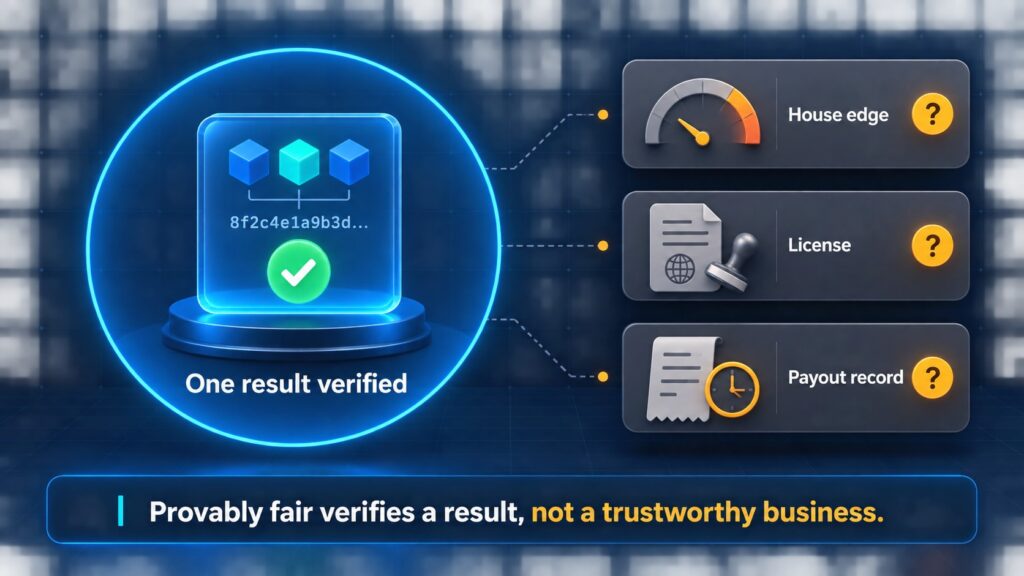
Provably fair solves a genuine problem, which is that online casino players have historically had no way to check whether a result was manipulated after the fact. The cryptography behind it works, and any player can confirm it in minutes. The gap is between what it proves and what operators imply it proves, which is the difference between one verified outcome and a trustworthy business. A provably fair casino can still hold an unfavourable house edge, an offshore licence, and a poor payout record, all at once.
Frequently Asked Questions
-
What does provably fair mean?
It means a player can cryptographically verify that a casino result was determined before the bet and not altered afterwards. The check uses a server seed, a client seed, and a nonce.
-
How do I verify a provably fair result?
Rotate your seed pair so the casino reveals its server seed, then hash that seed and confirm it matches the hash published before you played. Recompute the result with HMAC-SHA256 and the casino’s published formula.
-
Can a provably fair casino still cheat?
Yes, in ways the verification does not cover. It cannot stop an operator from setting an unfavourable house edge, applying hidden bonus conditions, or refusing a withdrawal.
-
Are provably fair casinos legal in the US?
Provably fair has no bearing on legality. Most sites offering it hold offshore licences and are not licensed by any US state, and whether play is lawful depends on state law.
-
Do sweepstakes casinos use provably fair?
No. Sweepstakes casinos use certified random number generators tested by independent laboratories, under the no-purchase-necessary model.
-
Is provably fair better than a certified RNG?
They answer different questions. Certification tests the whole game including its return to player, while provably fair lets a player verify individual results without trusting anyone.
Related reading:
Think You’ve Got a Gambling Problem?
Call or text the National Council on Problem Gambling helpline: 1-800-522-4700 (24/7, confidential).
Last updated: August 2026 | Clovr.com