Written By
  Published
  Last Updated
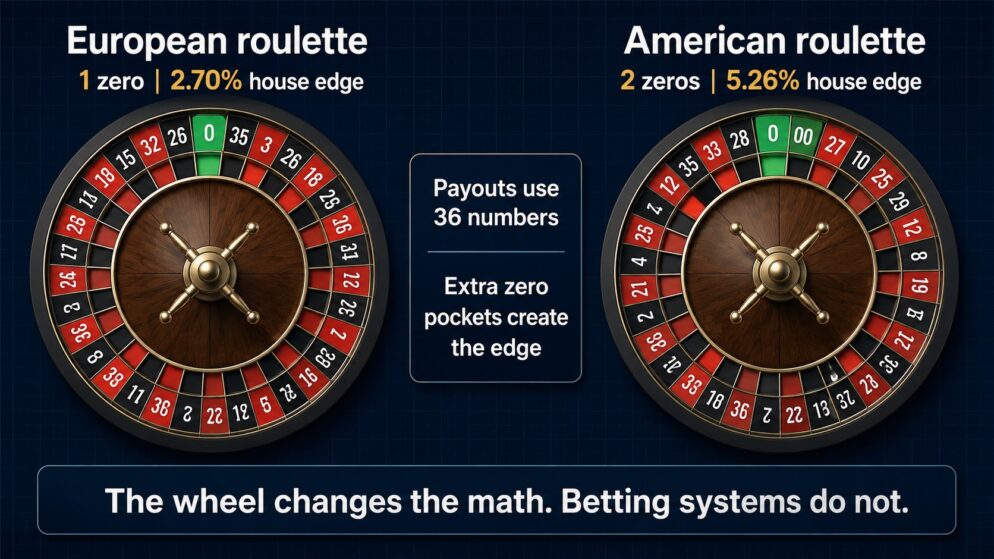
A roulette wheel has 37 or 38 pockets but pays as though it had 36. That single gap is the entire house edge. European roulette costs a player 2.70% of every dollar wagered, American roulette costs 5.26%, and no betting system alters either figure. The only decision that changes the maths is which wheel a player sits at.
Key Takeaways
- European roulette holds a 2.70% house edge across every standard bet. American roulette holds 5.26%.
- On any given wheel, a straight-up number and a red/black bet cost the same in the long run. Only the swings differ.
- French roulette with la partage cuts the edge to 1.35%, but only on even-money bets.
- The five-number bet on American roulette is the single worst wager on either wheel, at 7.89%.
Where The House Edge Comes From?
The house edge exists because payouts are calculated against 36 numbers while the wheel contains more than 36 pockets.
The 36-to-1 gap
A European wheel has 37 pockets, numbered 1 to 36 plus a single zero. A straight-up bet on one number wins once in 37 spins and pays 35 to 1.
Work through 37 spins with a $1 bet on the same number. The player wins once, collecting $35. The player loses 36 times, giving back $36. The net result is a loss of $1 across $37 wagered.
One divided by 37 is 2.70%. That is the house edge, and every other figure in this article derives from it.
The American wheel adds a double zero, taking the pocket count to 38. The payout stays at 35 to 1. Two divided by 38 is 5.26%, almost double the European figure for an identical-looking bet.
Every Variant Compared
| Variant | Pockets | Straight-up odds | House edge | RTP |
|---|---|---|---|---|
| French, even-money with la partage | 37 | 1 in 37 | 1.35% | 98.65% |
| European | 37 | 1 in 37 | 2.70% | 97.30% |
| American | 38 | 1 in 38 | 5.26% | 94.74% |
| Triple zero (Sands) | 39 | 1 in 39 | 7.69% | 92.31% |
Triple zero roulette appeared at The Venetian in Las Vegas in 2016, branded as Sands Roulette. It adds a third green pocket while keeping payouts unchanged, which pushes the edge to nearly three times the European figure.
Every Bet Type, Its Odds and Its Payout
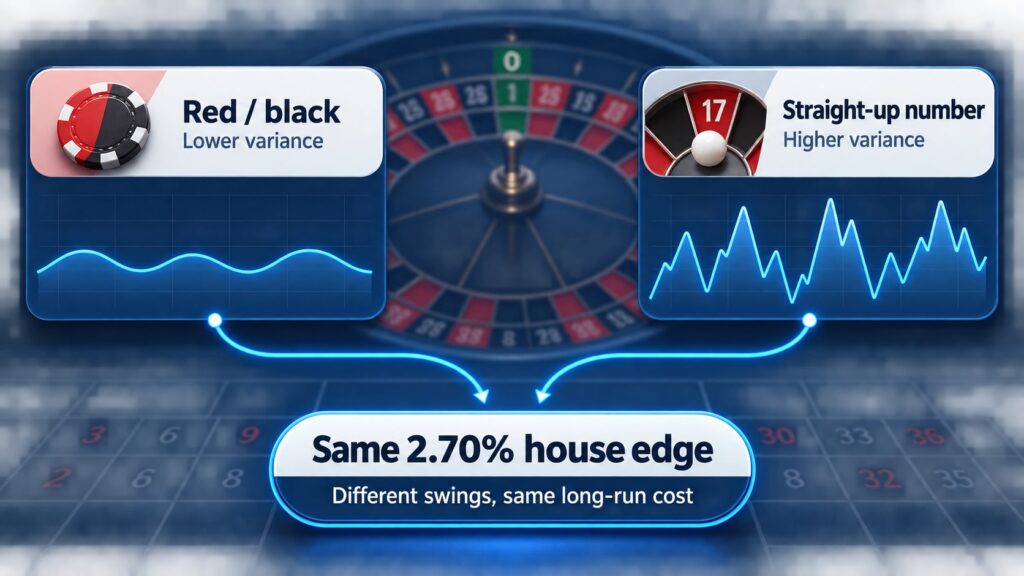
On a given wheel, every standard bet carries the same house edge. Only the variance changes.
That surprises most players. A straight-up number and a red/black bet on a European wheel both cost 2.70% over the long run. What separates them is how violently a bankroll swings on the way there.
European Wheel
| Bet | Pockets | Probability | Pays | House edge |
|---|---|---|---|---|
| Straight up | 1 | 2.70% | 35:1 | 2.70% |
| Split | 2 | 5.41% | 17:1 | 2.70% |
| Street | 3 | 8.11% | 11:1 | 2.70% |
| Corner | 4 | 10.81% | 8:1 | 2.70% |
| Six line | 6 | 16.22% | 5:1 | 2.70% |
| Column or dozen | 12 | 32.43% | 2:1 | 2.70% |
| Red/black, odd/even, high/low | 18 | 48.65% | 1:1 | 2.70% |
Note the even-money row. Red covers 18 pockets out of 37, which is 48.65%, not 50%. The zero is what makes the difference.
American Wheel
| Bet | Pockets | Probability | Pays | House edge |
|---|---|---|---|---|
| Straight up | 1 | 2.63% | 35:1 | 5.26% |
| Split | 2 | 5.26% | 17:1 | 5.26% |
| Street | 3 | 7.89% | 11:1 | 5.26% |
| Corner | 4 | 10.53% | 8:1 | 5.26% |
| Five number (0-00-1-2-3) | 5 | 13.16% | 6:1 | 7.89% |
| Six line | 6 | 15.79% | 5:1 | 5.26% |
| Column or dozen | 12 | 31.58% | 2:1 | 5.26% |
| Red/black, odd/even, high/low | 18 | 47.37% | 1:1 | 5.26% |
The One Bet to Avoid
The five-number bet is the only standard wager that breaks the flat-edge rule.
It covers 0, 00, 1, 2 and 3 on an American wheel and pays 6 to 1. Five pockets out of 38 gives a 13.16% chance of winning, but the true odds are 6.6 to 1. That gap produces a 7.89% house edge, half again worse than every other bet on the same table.
Wizard of Odds has flagged this bet for years. It exists as a leftover of older table design and there is no situation in which it is the better choice.
What La Partage and En Prison Actually Do?
Both rules cut the house edge to 1.35%, and both apply only to even-money bets.
La partage returns half a player’s stake when the ball lands on zero. En prison holds the stake for one further spin instead, and returns it in full if the next spin wins. The mechanics feel different at the table, and the long-run cost works out the same.
The caveat matters more than the rule. Neither protects a split, corner, street, column, dozen, or straight-up bet.
A player at a French table betting mostly on numbers faces the standard 2.70%, identical to European roulette. The 1.35% figure applies to red/black, odd/even, and high/low, and to nothing else.
Why Betting Systems Do Not Change the Maths?
No betting system alters the house edge. Wizard of Odds has tested this across every system submitted over three decades and reached the same result each time.
The reason is structural. A system changes bet sizing and bet timing. Expected loss is calculated per unit wagered, and no arrangement of unit sizes changes what each unit costs.
The Martingale Problem
The Martingale doubles the bet after every loss, so a single win recovers all prior losses plus one unit.
It works until it meets a limit, and it always meets a limit. Seven consecutive losses on a $10 base bet require a $1,280 eighth wager to continue. Table maximums and bankrolls both stop that sequence well before the maths breaks even.
The system produces many small wins and rare catastrophic losses. Averaged out, the expected loss per dollar wagered is unchanged at 2.70% or 5.26%, depending on the wheel.
The Gambler’s Fallacy
On 18 August 1913, black came up 26 consecutive times at the Casino de Monte-Carlo.
Players crowded the table betting heavily on red, convinced the streak had to break. Many lost substantial sums. The probability of black on spin 27 was 18 in 37, precisely what it had been on spin one.
That sequence had roughly a 1 in 137 million chance of occurring. Its rarity changed nothing about the following spin, because the wheel carries no record of what preceded it.
The error is now named after the venue. It is still the most expensive assumption a roulette player can make.
Does Online Roulette Work Differently?
The maths is identical. The verification model is not.
Online roulette replaces the physical wheel with a random number generator, tested by independent laboratories such as GLI, eCOGRA, or iTech Labs. A player cannot inspect the equipment the way they can watch a croupier spin a wheel.
Some crypto casinos offer provably fair roulette, which lets a player verify individual results cryptographically. Clovr’s guide to provably fair casinos covers how that verification works.
Neither model moves the house edge by a single basis point. A certified wheel is not rigged and it still holds a mathematical edge, and those are two separate facts. Fairness means the outcome was generated honestly. It has never meant the game is even money.
What The Numbers Mean for a Real Session?
Expected loss is calculated on the amount wagered, not the amount deposited.
That distinction catches most players. A $100 bankroll cycled through 20 bets of $10 has wagered $200, and the expected loss applies to the $200.
| Variant | Expected loss per $100 wagered |
|---|---|
| French, even-money with la partage | $1.35 |
| European | $2.70 |
| American | $5.26 |
| Triple zero | $7.69 |
Those figures describe the long run and nothing else. An individual session can finish well ahead or well behind, and the swings are far larger than the percentages suggest.
What the numbers do rule out is a path back to even. Extended play moves results toward the expected loss, not away from it. Roulette is priced entertainment, and the price is printed above.
Anyone finding that play has stopped feeling like entertainment should treat that as the signal it is. The NCPG helpline below is free, confidential, and available at any hour.
The Bottom Line
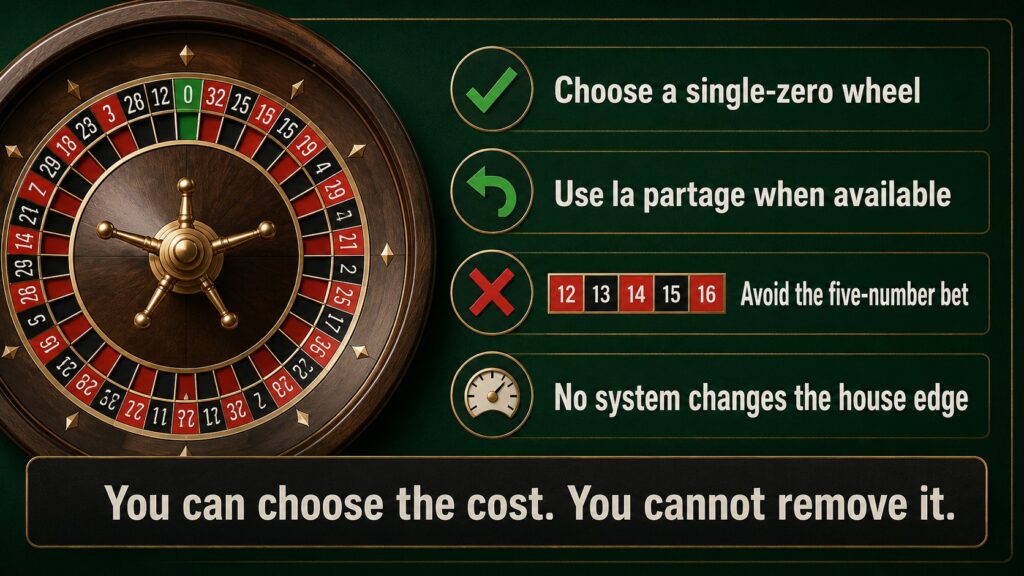
Roulette is one of the more transparent games in a casino, because every number needed to price it is visible on the felt. The house edge sits between 1.35% and 7.69% depending entirely on the wheel and the bet, and a player controls that choice completely. What no player controls is the edge itself, which no system, pattern, or streak has ever moved. Choose a single-zero wheel, take la partage where it exists, avoid the five-number bet, and treat the rest as the cost of playing.
Frequently Asked Questions
-
What is the house edge in roulette?
It depends on the wheel. European roulette carries 2.70%, American 5.26%, and triple zero 7.69%. French roulette with la partage drops to 1.35% on even-money bets.
-
Which roulette variant has the best odds?
French roulette with la partage, at 1.35% on even-money bets. European roulette at 2.70% is the best option for players betting on numbers.
-
Is roulette rigged?
Not at a licensed casino. Physical wheels are regularly inspected and online games run on certified random number generators. The house edge is built into the payout structure rather than added through manipulation.
-
Does the Martingale system work?
No. Doubling after a loss produces frequent small wins and occasional large ones, but table limits and bankroll limits stop the sequence before it recovers. Expected loss per dollar wagered stays unchanged.
-
What is the RTP of roulette?
European roulette returns 97.30%, American 94.74%, and triple zero 92.31%. French roulette with la partage returns 98.65% on even-money bets.
-
Are online roulette odds the same as in a casino?
Yes, provided the variant matches. A European wheel holds 2.70% online and on a casino floor, and an American wheel holds 5.26% in both settings.
Related reading:
Think You’ve Got a Gambling Problem?
Call or text the National Council on Problem Gambling helpline: 1-800-522-4700 (24/7, confidential).
Last updated: August 2026 | Clovr.com