Written By
  Published
  Last Updated
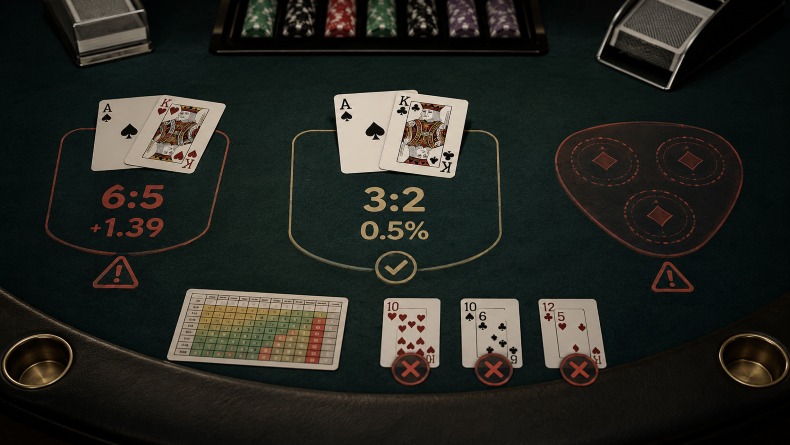
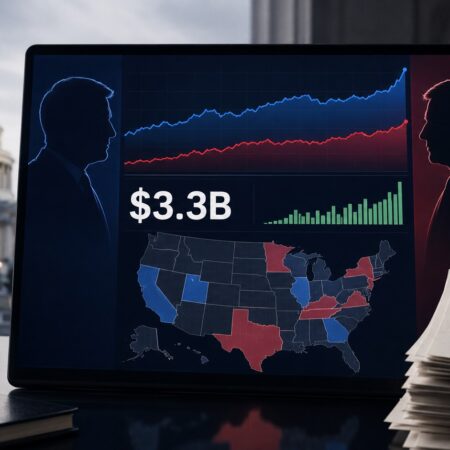
US internet gaming revenue reached a record $10.73 billion in 2025, growing 27.6% and passing $10 billion for the first time. Live dealer tables drove much of that, and blackjack is one of the three core live formats. This report covers the market data behind online blackjack alongside the game’s underlying mathematics, including a house edge that sits near 0.5% under conditions most players never actually get.
Key takeaways
- US iGaming revenue grew 27.6% to $10.73 billion in 2025, the fastest-growing US commercial gaming segment.
- In Pennsylvania and New Jersey, iGaming revenue passed land-based casino revenue for the first time in 2025.
- Live casino momentum turned in 2026, with Evolution’s live segment posting its first year-on-year revenue decline.
- Basic strategy at a 3:2 table produces a house edge near 0.5%. A 6:5 payout adds roughly 1.39 points to it.
The online blackjack market in 2025
Internet gaming was the fastest-growing segment of US commercial gaming in 2025, and it grew roughly three times as fast as the industry overall.
US iGaming set a record
| Metric | 2025 value | Change on 2024 |
|---|---|---|
| Total US commercial gaming GGR | $78.62 billion | +9.1% |
| iGaming revenue | $10.73 billion | +27.6% |
| Sports betting revenue | $16.89 billion | +22.6% |
| Direct gaming tax revenue | $17.86 billion | +12.3% |
| Jurisdictions setting revenue records | 34 states plus DC | n/a |
Source: American Gaming Association, State of the States 2026.
Only seven states operated regulated online casinos through 2025. Those seven produced an increase of more than $2 billion on the previous year.
Two milestones stand out. Pennsylvania and New Jersey both saw iGaming revenue exceed land-based casino revenue for the first time. Maine passed iGaming legislation during 2025, becoming the eighth state once the law took effect in early 2026.
Including tribal gaming, the AGA estimated total US gaming revenue near $125 billion for 2025.
Where live dealer fits
Live dealer tables were the growth engine inside that iGaming figure, and blackjack sits alongside roulette and baccarat as one of the three core formats.
Evolution, the largest live casino supplier, reported Q2 2025 net revenues of €524.3 million, up 3.1% year on year. Live casino accounted for €453.7 million of that, growing 3.6%, while RNG content contributed €70.6 million and grew 0.3%.
The company completed its entry into all seven regulated US online casino states during 2025, adding Rhode Island through a partnership with Bally’s.
Mobile is the access point
Mobile accounted for 80.13% of the US online gambling market in 2025, per Mordor Intelligence, growing at a 12.44% compound annual rate.
Casino games represented 50.12% of global online gambling revenue in the same year. Mordor put the global online gambling market near $101.45 billion for 2026.
One caveat applies to those three figures. Commercial research firms sell their underlying methodology, which makes their numbers less verifiable than AGA revenue data or a public company’s filed results. Treat them as directional rather than precise.
What changed in 2026
Live casino momentum turned, and the reversal came from the supplier that defined the segment.
| Evolution metric | Q2 2025 | Q2 2026 |
|---|---|---|
| Net revenue | €524.3 million | €517.8 million |
| Year-on-year change | +3.1% | -1.2% |
| Live casino segment | +3.6% | -3.6% |
| RNG segment | +0.3% | +14.0% |
| RNG revenue | €70.6 million | €80.5 million |
| EBITDA margin | 65.9% | 65.9% |
Source: Evolution AB interim reports.
Q2 2026 marked the first year-on-year decline in Evolution’s live casino revenue in its public history. RNG posted its first double-digit growth quarter in roughly three years.
At constant exchange rates the overall picture is less negative, with net revenue up 2.4%. Regional performance also diverged sharply. North America grew 9.5% and Latin America grew 26.3%, while Asia fell 3.7%.
The reasonable reading is that live dealer remains a large and profitable format that has stopped outgrowing everything around it. Anyone citing 2025 growth figures should note the year, because the 2026 data points the other way.
The house edge and what changes it
Blackjack holds the lowest house edge of any standard casino table game, and only under conditions that are increasingly uncommon.
Basic strategy versus average play
Basic strategy is a solved decision chart covering every player hand against every dealer upcard. It does not create a player advantage. It minimises expected loss.
| Player type | Approximate house edge |
|---|---|
| Basic strategy, favourable rules | ~0.5% |
| Standard rules range | 0.5% to 2% |
| Player without basic strategy | 2% or higher |
Source: Wizard of Odds; industry standard figures.
The gap between the first and last rows exceeds the entire house edge of a well-ruled game. Players lose more to their own decisions than to the casino’s built-in advantage.
That makes strategy error the largest controllable cost in blackjack. It is also why the game’s reputation for good odds is only half true.
How rule variations move the number
| Rule | Effect on house edge |
|---|---|
| Blackjack pays 6:5 instead of 3:2 | +1.39 points |
| Dealer hits soft 17 | Worse for the player |
| Double after split allowed | Better for the player |
| Late surrender allowed | Better for the player |
| Re-splitting aces allowed | Better for the player |
| Fewer decks | Generally better for the player |
Source: Wizard of Odds house edge calculator, covering 6,912 rule combinations.
Deck count matters less than most players assume. A well-ruled six-deck game paying 3:2 beats a single-deck game paying 6:5 comfortably.
Single-deck tables frequently carry the worse payout for exactly that reason. The low deck count attracts players who then pay for it elsewhere.
The 6:5 problem
Accepting a reduced blackjack payout is the costliest decision available at a blackjack table.
Wizard of Odds calculates the effect directly. In a single-deck game, the probability of a player blackjack without a dealer blackjack runs about 4.65%. Cutting the win from 1.5 units to 1.2 costs 4.65% multiplied by 0.3, or roughly 1.39 percentage points.
The cash version is easier to see. A $5 bet winning with a natural returns $7.50 at 3:2 and $6.00 at 6:5.
Applied to a game with a 0.5% edge, that one rule pushes the house advantage near 1.9%. Table selection matters more than any decision made after the deal.
Core probabilities
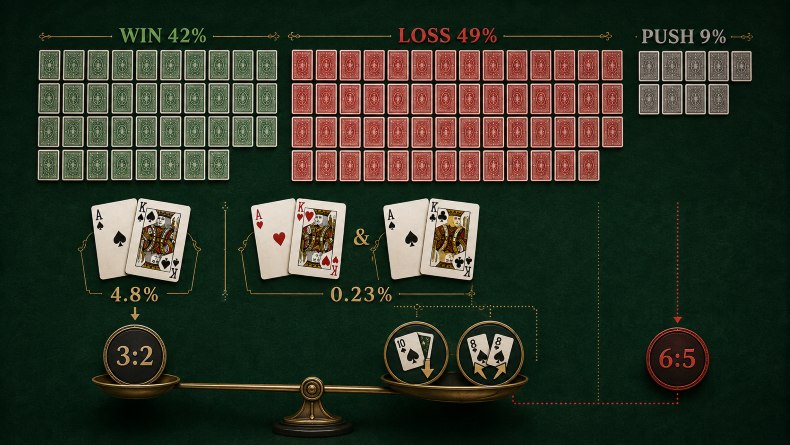
A player using basic strategy wins roughly 42% of hands, loses about 49%, and pushes the rest.
Hand outcomes
| Event | Probability |
|---|---|
| Player wins the hand (basic strategy) | ~42% |
| Natural blackjack dealt | ~4.8% |
| Player and dealer both draw a natural | ~0.23% |
Winning 42% of hands while facing a 0.5% edge looks contradictory. It resolves through the 3:2 payout on naturals, and through doubling and splitting.
Those options let a player commit more money in favourable spots. That structure is precisely what a 6:5 payout attacks.
Dealer bust rates
Dealer bust probability by upcard explains most of basic strategy.
| Dealer upcard | Approximate bust rate |
|---|---|
| 2 | 35% |
| 3 | 37% |
| 4 | 40% |
| 5 | 42% |
| 6 | 42% |
| 7 | 26% |
| 8 | 24% |
| 9 | 23% |
| 10 | 21% |
| Ace | 11% |
Source: standard blackjack probability tables.
The break between 6 and 7 is the sharpest in the game. Against a 5 or 6 the dealer busts more than four times in ten, which is why standing on weak totals is correct.
Side bets and insurance
Every side bet on a blackjack table carries a materially higher house edge than the main game.
Why insurance loses money
Insurance pays 2:1 when the dealer holds a natural after showing an ace. The true odds are worse than 2:1.
Wizard of Odds quantifies the habit rather than the single decision. Insuring every blackjack and every 20, a common pattern, adds 0.149% to the house edge. Taking even money on a blackjack against a dealer ace costs 0.014% in a six-deck game.
Those figures are small per hand and they compound across a session. Insurance is only correct for a counter who knows the shoe is rich in ten-value cards.
Side bet house edges
| Side bet | Approximate house edge |
|---|---|
| Insurance | ~7% |
| 21+3 | 3% to 4% |
| Perfect Pairs | Varies by paytable, always negative |
| Lucky Ladies | Up to ~25% |
Source: published paytable analysis.
Set those against a 0.5% main game. A player who found a 3:2 table and learned basic strategy can surrender all of that with one side bet placed each hand.
Side bets exist because they are profitable for operators. As a rule, the higher the advertised payout, the worse the underlying edge.
What live dealer changes for the player
Live dealer changes the experience. It does not change the mathematics.
A live table runs the same rules and the same house edge as the equivalent automated game. A 6:5 live table costs exactly what a 6:5 RNG table costs.
Session length is where the difference appears. Industry reporting puts live dealer sessions 30% to 40% longer than RNG sessions.
That matters more than it first appears. Expected loss is calculated on total amount wagered, so a longer session at an identical edge produces a larger expected loss. Higher engagement is why operators favour the format.
Card counting in 2026
Counting cards is legal, and it does not work against most games a player will encounter.
Counting requires a shoe that depletes, so the remaining card composition shifts during play. Continuous shuffling machines return played cards immediately and remove that shift.
Online blackjack reshuffles a virtual deck after every hand, so no count persists. Many live dealer tables use continuous shufflers for the same reason.
Casinos are private businesses and may refuse service to suspected counters. The practice is not a crime, and it is not a realistic route to an advantage.
What the numbers mean for a real session
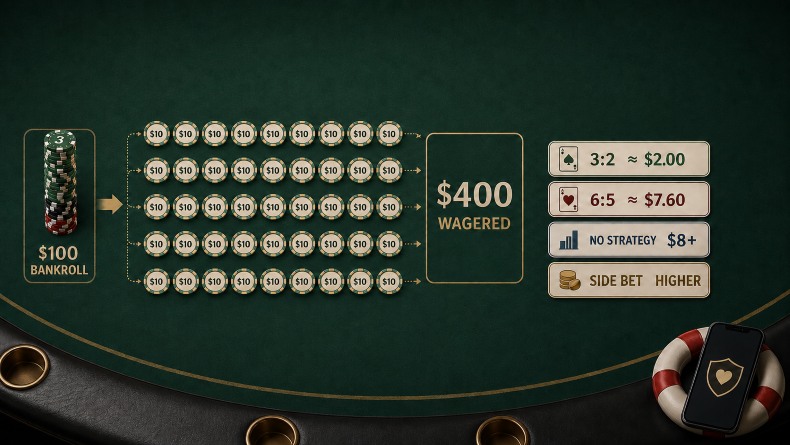
Expected loss applies to the total amount wagered, not to the amount deposited.
| Scenario | Expected loss per $100 wagered |
|---|---|
| Basic strategy, 3:2, favourable rules | ~$0.50 |
| Basic strategy, 6:5 table | ~$1.90 |
| No basic strategy, standard rules | $2.00 or more |
| Main bet plus a side bet every hand | Materially higher again |
A $100 bankroll cycled through 40 hands at $10 has wagered $400. The expected loss applies to that $400.
Those percentages describe long-run averages. Blackjack carries meaningful short-term variance, so individual sessions land well above and below the expected figure. Extended play moves results toward the average rather than away from it.
Anyone finding that play has stopped feeling like entertainment should treat that as the signal it is. The NCPG helpline below is free, confidential, and available at any hour.
The bottom line
Online blackjack sits inside the fastest-growing part of US regulated gaming, which grew 27.6% in 2025 and passed land-based casino revenue in two states for the first time. The 2026 supplier data suggests live dealer’s period of outperformance has ended rather than continued. Underneath the market figures, the game itself is unchanged and still offers the best value on a casino floor, at a 3:2 table, with basic strategy, and without side bets. The most valuable decision a blackjack player makes happens before the first card is dealt.
Frequently Asked Questions
-
How big is the online blackjack market?
US iGaming revenue reached $10.73 billion in 2025 across seven regulated states, up 27.6% on 2024. Live dealer tables including blackjack drove much of that growth.
-
What is the house edge in blackjack?
Roughly 0.5% with basic strategy at favourable rules, rising to 2% or more without it. A 6:5 payout adds around 1.39 percentage points on its own.
-
What is the RTP of blackjack?
Around 99.5% in an eight-deck game with basic strategy, and closer to 99.8% in a well-ruled single-deck game. A 6:5 payout lowers both figures substantially.
-
Should you ever take insurance?
Not unless you are counting cards and know the shoe is rich in ten-value cards. Insurance pays 2:1 against true odds worse than that, giving it roughly a 7% house edge.
-
Is 6:5 blackjack worth playing?
It costs about 1.39 percentage points against a 3:2 table, taking a 0.5% game close to 1.9%. Players receive 20% less on every natural they draw.
-
Are live dealer blackjack odds different?
No. Live tables run identical rules and an identical house edge to the equivalent automated game. Sessions tend to run 30% to 40% longer, which raises total expected loss at the same edge.
Related reading:
Think You’ve Got a Gambling Problem?
Call or text the National Council on Problem Gambling helpline: 1-800-522-4700 (24/7, confidential).
Last updated: August 2026 | Clovr.com