Written By
  Published
  Last Updated

Bitcoin’s protocol is decentralized. Almost everything built on top of it is not. The concentration that matters in 2026 sits in four places: mining pools, ETF custodians, stablecoin issuers, and one exchange. Whale wallets, the metric most often quoted, are the weakest part of the story. This article covers Bitcoin, Ethereum, and dollar stablecoins only.
Key takeaways
- Addresses holding 1,000 or more BTC held roughly 42% of circulating supply in early 2026, per Glassnode. Entity-adjusted analysis puts the real figure lower.
- Four mining pools controlled more than 70% of Bitcoin’s hashrate in a June 23, 2026 snapshot. The network’s Nakamoto coefficient sat at 3.
- Tether has frozen billions of dollars in USDT across thousands of addresses. Bitcoin has no equivalent switch.
- One exchange cleared 38.7% of top-10 centralized exchange spot volume in Q2 2026.
The whale number everyone quotes is wrong
Address-level concentration figures overstate the problem. One address often represents millions of people.
A crypto whale means a wallet holding 1,000 BTC or more. That threshold is a market convention. Bitcoin’s protocol does not define it.
The problem is what sits inside those addresses. Exchange cold wallets, ETF custody accounts, and corporate treasuries each occupy a single address. Counting them as individual whales inflates the concentration figure.
Glassnode’s entity-adjusted research makes this point directly. Once exchange-controlled addresses are removed, non-exchange whale entities control closer to 31% of supply.
Clovr published a study on this question in December 2019. That analysis covered 140,000 non-exchange addresses and stripped out 41 exchanges before measuring anything. The exclusion existed because raw address counts mislead. That remains true in 2026.
Where the bitcoin actually sits
| Holder type | Approximate holding | Share of supply | Source | As of |
|---|---|---|---|---|
| Addresses with 1,000+ BTC | Not disclosed | ~42% | Glassnode | Early 2026 |
| US spot Bitcoin ETFs (all) | 1.3M+ BTC | 5.2% to 6.2% | Arkham Intelligence, River Financial | April 2026 |
| BlackRock IBIT | 785,000 to 806,000 BTC | ~3.8% | ETF disclosures | April 2026 |
| Strategy (MicroStrategy) | 815,000 BTC | ~3.9% | Company filings | April 2026 |
| Satoshi-era dormant wallets | ~1.1M BTC | ~5.2% | Arkham Intelligence | April 2026 |
| Government holdings (global) | 305,000 to 328,372 BTC | ~1.5% | Arkham Intelligence | February 2026 |
| Held on exchanges | Not disclosed | ~8.3% | Glassnode | Early 2026 |
Two rows carry ranges rather than fixed figures. Published sources disagree on ETF share and on government totals. The ranges reflect that disagreement rather than hiding it.
Mining pools are the real concentration story
Four mining pools controlled more than 70% of Bitcoin’s hashrate in mid-2026. Under the older mining protocol, the pool decides what goes into each block, not the miner.
| Pool | Share, June 23 2026 | Share, 7-day window to Aug 10 2026 |
|---|---|---|
| Foundry USA | 31% | 24.3% |
| AntPool | 18% | 17.5% |
| F2Pool | 10% | 17.4% |
| ViaBTC | 13% | 8.5% |
| SpiderPool | Not in top four | 9.1% |
Sources: miningpoolstats.stream (June 23, 2026); mempool.space seven-day average (August 10, 2026).
The ordering changes week to week. The total does not.
D-Central’s H1 2026 mining report put Bitcoin’s Nakamoto coefficient at 3. Three pool operators can produce a majority of blocks between them.
The mechanic matters more than the percentage. Stratum V1, the protocol most pools have used for years, hands block template construction to the pool operator. Transaction selection therefore sits with a handful of companies rather than thousands of miners.
There is a counterweight, and it arrived recently. Seven pools representing close to 75% of global hashrate agreed to adopt Stratum V2 in May 2026. That protocol returns template construction to individual miners. Deployment across those pools is incomplete as of mid-2026.
Hashrate concentration and block construction control are separate problems. Stratum V2 addresses the second one. It does not address the first.
Ethereum’s version of the problem
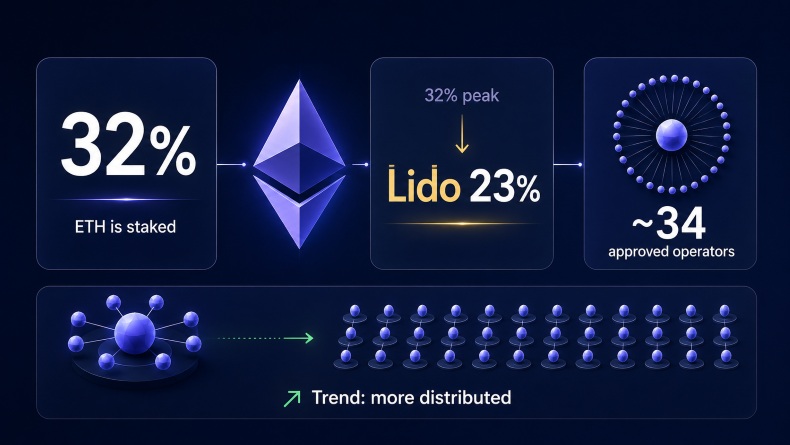
Ethereum’s concentration sits in staking. It has eased rather than worsened.
Roughly 32% of total ETH supply was locked in proof-of-stake as of May 2026, per ultrasound.money data. That ratio has held steady for months.
Lido is the largest single staking provider. Its share of all staked ETH stood near 23% in mid-2026, down from a peak around 32% in late 2023.
The live criticism concerns operator count rather than market share. Lido’s curated module routes a large share of that stake through a set of approximately 34 approved node operators. Critics describe the arrangement as permissioned rather than open.
Direction of travel on Ethereum staking has been toward dispersion, not away from it.
The stablecoin freeze switch
USDT and USDC smart contracts let the issuer freeze any address. Both issuers use that power.
| Issuer | Addresses blacklisted | Value frozen | Stated threshold | Period |
|---|---|---|---|---|
| Tether (USDT) | ~9,600 | ~$5.7 billion | Coordinates with law enforcement globally | Through early 2026 |
| Circle (USDC) | ~372 | ~$110 million | Requires a lawful court order | 2023 to 2025 |
| MakerDAO (DAI) | None | None | No issuer freeze function exists | 2026 |
The threshold difference is the substance. Circle’s stated position in April 2026 was that USDC freezes require a court order. Tether acts on law enforcement coordination more broadly, sometimes without one.
Both approaches carry a cost. Tether’s speed has recovered stolen funds and satisfied sanctions designations. Circle’s caution drew a class action lawsuit after a April 2026 protocol exploit, when a large USDC sum went unfrozen for hours.
Bitcoin has no equivalent function. No party can freeze a BTC balance at the protocol level.
Does any of this affect crypto casino players?
Three of these facts change how a crypto casino balance behaves. The rest do not.
Price risk is separate from game risk. A bankroll held in BTC or ETH carries the volatility of a market where liquidity has thinned sharply.
| Quarter | Top-10 CEX spot volume | Largest exchange share |
|---|---|---|
| Q4 2025 | $4.5 trillion | 38.3% (December 2025) |
| Q1 2026 | $2.7 trillion | ~37% |
| Q2 2026 | $1.95 trillion | 38.7% |
Source: CoinGecko quarterly industry reports.
Thinner order books mean a large sell order moves price further than the same order did in 2021. A balance can lose value between deposit and withdrawal without any game being played.
A USDT balance sits behind a freeze function. A BTC balance does not
That is a structural difference between two deposit options offered by the same casino. Anyone choosing a deposit currency is choosing a custody model at the same time.
A provably fair system verifies the game, not the coin.
Cryptographic verification proves a deal was not manipulated. It says nothing about what the coin is worth when a player redeems the balance. Clovr’s guide to provably fair casinos covers what that verification does and does not prove.
Nothing in this article is investment advice. Clovr does not recommend holding cryptocurrency as an investment, and readers should treat any casino balance as money they can afford to lose.
The bottom line
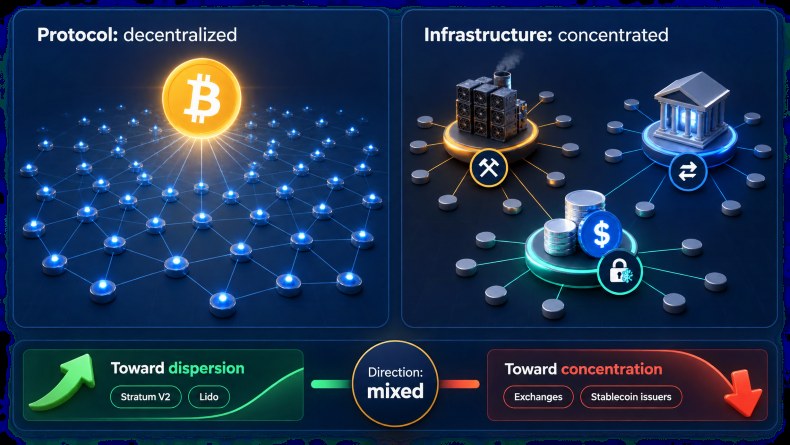
Bitcoin’s protocol layer remains decentralized. Its infrastructure layer does not. Mining pool concentration and stablecoin freeze powers are real control points, and neither existed in the form Satoshi Nakamoto described. The trend is mixed rather than uniformly negative: Stratum V2 adoption and Lido’s declining share both move toward dispersion. Exchange concentration and issuer freeze powers move the other way.
Frequently asked questions
-
Is Bitcoin decentralized?
Partly. Bitcoin’s protocol and node network are decentralized, with no central authority able to alter rules unilaterally. Its mining layer is concentrated, with four pools holding more than 70% of hashrate in June 2026.
-
How much bitcoin makes you a whale?
1,000 BTC or more. That threshold is a market convention rather than a protocol rule, and some analysts use different cutoffs.
-
Can whales manipulate the crypto price?
Large holders can move price, though manipulation requires proven intent to deceive. Spoofing and coordinated wash trading are illegal in regulated markets. Concentration risk is the more documented concern than deliberate manipulation.
-
Can Tether freeze my USDT?
Yes. Tether’s smart contract includes a blacklist function that blocks a specified address from sending or receiving USDT. Tether had blacklisted roughly 9,600 addresses through early 2026.
-
Is Ethereum more centralized than Bitcoin?
They concentrate differently. Ethereum’s concentration sits in staking providers, with Lido at roughly 23% of staked ETH in mid-2026. Bitcoin’s concentration sits in mining pools.
-
Does crypto concentration affect crypto casino players?
In three ways. Thinner exchange liquidity increases price volatility for any balance held in crypto. Stablecoin balances carry issuer freeze risk that Bitcoin balances do not. Provably fair verification covers game outcomes, not coin value.
Related reading:
Think You’ve Got a Gambling Problem?
Call or text the National Council on Problem Gambling helpline: 1-800-522-4700 (24/7, confidential).
Last updated: August 2026 | Clovr.com