Written By
  Published
  Last Updated
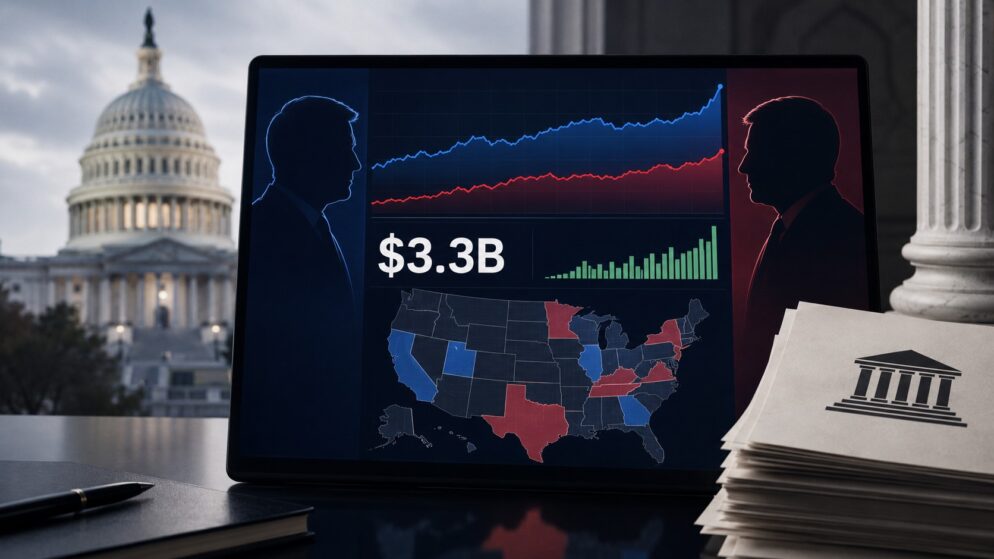
Political prediction markets moved from a legal grey area to a multi-billion dollar sector in a single election cycle. Polymarket’s 2024 presidential market alone drew more than $3.3 billion. Since that contract resolved, politics has become a small share of activity on both major platforms, and roughly a dozen states are fighting the federal regulator in court over whether these markets are legal at all.
Key Takeaways
- Polymarket handled above $3.3 billion on the 2024 Trump versus Harris market, the largest single prediction market event on record.
- Politics made up 90% of Kalshi volume and 65% of Polymarket volume around the 2024 election. Sports has since taken over both.
- Midterm election markets passed $197 million across 1,408 contracts by July 2026.
- Legal US sportsbooks handled around $14 billion per month in 2025, which puts the entire political market in perspective.
How Much Money Moves through Political Prediction Markets?
The 2024 presidential race produced the largest prediction market event in history, and political volume has been a minority of platform activity ever since.
The 2024 Presidential Cycle
Polymarket’s total trading volume rose from $73 million in 2023 to roughly $9 billion in 2024. The presidential winner market accounted for more than $3.3 billion of that on its own.
Kalshi entered late and from a standing start. A federal court ruled in its favour in September 2024, and the platform launched election contracts on 4 October, 32 days before the vote. It cleared over $1 billion in volume by November.
The gap between the two platforms was substantial through the cycle. In late October 2024, Polymarket showed roughly $2.6 billion traded on the presidential market while Kalshi reported just under $85 million.
What Happened After the Election?
Volume collapsed once the contracts resolved.
That is the structural feature of political prediction markets and the reason platform valuations do not rest on them. A presidential contract concentrates enormous activity into a few months, pays out, and leaves nothing behind. Polymarket’s activity fell sharply in the weeks after the result was called.
Both platforms responded by expanding into sports, which produces continuous rather than episodic volume.
The 2026 Midterms So Far
| Metric | Value | As of |
|---|---|---|
| Midterm market volume | Above $197 million | July 2026 |
| Open midterm markets | 1,408 across both platforms | July 2026 |
| Kalshi total notional volume | $1.7 billion | June 2026 |
| Polymarket monthly volume | Above $8 billion in multiple months | 2026 |
Source: NBC News analysis; platform reporting.
The midterm figure is small against a presidential cycle and large against any prior midterm. It will rise materially before November, so treat the July number as a floor rather than a total.
Polymarket vs Kalshi
Kalshi is a CFTC-regulated exchange taking dollar deposits. Polymarket International operates offshore on crypto rails and is considerably larger.
How the Two Platforms Differ?
| Kalshi | Polymarket | |
|---|---|---|
| Regulator | CFTC-regulated designated contract market | Polymarket US is CFTC-regulated; Polymarket International is not |
| Funding | Bank transfer, USDC | USDC and a crypto wallet |
| Founded | 2018, launched 2021 | 2020 |
| US availability | All 50 states federally, restricted in several by state action | Polymarket US available, International not intended for US users |
| Regulatory history | Sought CFTC approval before launching | CFTC cease and desist in January 2022, $1.4 million penalty, moved offshore |
Polymarket returned to the US market through its acquisition of QCEX, receiving an Amended Order of Designation from the CFTC on 25 November 2025.
Volume Comparison
| Platform | Monthly volume | Period |
|---|---|---|
| Polymarket International | $9 billion | April 2026 |
| Polymarket US | $1.3 billion | April 2026 |
| Kalshi | $1.7 billion notional | June 2026 |
Source: Pew Research Center; platform reporting.
The offshore entity remains roughly seven times the size of the US-regulated one. That gap is the clearest measure of how much of Polymarket’s activity comes from outside the regulated perimeter.
What Each is Actually Used For?
Neither platform is primarily a political one, and most coverage misses this.
Pew Research Center found that politics made up 90% of Kalshi trading volume and 65% of Polymarket volume during October and November 2024. Kalshi had not launched sports trading at that point.
Since July 2024, sports has accounted for 80% of total Kalshi volume. Sports, politics and cryptocurrency together represent 91% of Kalshi activity and 90% of Polymarket activity across that period.
These are sports platforms that occasionally host very large political events. Election cycles are spikes on a chart that is otherwise driven by games.
Are Prediction Markets Legal in the US?
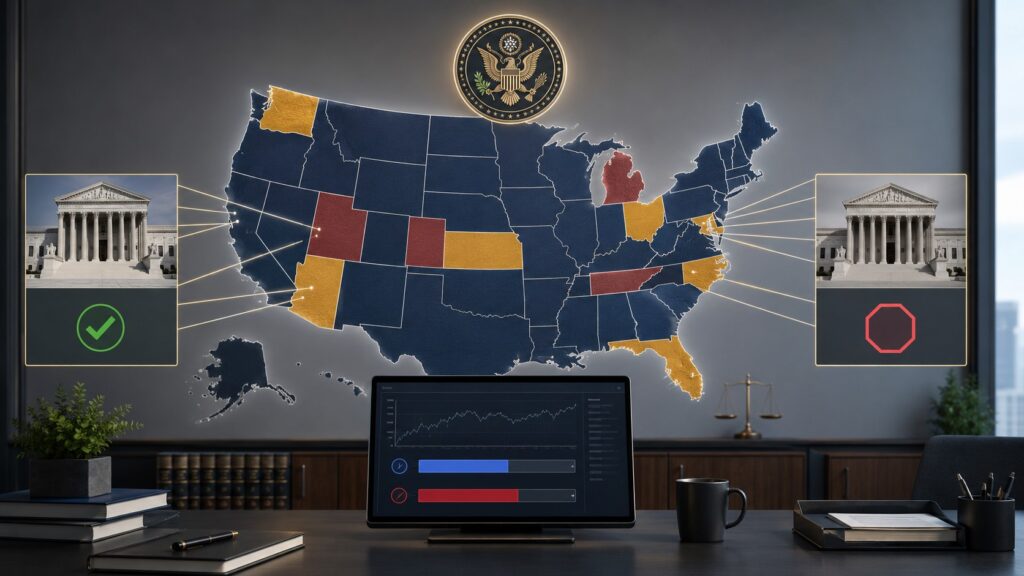
Federally yes. Roughly a dozen states are contesting it in court, and the outcomes so far have split.
The Federal Position
The Commodity Futures Trading Commission regulates event contracts as swaps under the Commodity Exchange Act.
Kalshi challenged the CFTC’s refusal to allow election contracts and won in 2024, with the court describing the agency’s manipulation concerns as speculative. The CFTC reversed position and dropped its appeal in May 2025.
CFTC Chairman Michael Selig, confirmed in December 2025, has taken an active stance defending federal exclusivity. In August 2026 the agency used emergency authority under Section 8a(9) of the Commodity Exchange Act to order Kalshi to continue operating nationwide following New York’s lawsuit.
The State Challenges
Courts have reached opposite conclusions on nearly identical facts.
| State | Outcome | Date |
|---|---|---|
| Massachusetts | Injunction against Kalshi, state gaming law applies | January 2026 |
| Tennessee | Preliminary injunction favouring Kalshi, contracts likely swaps | 19 February 2026 |
| Arizona | 20-count criminal information filed against KalshiEX | 17 March 2026 |
| New Jersey | Third Circuit affirmed injunction barring state enforcement | 6 April 2026 |
| Maryland | Kalshi injunction request denied, state enforcement continues | August 2025 |
| Nevada | Injunctions secured against both platforms | 2025 to 2026 |
| Minnesota | Preliminary injunction favouring platforms and CFTC | 27 July 2026 |
| New York | State lawsuit filed, CFTC emergency order issued | July to August 2026 |
The dispute is jurisdictional rather than moral. States argue event contracts are gambling subject to their police powers. The CFTC argues they are interstate financial instruments under exclusive federal authority.
Where Things Stand for Political Contracts?
Almost all of this litigation concerns sports contracts rather than political ones.
Arizona is the exception. Its March 2026 filing included four counts of election wagering, covering contracts on the 2028 presidential race and two 2026 Arizona state races.
For anyone tracking political markets specifically, that distinction matters. The legal pressure on election contracts is much lighter than the headline volume of litigation suggests, because the fight is mostly about sports.
How Accurate Were the Markets in 2024?
The markets called the presidential result. Why they got it right is more contested than the coverage suggested.
Two problems complicate the accuracy claim. Participants frequently bet on outcomes they preferred rather than outcomes they considered likely, which introduces partisan bias into prices. That effect is strongest on platforms with a concentrated or ideologically uniform user base.
Liquidity also distributed unevenly. The presidential market carried billions and priced efficiently. Down-ballot races traded thinly, where a handful of participants could move a price without holding better information.
The reasonable conclusion is that deep markets on major races produced useful signals, and thin markets on minor races produced noise. Prediction markets incorporate breaking developments faster than polling does. They are not a substitute for it.
How Political Betting Compares to Sports Betting?
Political prediction markets are small next to regulated US sportsbooks.
| Market | Volume | Period |
|---|---|---|
| Legal US sportsbooks | ~$14 billion per month | 2025 average |
| All midterm prediction markets | $197 million cumulative | To July 2026 |
| Polymarket World Cup Winner market | $4.3 billion single contract | 2026 |
Source: Pew Research Center; platform reporting.
A single sports contract on Polymarket outdrew every 2026 midterm market combined by a factor above twenty. Political betting attracts attention disproportionate to the money involved, which is worth remembering when reading coverage that treats these markets as a major force in electoral politics.
The Bottom Line
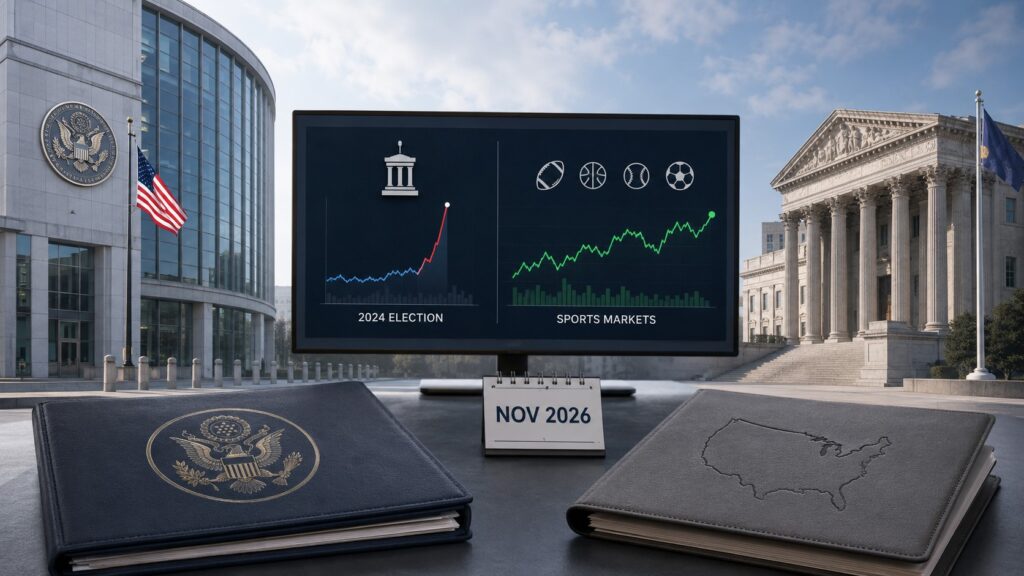
Political prediction markets are now a real and federally regulated category, and they are far smaller than their media profile suggests. The 2024 presidential cycle was an outlier that neither platform has come close to repeating, and both have rebuilt around sports because political contracts resolve and disappear.
The unsettled question is jurisdictional: whether these contracts are financial instruments under CFTC authority or gambling under state law. Courts have answered both ways in 2026, and the November midterms will arrive before that question is resolved.
Frequently Asked Questions
-
Can you legally bet on elections in the US?
Federally, yes. The CFTC regulates election event contracts on platforms including Kalshi and Polymarket US following a 2024 court ruling. Several states dispute this and Arizona has filed criminal charges including election wagering counts.
-
How much was bet on the 2024 election?
Polymarket handled more than $3.3 billion on its Trump versus Harris market alone, with roughly $9 billion in total platform volume across 2024. Kalshi cleared over $1 billion in the 32 days it operated before the vote.
-
Is Polymarket legal in the US?
Polymarket US is CFTC-regulated and received an Amended Order of Designation in November 2025. Polymarket International, which handles roughly seven times the volume, operates offshore and is not intended for US users.
-
What is the difference between Polymarket and Kalshi?
Kalshi is a CFTC-regulated exchange accepting bank deposits and USDC. Polymarket runs on crypto rails through a wallet, and its international entity is far larger than its US-regulated one.
-
How much is being bet on the 2026 midterms?
Above $197 million across 1,408 markets on both platforms as of July 2026, per NBC News. That figure will rise before November.
-
Are prediction markets more accurate than polls?
They incorporate new information faster, and they were accurate on the 2024 presidential race. Thinly traded markets on smaller races are considerably less reliable, and participants sometimes bet preferences rather than probabilities.
Related reading:
- Crypto Casinos
- Sweepstakes Casinos
- Is Crypto Really Decentralized?
- Ethereum Smart Contracts Explained
Think You’ve Got a Gambling Problem?
Call or text the National Council on Problem Gambling helpline: 1-800-522-4700 (24/7, confidential).
Last updated: August 2026 | Clovr.com