Written By
  Published
  Last Updated
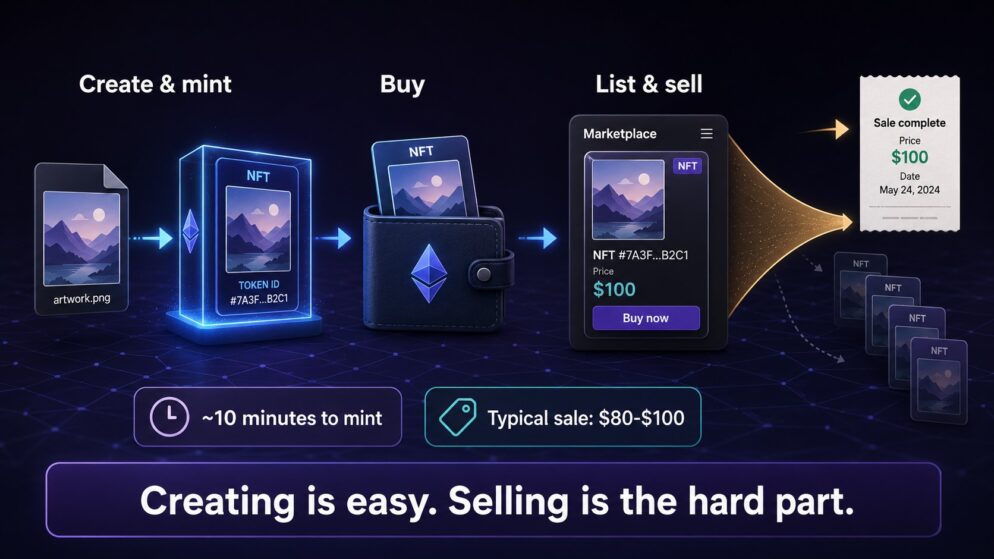
Creating an NFT takes about ten minutes and costs very little. Selling one is the hard part. Research covering more than 73,000 collections found that roughly 95% held a market cap of zero, and the average NFT sale price has since settled between $80 and $100. This guide covers how minting, buying and selling work, what each step costs, and what a creator can realistically expect to earn.
Key Takeaways
- NFT trading volume collapsed from its 2021 peak while transaction counts rose, which means far more sales at far lower prices.
- Minting is cheap. Ethereum mainnet gas averaged around 0.5 gwei through April 2026, and Solana and Layer 2 costs are lower still.
- A 6% royalty on a typical $90 resale returns roughly $5.40 to the creator, and most major marketplaces make that payment optional.
- Around 79% of collections have never sold out their primary mint, so most creators never reach a secondary market at all.
Are NFTs Dead?
No, but the market operating today bears little resemblance to 2021.
What the Volume Data Shows?
Total annualised NFT trade volume reached roughly $5.5 billion in 2025, per The Block, well below 2024 levels.
The quarterly trend inside that year was steep. DappRadar recorded $1.5 billion in trading volume in Q1 2025, falling to $823 million in Q2, a drop of 45%.
What the Sales Count Data Shows?
Transaction counts moved the opposite way.
| Quarter | NFT sales count | Unique trading wallets |
|---|---|---|
| Q1 2025 | 7 million | 1.66 million |
| Q2 2025 | 12.5 million | Not disclosed |
| Q3 2025 | 18.1 million | 2.14 million |
Source: DappRadar quarterly reports.
More people bought more NFTs while total value fell. The reconciling figure is price: CryptoSlam put the average NFT sale between $80 and $100 through the first half of 2025.
What exists now is a functioning market for cheap collectibles. It is not the speculative asset class that dominated headlines four years ago, and anyone approaching it as one is working from an outdated picture.
Can You Realistically Make Money from NFTs?
For most people, no. The arithmetic is public and it is not close.
The Base Rates
Research published by dappGambl analysed 73,257 NFT collections and found 69,795 of them holding a market cap of zero ETH.
The same study reported that 79% of collections had unsold assets, and that fewer than 1% of the top 8,850 collections carried a value above $6,000. Around 41% of those top collections sat between $5 and $100.
That research dates from September 2023 and its methodology drew criticism, including an inconsistency over how many collections were analysed. It is included because it remains the largest published sample, and nothing since has contradicted its direction.
What a Creator Actually Earns Per Sale?
Four inputs determine creator income, and all four are public.
| Input | Value | As of |
|---|---|---|
| Average NFT sale value | $80 to $100 | H1 2025 (CryptoSlam) |
| Typical royalty rate | 5% to 10% | Marketplace standard |
| Royalty enforcement | Optional on major marketplaces unless the contract is ERC-721C | OpenSea documentation, 2026 |
| Marketplace fee | 0% (Blur) to 7.5% (SuperRare), 2.5% typical | Published fee schedules |
Work a realistic example. A secondary sale at $90 carrying a 6% royalty returns $5.40 to the creator.
That figure assumes the royalty gets paid at all. On an optional-royalty marketplace, the seller decides whether to honour it, and many do not.
What it Takes to Earn $500 a Month?
At $5.40 per resale, monthly royalty income of $500 requires roughly 93 secondary sales every month.
For scale, DappRadar counted 2.14 million unique wallets trading NFTs across the entire market in Q3 2025. Sustained resale demand at that level is not common, and a collection with no resale activity generates no royalty income regardless of what its smart contract specifies.
The harder constraint sits earlier in the process. Roughly 79% of collections have never sold out their primary mint, which means most creators never reach a secondary market to earn royalties from.
Buying and Flipping
An average sale value of $80 to $100 caps the absolute margin on a successful flip at a small number.
Marketplace fees and gas apply to every attempt, including the ones that do not sell. A trader needs a high hit rate on cheap assets to clear costs, and the assets are cheap precisely because demand for them is thin.
Some marketplaces run trading incentive programmes that reward volume rather than profit. Those inflate reported activity without indicating that participants are making money, which makes headline volume figures a poor guide to whether flipping works.
Who Does Make Money?
Three groups. Established collections with pre-existing demand. Creators who built an audience somewhere else first and brought it with them. Marketplace operators, who collect a fee on every transaction whether the participants profit or not.
The realistic expectation for someone starting now with no existing audience is that the collection does not sell, and the minting cost is the entire financial outcome.
Nothing here is investment advice. Minting costs are a real loss when a collection fails to sell, and anyone spending money on this should treat it as money they can afford to lose.
What You Need Before You Start?
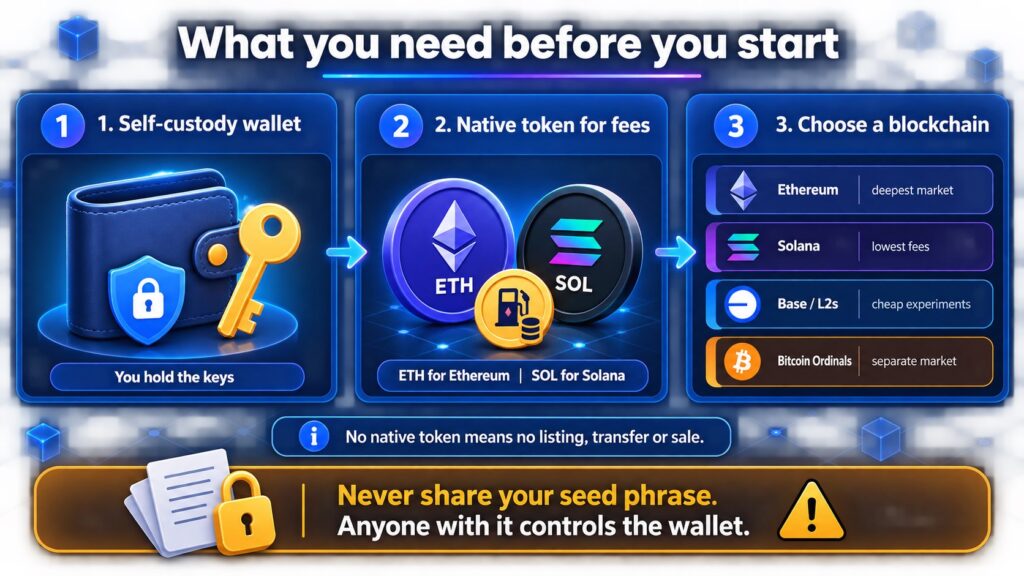
Three things: a self-custody wallet, cryptocurrency for fees, and a decision about which blockchain.
A Self-custody Wallet
A self-custody wallet is one where the user holds the private keys rather than an exchange.
MetaMask covers Ethereum and EVM-compatible chains. Phantom covers Solana. Both are free browser extensions with mobile apps.
The seed phrase rule applies without exception. Anyone holding that phrase controls the wallet and everything in it. No legitimate service will ever ask for it.
Cryptocurrency for Fees
Fees are paid in the chain’s native token, separately from any purchase price.
Ethereum transactions need ETH. Solana transactions need SOL. A wallet holding only an NFT and no native token cannot list, transfer, or sell it.
Choosing a Blockchain
| Chain | Best for | Typical cost profile |
|---|---|---|
| Ethereum | Deepest secondary market, highest-value collections | Low in 2026, higher than alternatives |
| Solana | High-volume, low-price collections | Fractions of a cent |
| Base and other L2s | Cheap experimentation | Fractions of a cent |
| Bitcoin Ordinals | A separate collector ecosystem | Variable, tied to Bitcoin fees |
Ethereum remains the primary venue for most of the value that still trades.
How to Create and Mint an NFT
Minting means writing a token to a blockchain, and on most marketplaces the process takes under ten minutes.
Preparing the File
Common formats include PNG, JPG, GIF, MP4 and MP3, with size limits set by each marketplace.
One detail matters more than creators expect. Most marketplaces store the asset itself off-chain, usually on IPFS, and put only a pointer on the blockchain. If that storage stops being paid for or maintained, the token survives and the image does not.
Minting on a Marketplace
- Connect the wallet to the marketplace.
- Create a collection and set its name, description and blockchain.
- Upload the file and add traits or properties.
- Set the royalty percentage and the receiving wallet address.
- Mint, and approve the transaction in the wallet.
Many marketplaces offer lazy minting, where the token is only written to the chain when someone buys it. That shifts the gas cost to the buyer and removes the upfront expense.
What Minting Costs?
| Chain | Typical minting cost | As of |
|---|---|---|
| Ethereum mainnet | Cents at prevailing gas levels | August 2026 |
| Solana | Well under $0.01 | 2026 |
| Base and other L2s | Well under $0.01 | 2026 |
| Lazy minting (any chain) | $0 to the creator | 2026 |
Ethereum gas averaged around 0.5 gwei through April 2026 per ethereum.org, and Etherscan showed 0.089 gwei on 12 August 2026. Older guides quoting $50 to $100 minting costs describe conditions that no longer exist.
How to Buy an NFT
The purchase takes seconds. The research before it is what separates a considered buy from a loss.
Choosing a Marketplace
| Marketplace | Chain focus | Suits |
|---|---|---|
| OpenSea | Ethereum and multi-chain | Beginners, broadest selection |
| Blur | Ethereum | Active traders, advanced tooling |
| Magic Eden | Solana, Bitcoin Ordinals, multi-chain | Solana and Ordinals collectors |
| Tensor | Solana | High-frequency Solana trading |
Marketplace share has moved repeatedly and reported figures conflict across sources. The Block’s analysis found OpenSea regained the lead in Ethereum and EVM marketplace volume through 2025, climbing above 67% by late in the year while Blur fell below 24%. Treat any share figure as a snapshot rather than a fixed position.
Checking a Collection Before You Buy
Five checks, in order of usefulness.
- Floor price history direction matters more than the current floor. A collection with a rising floor over 90 days behaves differently from one that has fallen 80%.
- Unique buyer count against total sale count exposes wash trading. Thousands of sales among a handful of wallets is manufactured activity, not demand.
- Thirty-day trading volume shows whether a secondary market exists at all. A collection with no recent volume cannot be sold, whatever its listed floor.
- Contract verification on a block explorer confirms the collection is what it claims to be. Copycat collections mimicking verified ones are common.
- Whether anything exists beyond the image is the last question, and often the most useful.
Completing the Purchase
Connect the wallet, select the item, confirm the transaction, then verify it on a block explorer such as Etherscan or Solscan. Ownership transfers on-chain within seconds to minutes.
How to Sell an NFT
Listing takes minutes. Whether it sells depends entirely on whether a buyer exists.
Listing and Pricing
Fixed-price listings sit until someone buys or the listing expires. Auctions run to a deadline and suit items with established demand.
Most sellers price against the collection floor. Listing meaningfully above the floor on a collection with thin volume usually means no sale.
Marketplace Fees and Royalties
| Marketplace | Marketplace fee | Royalty policy |
|---|---|---|
| OpenSea | 2.5% typical | Optional unless contract enforces |
| Blur | 0% | Optional |
| Magic Eden | ~2% | Optional on most collections |
| SuperRare | Up to 7.5% | Enforced |
The royalty situation changed materially after 2023 and most guides have not caught up. Creator royalties became optional across most major marketplaces during the competition for trading volume.
A royalty percentage written into a smart contract is a request unless the contract uses an enforcing standard such as ERC-721C. Buyers on optional-royalty marketplaces frequently pay nothing.
Tax Treatment in the US
The IRS treats NFTs as property, so selling one is a taxable disposal and any gain is a capital gain.
Royalty income is treated separately as income rather than as a capital gain. Gas fees may factor into cost basis.
Clovr is not a tax advisor and this is not tax advice. Anyone transacting at any meaningful volume should speak to a qualified accountant, because the record-keeping burden is heavier than most people expect.
What Can Go Wrong?
The most common losses are not exchange hacks. They are wallet approvals granted to malicious contracts.
Common Scams
Malicious signature requests are the primary vector. A prompt that looks like a routine wallet connection can authorise a contract to move every asset in the wallet. Read what a signature request is asking for before approving it.
Copycat collections replicate the name and artwork of verified projects. Check the contract address, not the name.
Mint links shared through direct messages on Discord, X or Instagram are a persistent scam pattern. Legitimate projects do not recruit buyers that way.
Wash Trading and Fake Volume
Wash trading means selling an asset between wallets under the same control to manufacture the appearance of demand.
The tell is the ratio between unique buyers and total sales. A collection showing 4,000 sales across 30 unique wallets is not trading, it is being cycled. Most marketplaces publish both figures, and comparing them takes seconds.
Incentive programmes create a legitimate version of the same distortion. When a marketplace rewards trading volume with tokens or points, reported volume rises without reflecting genuine collector demand.
The Bottom Line
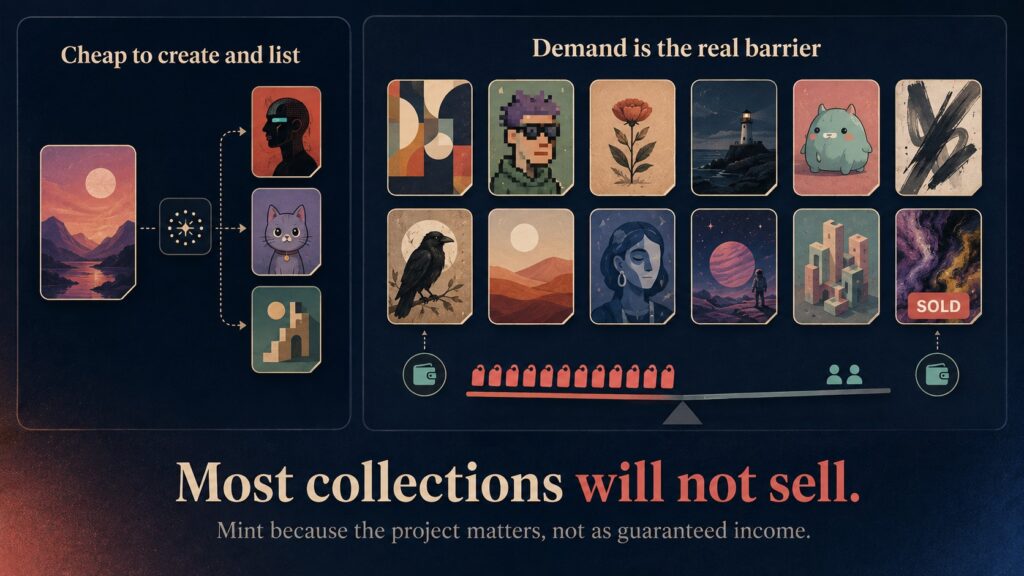
Creating and listing an NFT is now cheap enough that cost is no longer the barrier to entry. Demand is. The market that exists in 2026 processes a high volume of low-priced transactions among roughly two million active wallets, which supports established collections and a small number of creators who brought an audience with them. For everyone else the realistic outcome is a collection that does not sell, and the honest way to approach minting one is as a project worth doing for its own sake rather than as an income stream.
Frequently Asked Questions
-
How much does it cost to mint an NFT?
Very little. Solana and Layer 2 minting costs sit well under a cent, Ethereum mainnet costs cents at 2026 gas levels, and lazy minting shifts the cost to the buyer entirely.
-
How much money can you make from NFTs?
For most creators, nothing. A 6% royalty on a typical $90 resale returns about $5.40, and roughly 79% of collections never sell out their primary mint, so most never reach a secondary market at all.
-
Are NFTs dead?
No, but the market changed shape. Trading volume fell sharply from its 2021 peak while transaction counts rose, producing a high-volume market in collectibles averaging $80 to $100 per sale.
-
What is the best NFT marketplace for beginners?
OpenSea, for its interface and multi-chain selection. Magic Eden suits Solana and Bitcoin Ordinals, and Blur is built for active traders rather than first-time buyers.
-
Do I pay tax on NFT sales?
Yes. The IRS treats NFTs as property, so a sale is a taxable disposal and royalty income is taxed as income. Consult a qualified accountant rather than relying on general guidance.
-
Why won't my NFT sell?
Most likely because no secondary market exists for the collection. Research covering 73,257 collections found around 95% with a market cap of zero, and thin or absent trading volume is the norm rather than the exception.
Related reading:
Think You’ve Got a Gambling Problem?
Call or text the National Council on Problem Gambling helpline: 1-800-522-4700 (24/7, confidential).
Last updated: August 2026 | Clovr.com