This page is a neutral informational resource. Clovr.com earns affiliate commissions on some pages across this site. This Pennsylvania state guide contains no affiliate links, operator CTAs, or promotional recommendations.
BLUF Verdict | Legal Status in Pennsylvania
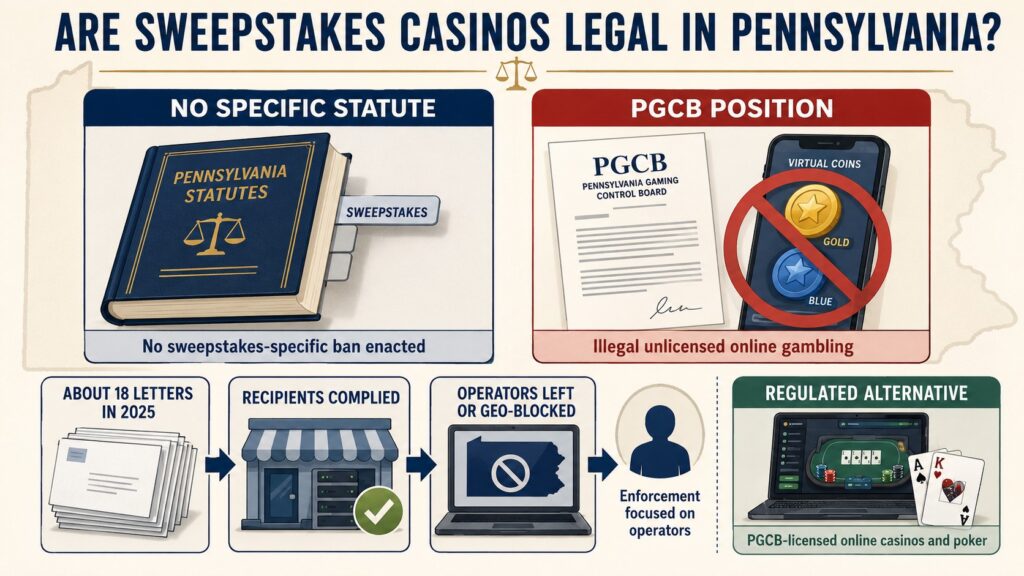
Sweepstakes casinos in Pennsylvania are available but contested in 2026. No Pennsylvania statute bans them by name, but the Pennsylvania Gaming Control Board classifies them as illegal online gambling. Most major operators exited after the PGCB issued 18 cease-and-desist letters in April 2025.
Three facts define the situation for Pennsylvania-based players:
- No enacted PA law explicitly names or bans sweepstakes casinos.
- The PGCB issued 18 cease-and-desist letters in April 2025; all 18 recipients complied by exiting or geo-blocking Pennsylvania.
- Operator availability in Pennsylvania is now partial, fluid, and subject to change without notice.
Pennsylvania is among the most active sweepstakes casino enforcement states in the US as of 2026. The PGCB acknowledges its enforcement ceiling is cease-and-desist letters and civil remedies rather than criminal prosecution. This distinction explains why some operators remain reachable from Pennsylvania despite the enforcement wave.
The PGCB is lobbying the Pennsylvania legislature for an explicit statutory ban. As of mid-2026, no naming bill has been enacted. If legislation passes, this page shifts immediately to the full ban-state format.
For Pennsylvania residents, any sweepstakes casino account carries ongoing legal risk. Gold Coin-only social play is the lowest-risk option available to PA players. Clovr is a sweepstakes casino and crypto casino affiliate review platform. Clovr publishes this page as a neutral legal-status resource, not an operator endorsement.
Are Sweepstakes Casinos Legal in Pennsylvania
No Pennsylvania statute enacted as of mid-2026 names sweepstakes casinos and bans them by law. A co-sponsorship memo circulated during the 2025-2026 Pennsylvania General Assembly session, signaling legislative intent for an explicit ban. No naming bill has been signed into law.
The absence of a naming statute does not make sweepstakes casinos legal in Pennsylvania. The Pennsylvania Gaming Control Board has classified them as unlicensed illegal online gambling. That classification drove the April 2025 enforcement wave that removed most major operators from the state.
What the PGCB Did in 2025
The Pennsylvania Gaming Control Board, established in 2004, regulates all gambling activity in the state. When sweepstakes casinos expanded across the US market, the PGCB determined they operate outside the licensed iGaming framework. The board issued 18 cease-and-desist letters in April 2025; all 18 recipients complied.
The PGCB’s enforcement authority derives from Act 42 of 2017. That act is the Pennsylvania Gaming Act that created the licensed iGaming structure. Any casino-style platform without an Act 42 license sits outside the state’s legal gambling framework. PA licensed iGaming generated $3.46 billion in gross revenue in 2025. The PGCB frames unlicensed sweepstakes competition as both a legal violation and a fiscal concern.
The economic motive is direct. Sweepstakes casinos offer casino-style gameplay without paying into PA’s licensed tax structure. Act 42 operators pay state gaming tax on gross revenue; sweepstakes casinos do not. The PGCB cites this as unfair competition against the regulated market.
The Prosecutorial Authority Gap
The PGCB acknowledged a significant enforcement limitation at the 2025 Gaming Oversight Committee hearing. Board officials described the situation as “whack-a-mole” enforcement. The PGCB can issue cease-and-desist letters and pursue civil remedies. It cannot bring criminal prosecutions against sweepstakes operators.
This gap matters for Pennsylvania players. An operator resisting a C&D letter faces civil action, not criminal charges. Most operators complied in April 2025. The legal ceiling on PGCB enforcement explains why PA availability remains fluid rather than fully blocked.
The “whack-a-mole” characterization also drives the PGCB’s push for legislation. A naming statute would let the board block new entrants without issuing individual letters. Until that statute exists, operators can enter or re-enter Pennsylvania without PGCB pre-authorization.
The Industry Counter-Argument
The Social and Promotional Games Association contends the PGCB’s enforcement constitutes regulatory overreach. The SPGA argues that properly structured promotional sweepstakes satisfy federal no-purchase-necessary standards and are legal under federal law. The PGCB disputes that federal compliance overrides Pennsylvania’s state-level gambling definitions.
Pennsylvania determines legality under state law, separately from federal eligibility. A product satisfying the federal no-purchase-necessary standard can still violate Title 18 §5513. The PGCB applies that statute’s three-element gambling test independently of the federal framework.
The April 2025 Enforcement Timeline
The PGCB issued 18 cease-and-desist letters to sweepstakes casino operators in April 2025. All 18 named operators complied by exiting or geo-blocking Pennsylvania. The enforcement action did not name every active sweepstakes casino in the market.
The C&D letters were issued across a short window, signaling coordinated enforcement rather than a case-by-case review. Operators received the letters, assessed the risk of non-compliance, and moved quickly. The PA exit was one of the largest coordinated sweepstakes market withdrawals in the US that year.
Operators that did not receive C&D letters made individual risk assessments. Some withdrew preemptively to avoid future enforcement. Others continued operating, assessing that their structure or market position placed them outside the PGCB’s immediate targeting. Availability in Pennsylvania shifted significantly in the weeks after April 2025.
Why Pennsylvania’s Enforcement Posture Is Unlikely to Soften
Pennsylvania built one of the largest licensed iGaming markets in the US under Act 42. The state has a structural incentive to protect that regulated market from untaxed competition. The PGCB’s enforcement posture reflects both legal authority and fiscal interest in maintaining the Act 42 framework.
PA players who want legal certainty have a clear alternative. Pennsylvania is one of only eight US states with a fully licensed real-money online casino and poker market. The licensed category is described further in the What Pennsylvania Players Should Know section below.
Is There a Law Banning Sweepstakes Casinos in Pennsylvania
Not as of mid-2026. No enacted Pennsylvania statute names and bans sweepstakes casinos. The PGCB relies on cease-and-desist authority under its Act 42 mandate. The board is lobbying the legislature for an explicit naming statute. PA players should monitor this page for updates as the 2025-2026 legislative session progresses.
Why Sweepstakes Operators Left Pennsylvania
The April 2025 PGCB cease-and-desist wave was the direct cause of the operator exits from Pennsylvania. The board issued 18 formal letters to sweepstakes casino operators across the market. All 18 recipients complied by exiting the state, implementing geo-blocks on PA registrations, or restricting existing PA accounts.
The causal chain was direct. The PGCB classified sweepstakes casinos as unlicensed illegal online gambling. The board issued formal C&D letters to 18 operators. Every recipient chose compliance over contesting the letters.
Compliance Was Not a Legal Concession
Operators complied with PGCB cease-and-desist letters without admitting legal wrongdoing. A C&D compliance is a business risk decision, not a court ruling on underlying legality. No Pennsylvania court has issued a definitive ruling on sweepstakes casino legality under Title 18 §5513 as of mid-2026.
This distinction matters for the availability picture. The PGCB’s enforcement posture is aggressive, but its legal ceiling is civil remedies. Operators weighed litigation cost against the cost of PA exit. Most chose exit, which explains why availability shifted abruptly but is not legally permanent.
Preemptive Exits and Non-C&D Operators
Operators that did not receive C&D letters made their own assessments after the April 2025 wave. Some withdrew preemptively to avoid future enforcement action. Others continued accepting PA players, calculating that their structure or size placed them outside the PGCB’s immediate enforcement priority.
The result is a fragmented availability picture. Major brands named in the C&D wave are gone from Pennsylvania. A smaller group of operators continues accepting PA registrations, but each operator’s status can change without notice.
Why Availability Remains Fluid
The PGCB describes its enforcement as “whack-a-mole” because it lacks statutory authority to block new entrants preemptively. An operator can launch or re-enter Pennsylvania without PGCB pre-authorization. Each new entrant triggers a new C&D letter cycle. Until the legislature enacts a naming statute, this cycle will continue.
PA players relying on any operator’s stated availability should verify directly with the operator before registering. ToS listings can update without notice. Enforcement status can change between the date this page was published and the date a player attempts to sign up.
What Conflicts Between ToS and Enforcement Reporting Mean
Some operators’ terms of service list Pennsylvania as available despite compliance with PGCB enforcement at other points. These conflicts between ToS listings and compliance reporting are not publicly reconciled by either operators or the PGCB. Clovr flags these conflicts as requiring direct verification rather than asserting a definitive status. PA players should treat any availability claim as a starting point, not a guarantee of access.
These discrepancies can shift between publication date and the date a player signs up. An operator’s ToS may update within days of a new enforcement letter. Always check the current ToS on the day of registration.
How the Sweepstakes Model Works Under PA Law
Pennsylvania’s sweepstakes casino legal dispute centers on the three-element gambling test. That test is defined in Title 18 §5513 of the Pennsylvania Consolidated Statutes. Under Pennsylvania case law, an activity constitutes illegal gambling when all three elements are present. Removing any single element takes the activity outside the gambling definition.
Sweepstakes casinos are structured to remove the consideration element via a free Alternate Method of Entry. The table below shows how each element maps onto the sweepstakes model:
| Element | Definition | Sweepstakes Approach |
|---|---|---|
| Prize | Something of value awarded to a winner | Sweeps Coins redeemable for cash prizes |
| Chance | Random or probability-based outcome | Slot-style and table-style gameplay |
| Consideration | Payment or value given to participate | Removed via free AMOE (mail-in entry route) |
The PGCB disputes that the AMOE route cures the unlicensed gambling classification. Both the operator theory and the PGCB’s position remain legal arguments. No Pennsylvania court has settled this question as of mid-2026.
The No-Purchase-Necessary Standard
The no-purchase-necessary rule is a federal baseline for promotional sweepstakes. Under federal law, a promotional sweepstakes must provide a free entry route. This requirement distinguishes a lawful sweepstakes from an illegal lottery. Sweepstakes casinos use the Alternate Method of Entry as their free entry mechanism to satisfy this federal standard.
Federal compliance does not guarantee state legality. Pennsylvania determines whether an activity constitutes gambling under state law, independently of federal eligibility. A product satisfying the federal no-purchase-necessary standard can still violate Title 18 §5513. That violation occurs when the PGCB finds all three gambling elements are present.
The PGCB’s Dispute With the Operator Theory
The PGCB argues that the redeemable Sweeps Coin layer constitutes gambling regardless of the free AMOE route. The board focuses on the overall product, including casino-style gameplay and real-money prize redemption. The PGCB holds that these features meet the three-element test. This applies even when no purchase is required for account signup.
The Social and Promotional Games Association disputes this interpretation. No PA court has resolved the dispute as of mid-2026. Both the operator theory and the PGCB’s position represent competing legal arguments.
The Mail-In AMOE Route
The sweepstakes casino AMOE is typically a written request mailed to the operator. No purchase or payment is required to use it. A player submits the request and receives a small allocation of Sweeps Coins in return. The AMOE is rarely used by most players. It is legally significant as the mechanism operators cite to satisfy the no-purchase-necessary standard.
The PGCB has not accepted the AMOE argument as curing its illegal gambling classification. The board focuses on the product’s overall nature rather than the entry mechanism alone. Casino-style gameplay and real-money prize redemption are the features it cites.
Why the Federal-State Distinction Matters
Sweepstakes casino operators argue that satisfying the federal no-purchase-necessary standard provides legal protection at the state level. Pennsylvania law does not recognize this extension. The PGCB applies the three-element test under Title 18 §5513 independently of federal promotional sweepstakes law.
This is why sweepstakes casinos operate without challenge in most US states but face enforcement in Pennsylvania. State gambling law and federal promotional sweepstakes law are jurisdictionally separate. Federal compliance does not resolve the state-level question in Pennsylvania.
Gold Coins vs Sweeps Coins Explained
Sweepstakes casinos operate on a dual-currency system that separates free entertainment play from redeemable prize play. The two currencies are Gold Coins and Sweeps Coins. Each has a distinct function, cost structure, and risk profile that matters specifically in the Pennsylvania enforcement context.
Gold Coins are the free, non-redeemable entertainment currency at sweepstakes casinos. Players receive Gold Coins through daily login bonuses, promotional offers, and coin package purchases. Gold Coins carry no cash value and cannot be redeemed for prizes.
Sweeps Coins are the promotional prize currency redeemable for cash prizes. Sweeps Coins are not directly purchasable. Players obtain them as bonus attachments to Gold Coin packages or through the free AMOE route. The redeemable nature of Sweeps Coins is the exact feature the PGCB targets in its illegal gambling classification.
| Feature | Gold Coins (GC) | Sweeps Coins (SC) |
|---|---|---|
| Currency type | Virtual entertainment currency | Promotional prize currency |
| Direct cost | Free (daily bonuses, login rewards) | Not directly purchasable |
| How obtained | Login bonuses, coin packages | AMOE, bonus with GC packages |
| Redeemable for prizes | No | Yes (cash prizes) |
| PA risk profile | Low (no cash value) | Elevated (PGCB scrutiny target) |
Why GC-Only Play Is the Safest Option in Pennsylvania
All sweepstakes casinos are social casinos, but not all social casinos offer Sweeps Coin cash redemption. A GC-only player never engages with SC-eligible games. This avoids the redeemable prize layer that forms the basis of the PGCB’s enforcement concern. GC-only play is free-to-play social gaming with no cash prize element.
For Pennsylvania residents, GC-only social play is the defensible low-risk option. This approach does not guarantee legal certainty. The PGCB may object to a platform’s existence regardless of how an individual player uses it. However, GC-only activity avoids the specific prize-redemption elements the PGCB cites in its enforcement classification.
What Sweeps Coins Mean for PA Players
PA players who redeem Sweeps Coins engage with the layer the PGCB classifies as illegal gambling consideration. Players should weigh this risk before engaging with the SC layer of any sweepstakes platform from Pennsylvania. No SC welcome figures or coin-package pricing are published on this page. PA players should verify any bonus offers directly with operators on the day of intended signup.
Which Sweepstakes Casinos Still Accept Pennsylvania Players
Sweepstakes casino availability in Pennsylvania is partial, fluid, and operator-dependent as of mid-2026. Most major brands exited after the PGCB’s April 2025 cease-and-desist wave. A smaller group of operators remains accessible. Some were not named in the C&D wave; others made a different risk assessment.
The table below reflects availability as reported from operator terms of service and enforcement reporting. Where these sources conflict, the status is flagged for verification. This table is informational only and contains no rankings, bonuses, or affiliate endorsements. Clovr does not publish affiliate CTAs for Pennsylvania operators. The elevated enforcement posture in the state makes a neutral informational format appropriate.
Pennsylvania Operator Availability Status
| Operator | PA Availability | Min. Age | Status Notes |
|---|---|---|---|
| Mega Bonanza | Not available in PA | 21+ | PA appears on Mega Bonanza’s excluded-states list; complied with April 2025 C&D. Not an option for PA players. |
| Stake.us | Exited PA after April 2025 C&D | 21+ | Not available. Stake.us is subject to an active federal class action filed in Ohio (February 2026) and a separate Ohio class action. |
| Chumba Casino | Not accepting PA | 18+ | Verify at platform. |
| McLuck | ToS lists PA as available | 21+ | Conflicts with C&D compliance reporting. Verify directly before registering. Ongoing legal risk applies. McLuck is a B2 sister brand to Play Fame. |
| Play Fame | Not available in Pennsylvania (PA) | 21+ | B2 sister brand to McLuck. Likely mirrors McLuck’s posture; verify independently before relying on any availability claim. |
| Pulsz | ToS lists PA as available | 21+ | Conflicts with C&D compliance reporting. Verify directly before registering. Ongoing legal risk applies. |
| Crown Coins | Availability reported but unconfirmed | 18+ | Status unconfirmed for PA. Crown Coins is subject to an active Ohio class action. Verify before registering. |
How to Verify Availability in Pennsylvania
Terms of service and enforcement reporting conflict for several Pennsylvania operators. The only reliable confirmation method is to check the operator’s own terms of service or registration flow. Do this on the day of intended signup. No status in this table should be treated as permanent or guaranteed.
Standing Caution for Pennsylvania Players
Any sweepstakes casino account opened from Pennsylvania carries ongoing legal risk. The PGCB may issue additional cease-and-desist letters to operators listed as available. A statutory ban, if enacted, could affect existing accounts regardless of when they were opened. Players should weigh this fully before registering with any operator.
What Pennsylvania Players Should Know Before Playing
Legal Alternatives to Sweepstakes Casinos
Pennsylvania is one of eight US states with a fully licensed real-money online casino market. PGCB-licensed iGaming operators under Act 42 of 2017 offer casino games and online poker. These platforms include formal consumer protections, regulatory dispute resolution, and required responsible gambling tools. Licensed PA casinos provide legal certainty that unlicensed sweepstakes platforms cannot offer in Pennsylvania.
The licensed PA iGaming market generated $3.46 billion in gross revenue in 2025. Players who want full consumer protections and regulatory oversight should consider the licensed real-money market as the compliant alternative. Clovr does not rank or promote specific licensed PA casino brands in this informational state guide.
Sweepstakes Casino Winnings and Pennsylvania Tax
Sweeps Coin redemptions constitute taxable income in Pennsylvania. The Pennsylvania Department of Revenue applies a flat 3.07% personal income tax to all gambling and sweepstakes redemptions. Players report these redemptions on PA-40 Schedule T. Federal income tax also applies at the filer’s marginal bracket.
Players should maintain records of all Sweeps Coin redemptions, including dates and amounts. These records support accurate PA-40 Schedule T filing. Operators may issue a federal 1099 for redemptions above IRS thresholds. The 3.07% PA flat rate applies regardless of whether a 1099 is issued.
If a Statutory Ban Passes
The PGCB is lobbying the Pennsylvania General Assembly for an explicit sweepstakes casino ban. If a naming statute is enacted, the legal situation in Pennsylvania shifts from contested to prohibited. This page will update to the full ban-state format immediately upon enactment, removing all operator information.
A statutory ban could affect existing accounts, including access to balances and pending redemptions. Players with active accounts should monitor the legislative situation. Sweepstakes casinos without a PA license have no formal consumer dispute resolution mechanism under Pennsylvania state law.
Age Requirements by Operator
Sweepstakes casino age requirements in Pennsylvania vary by operator and are not governed by a PA state standard. Each operator sets its own minimum age. PA players should verify the requirement for any platform before registering.
Per-platform age gates:
- Mega Bonanza: 21+ (not available in PA)
- Stake.us: 21+ (exited PA)
- Chumba Casino: 18+
- McLuck: 21+
- Play Fame: 21+ (verify)
- Pulsz: 21+
- Crown Coins: 19+
Keeping Records of Play
Players who engage with sweepstakes casinos from Pennsylvania should document all Sweeps Coin redemptions. Records should include date, amount, and operator name for each transaction. This documentation supports PA-40 Schedule T reporting and any potential disputes with operators.
Sweepstakes casinos are not PGCB-licensed and are not required to provide standard player history reports. PA players cannot rely on the state’s dispute resolution process for unlicensed platforms. Independent recordkeeping is the only reliable protection.
Redemption records also serve as evidence in the event an operator exits the market mid-balance. Several PA-exit operators in 2025 closed accounts without full redemption processing. Players with documented balance histories were better positioned to escalate those disputes.
Responsible Gaming in Pennsylvania
Pennsylvania residents experiencing gambling-related concerns can call the PA Problem Gambling Helpline at 1-800-GAMBLER (1-800-426-2537). The PGCB operates a self-exclusion program for licensed PA iGaming platforms. Coverage for unlicensed sweepstakes sites is not guaranteed through that program. Players should use the session limits and spend controls available on any platform they use.
Frequently Asked Questions
-
Is it illegal for a Pennsylvania resident to play at a sweepstakes casino?
No, no Pennsylvania statute criminalizes a resident for accessing a sweepstakes casino. PGCB enforcement targets operators, not individual players. However, the PGCB classifies these platforms as illegal online gambling. Any account carries risk, including sudden exits, geo-blocks on existing accounts, or future legislation affecting active players.
-
How is a sweepstakes casino different from a licensed PA online casino?
PGCB-licensed real-money online casinos operate under Act 42 of 2017. They carry formal consumer protections, regulatory oversight, and dispute resolution mechanisms. Sweepstakes casinos are free-to-play dual-currency social platforms with no PA license, operating in a contested legal space. Licensed PA casinos pay state gaming tax; sweepstakes casinos operating in PA do not.
-
Are sweepstakes casino winnings taxable in Pennsylvania?
Yes. Pennsylvania taxes all gambling and sweepstakes redemptions at a flat 3.07% rate, reported on PA-40 Schedule T. Federal income tax also applies at the filer’s marginal bracket. Players should keep records of all Sweeps Coin redemptions to support accurate tax reporting.
-
What can Pennsylvania players legally play instead?
PGCB-licensed real-money online casinos and poker under Act 42 of 2017 offer the highest legal certainty for PA players. Gold Coin-only social play at sweepstakes casinos is the lowest-risk option within the sweepstakes model itself. Players who want full consumer protections and a regulated dispute resolution process should use a licensed PA iGaming operator.
-
Is there a law banning sweepstakes casinos in Pennsylvania?
Not as of mid-2026. No enacted Pennsylvania statute names and bans sweepstakes casinos. The PGCB relies on cease-and-desist authority and is lobbying the legislature for an explicit naming statute. PA players should check this page for updates if a naming bill advances through the General Assembly.
-
Is McLuck, Pulsz, or Stake.us Available in Pennsylvania?
Stake.us exited Pennsylvania after the April 2025 PGCB cease-and-desist wave and is not available. McLuck and Pulsz list Pennsylvania in their terms of service. These listings conflict with enforcement compliance reporting from the same period. Verify availability directly with each operator before registering; any account in Pennsylvania carries ongoing legal risk.
Related reading:
Think You’ve Got a Gambling Problem? Call or text the National Council on Problem Gambling helpline: 1-800-522-4700 (24/7, confidential).
Last updated: July 2026 | Clovr.com