Key Takeaways
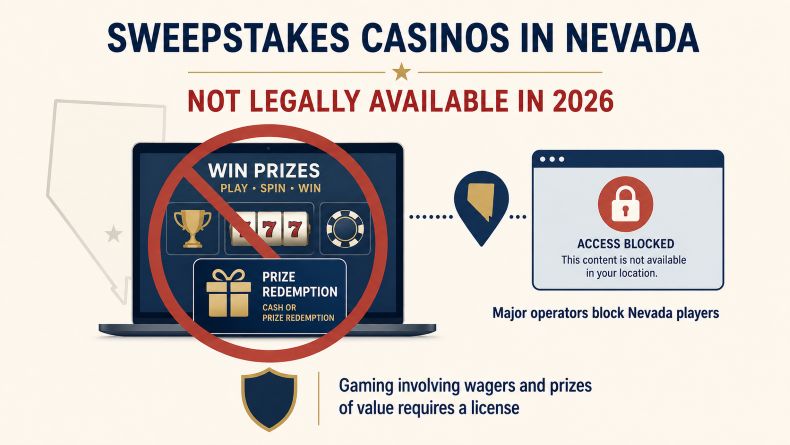
- Sweepstakes casinos with Sweeps Coins prize redemption are not legally accessible in Nevada in 2026.
- NRS Chapter 463 defines gambling broadly to include any game played for a “representative of value.” Redeemable Sweeps Coins meet that definition under NGCB interpretation.
- SB 256 (Chapter 337, 83rd Session), effective October 1, 2025, added Category B felony exposure, profit disgorgement, and extraterritorial reach for out-of-state operators.
- Every major sweepstakes operator, including Chumba Casino, Stake.us, and Pulsz, blocks Nevada-located players by geolocation.
- Gold-Coin-only social casino play is the legally defensible entertainment alternative for Nevada residents. No cash prizes. No redemption.
- Nevada permits licensed online poker under NRS 463.016425, limited to two operators: Real Gaming and WSOP.
Sweepstakes casinos with Sweeps Coins prize redemption are not legally accessible in Nevada in 2026. No reputable operator offers cash-prize play to Nevada-located players. Every major platform blocks the state by geolocation.
The legal basis is NRS Chapter 463, Nevada’s broad gambling statute, combined with SB 256 (Chapter 337, 83rd Session). SB 256 took effect October 1, 2025. NRS Chapter 463 defines gambling to include any game played for money or any “representative of value.” The Nevada Gaming Control Board (NGCB) treats redeemable Sweeps Coins as a “representative of value.” That classification brings the dual-currency sweepstakes model under the gambling statute.
The one legally defensible option for Nevada residents is Gold-Coin-only social casino play. That format uses a single entertainment currency with no cash value and no prize redemption. It falls outside Nevada’s gambling definition under NRS Chapter 463.
This Clovr guide explains the statutes, the legal mechanics, and what they mean for Nevada residents in practice. This page ranks no operators and links none. No operator with prize redemption serves Nevada residents as of 2026. There is nothing to rank.
All players must be 21 or older to participate in any form of gaming in Nevada.
Are Sweepstakes Casinos Legal in Nevada in 2026
Sweepstakes casinos with cash-redeemable prize currency are not legally accessible to Nevada-located players in 2026. Nevada’s gambling statute is among the broadest in the United States. The law defines gambling to include any game played for money, property, checks, credit, or any “representative of value.” That final phrase is the legal hinge on which Nevada’s treatment of sweepstakes casinos turns.
NRS Chapter 463 and the Gambling Definition
NRS Chapter 463 is Nevada’s primary gaming statute. The law governs every aspect of licensed gambling in Nevada. NRS Chapter 463 defines a “game” as any device or system where something of value is wagered on a chance-determined outcome. The phrase “representative of value” extends the definition beyond cash.
Sweeps Coins are redeemable for cash prizes. The Nevada Gaming Control Board (NGCB) treats that redemption feature as supplying the “representative of value” element required under NRS Chapter 463. When that element is present, the activity meets Nevada’s gambling definition.
NRS Chapter 465 covers crimes and liabilities in gaming. NRS Chapter 465 works alongside NRS Chapter 463 to establish criminal penalties for unlicensed gaming activity. The two chapters form the legal backbone of Nevada’s enforcement posture against the dual-currency sweepstakes model.
NRS 463.0152 and the Prize-of-Value Rule
NRS 463.0152 is the specific subsection the NGCB cites in sweepstakes enforcement. Under NRS 463.0152, any game that awards a prize of real value is gaming. This applies regardless of whether the player paid to enter. The NGCB does not accept the no-purchase-necessary argument as a legal cure when a redeemable prize exists.
This rule is the reason Nevada’s position is stricter than most permissive states. Permissive states accept the no-purchase-necessary principle as removing the “consideration” element from the three-element gambling test. Nevada reads NRS 463.0152 differently. When a cash-redeemable prize exists, consideration becomes legally irrelevant under the NGCB’s reading of the statute.
The “representative of value” phrase in NRS Chapter 463 and the prize-of-value rule in NRS 463.0152 work together. They create a statutory framework that treats Sweeps Coins as gambling currency regardless of how the player obtained them.
The Nevada Gaming Control Board
The Nevada Gaming Control Board is the primary enforcement authority for gaming law in Nevada. The NGCB investigates unlicensed operators, issues cease-and-desist orders, and recommends criminal and civil penalties. The Nevada Gaming Commission sits above the NGCB as the final licensing and regulatory authority. The Commission acts on NGCB recommendations.
The NGCB has maintained one of the most aggressive enforcement postures of any state gaming regulator in the United States. Nevada’s economy is built around licensed, regulated casino gambling. The board treats unlicensed prize gaming as a direct threat to that framework and the tax revenue it generates.
The NGCB’s approach to sweepstakes platforms predates SB 256. Nevada did not require new legislation to classify the dual-currency model as unlicensed gambling. The existing statute already covered it under the “representative of value” language. SB 256 strengthened the tools available to enforce what the law already said.
The Practical Result for Nevada Residents
Every major sweepstakes casino platform excludes Nevada from its service territory. Chumba Casino lists Nevada as an excluded territory in its published Terms and Conditions. Stake.us lists Nevada in its excluded territories. Pulsz blocks Nevada-located players at the point of geolocation verification.
A Nevada-located player who attempts to register on a dual-currency platform will encounter a geolocation block during account verification. If access is somehow granted, the prize redemption function will not be available. These blocks result from NGCB enforcement posture and the SB 256 penalty structure described in the next sections.
For players in states where sweepstakes casinos operate legally, Clovr publishes detailed, verified operator reviews. For Nevada residents, this page covers the legal framework that explains why those reviews do not apply here.
Sweepstakes Casinos vs Social Casinos | How Nevada Draws the Line
Nevada’s gambling law does not treat all casino-style entertainment platforms the same way. The determining factor is not the games themselves. It is the currency structure and whether any currency can be redeemed for a prize of real value.
The Dual-Currency Model Defined
Sweepstakes casinos use two virtual currencies. Gold Coins (GC) are a free-play entertainment currency. Gold Coins have no cash value and cannot be redeemed for prizes. Sweeps Coins (SC) are a promotional currency. Sweeps Coins can be redeemed for cash prizes. Sweeps Coins cannot be directly purchased.
The games available on a dual-currency platform are typically identical regardless of which currency is in play. A player can use the same slot game with Gold Coins or Sweeps Coins. The difference is the outcome’s real-world value. A Sweeps Coin win produces coins redeemable for cash.
The Sweeps Coin redemption leg is the specific mechanic that Nevada law targets. The games themselves are not the issue. The cash-redeemable prize on the other side is.
The Three-Element Gambling Test
Nevada law, like most US state gambling statutes, applies a three-element test to classify an activity as gambling:
- Consideration – something of value must be risked or given
- Chance – the outcome must be determined by chance
- Prize – something of real value must be winnable
All three elements must be present. Sweepstakes operators argue that the Alternate Method of Entry (AMOE) removes the “consideration” element. The AMOE allows players to request Sweeps Coins by mail without making a purchase. If no purchase is required, the argument goes, no consideration exists.
Nevada does not accept this argument when a cash-redeemable prize exists. Under NRS 463.0152, the NGCB treats the presence of a cash-redeemable prize as sufficient to trigger gaming jurisdiction. The consideration element is bypassed by the prize-of-value reading. The AMOE defense, which works in many permissive states, does not rescue the model in Nevada.
Sweepstakes Casino vs Social Casino in Nevada
| Feature | Sweepstakes Casino (Dual-Currency) | Social Casino (Gold-Coin-Only) |
|---|---|---|
| Currencies used | Gold Coins + Sweeps Coins | Gold Coins only |
| Redemption available | Sweeps Coins exchangeable for cash prizes | No redemption; Gold Coins have no cash value |
| Nevada legal status | Not legally accessible (NRS 463, SB 256) | Legal entertainment platform |
| What you can win | Cash prizes via Sweeps Coin redemption | Entertainment only; no prizes of real value |
Why This Distinction Matters
A Nevada-located player using Gold Coins engages in entertainment. No prize of real value exists. No element of the three-element gambling test is triggered under NRS Chapter 463. The activity is legally defensible.
A Nevada-located player using Sweeps Coins engages in activity that the NGCB classifies as unlicensed gambling. The prize redemption feature supplies the “representative of value” that brings the activity inside NRS Chapter 463’s definition. That classification creates enforcement exposure for any operator accepting Nevada players on the Sweeps Coin side.
This is the distinction that determines everything on this page.
What Nevada’s SB 256 Changed
Nevada law treated the dual-currency redemption model as unlicensed gambling before 2025. SB 256 did not create that classification. SB 256 strengthened the enforcement tools available to pursue it.
The Legislative Background
Senate Bill 256 (Chapter 337) was introduced in the 83rd Session of the Nevada Legislature by Senator Rochelle Nguyen. The bill addressed unlicensed gambling operators broadly. Sweepstakes casinos were discussed explicitly in legislative committee hearings, though the bill text does not name the format by category.
SB 256 passed both chambers with unanimous approval. The Assembly Final Passage vote was 42 to 0. The Senate Final Passage vote was 20 to 0. Governor Joe Lombardo signed SB 256 on June 6, 2025. The law took effect on October 1, 2025. The full text of SB 256 is at the Nevada Legislature’s official bill page (leg.state.nv.us, Chapter 337, 83rd Session).
During legislative hearings, supporters described platforms “operating in the shadows” and accepting illegal wagers outside the regulatory framework. This framing confirmed the sweepstakes model fell within the bill’s targets.
Three Core Changes Under SB 256
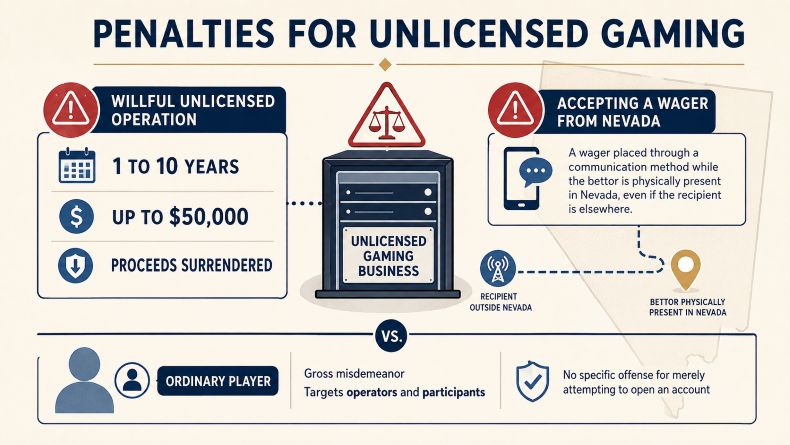
Elevated criminal penalties: SB 256 reclassified violations that were previously misdemeanors as felonies. Category B felony classification carries a minimum prison term of one year and a maximum of 10 years. Fines reach up to $50,000 per offense. The statute also covers persons who “conspire to violate” its provisions. That language reaches payment processors, marketing affiliates, and compliance personnel who knowingly support a Nevada-accessible prize platform.
Extraterritorial reach: SB 256 gave Nevada authority to pursue unlicensed operators based outside the state. Under SB 256, an out-of-state operator is subject to Nevada enforcement if Nevada residents play on that platform. Physical presence in Nevada is not required for liability to attach. This provision directly targets sweepstakes platforms headquartered outside Nevada.
Profit disgorgement: SB 256 requires courts to order forfeiture of all profits, gains, and gross receipts from illegal gaming activity. Forfeited funds go to the Nevada General Fund. This provision eliminates the financial logic of serving Nevada players. Any revenue earned from Nevada players must be returned.
What SB 256 Did Not Change
SB 256 is an enforcement-strengthening statute, not a sweepstakes-specific prohibition by name. The dual-currency model was already outside Nevada’s licensing framework under NRS Chapter 463 before SB 256. What changed was the risk-reward calculation.
Before SB 256, a sweepstakes operator accessible to Nevada players faced lower penalty exposure. After SB 256, the same operator faces felony-level criminal exposure, complete profit disgorgement, and extraterritorial liability. That combination made maintaining Nevada access irrational for any operator seeking compliance.
Montana SB 555 as the Template
Nevada’s SB 256 arrived in the wave of state enforcement actions that followed Montana SB 555. Montana SB 555 was the first explicit US sweepstakes casino ban. Governor Gianforte signed Montana SB 555 on May 12, 2025. Montana SB 555 also took effect on October 1, 2025. The Montana framework was cited in legislative discussions across multiple states during 2025 and 2026. California, Connecticut, New Jersey, and Indiana all enacted enforcement measures targeting the dual-currency model within months of Montana’s action.
Penalties and Why Operators Left Nevada
SB 256’s penalty structure explains the operator exodus from Nevada better than any regulatory announcement. Operators did not exit because the NGCB issued a public statement. Operators exited because staying accessible to Nevada players became legally and financially indefensible.
Category B Felony Exposure
Under SB 256, operating an unlicensed gambling platform accessible to Nevada residents is a Category B felony. A Category B felony in Nevada carries a minimum prison term of one year and a maximum of 10 years. Fines reach up to $50,000 per offense. The statute covers persons who “conspire to violate” its provisions. That language extends liability to payment processors, compliance personnel, and promoters.
Multiple violations compound penalties. A platform accessible to Nevada players over multiple months faces compounding exposure across each period of violation.
Disgorgement of All Profits
SB 256 authorizes Nevada courts to order disgorgement of every profit, gain, and gross receipt derived from illegal gaming activity. Disgorged funds go to the Nevada General Fund. This provision eliminates the economic logic of serving Nevada players entirely.
An operator that earned revenue from Nevada players before exiting does not keep that revenue if later pursued. Nevada courts can require the full amount be forfeited. This retroactive exposure turns any prior Nevada presence into a liability.
Extraterritorial Liability
SB 256’s extraterritorial provision is the mechanism that drove the majority of operator exits. A sweepstakes platform based outside Nevada faces Nevada enforcement if Nevada residents play on that platform. The operator’s physical location does not matter. What matters is whether Nevada-located players accessed the platform.
This provision is also the reason this page carries no operator links or affiliate CTAs. Promoting or linking to a prize platform accessible to Nevada players creates exposure under SB 256’s conspiring language. Clovr’s Nevada guide covers the legal framework only.
Operator Exits From Nevada
Multiple sweepstakes platforms exited Nevada ahead of or immediately following SB 256’s October 1, 2025 effective date. These exits are reported here as evidence of the law’s effect, not as a directory of former options:
- RubySweeps exited Nevada in August 2025, ahead of the October effective date. The platform cited “changes in Nevada” in communications to affected users.
- Zula Casino restricted Sweeps Coin game availability for Nevada-located accounts.
- Chumba Casino and LuckyLand Slots geo-blocked Nevada players in 2025. Affected accounts were closed without a withdrawal window. Pending balances became inaccessible.
- Stake.us, Pulsz, and Global Poker list Nevada in their excluded territories. None of these platforms accepts Nevada-located registrations.
The pattern across all exits was the same. Operators removed Nevada access without announcing a timeline. Players with active accounts and pending balances lost access when the geo-block activated.
Which Sweepstakes Sites Still Work in Nevada
No reputable sweepstakes casino offers Sweeps Coins prize redemption to players located in Nevada in 2026. The list of compliant operators accepting Nevada players is empty.
How Geolocation Governs Access
Sweepstakes platforms determine player eligibility by physical location at the time of play, not by state of residency. A device with a Nevada IP address triggers a geolocation block during account registration. GPS location at the verification stage produces the same result.
This means:
- A Nevada resident who travels to a permissive state may access a platform from that location.
- A visitor to Nevada from a permissive state will be blocked while physically in Nevada.
- Residency does not override geolocation. Location at the time of play is what controls.
Geofencing operates at the device level. A player cannot resolve a Nevada block by changing browser settings or adjusting location permissions manually.
What It Means If a Site Still Accepts Nevada Players
Any prize redemption platform accessible to Nevada-located players in 2026 is in one of two situations. Either the platform is failing to geolocate correctly, or the platform is knowingly ignoring Nevada law. Neither situation provides the player with legal protection.
A pending Sweeps Coin balance on a non-compliant platform becomes legally unclaimable. Under NRS 463.150, unauthorized gaming agreements are unenforceable in Nevada courts. The player has no recourse to recover a balance held on an unauthorized platform.
Do not attempt to bypass geolocation controls using a VPN or similar tool. Circumventing location verification violates the operator’s Terms of Service. It may also create exposure under Nevada statutes on false identification in gaming contexts (NRS 463.368).
If You Hold an Existing Balance
If you hold an account on a sweepstakes platform that is still accessible in Nevada, attempt to redeem any available Sweeps Coin balance now. Contact the operator’s support team to confirm your eligibility to redeem. After a geo-block is applied, recovery of an existing balance is rarely possible. NRS 463.150’s unenforceability provision means Nevada courts cannot compel an unauthorized platform to honor a prize obligation.
What Nevada Players Can Play Legally Instead
Nevada residents are not without options for casino-style entertainment. Two categories of legal play exist: Gold-Coin-only social casinos and Nevada-licensed online poker.
Gold-Coin-Only Social Casinos
Gold-Coin-only social casinos are entertainment platforms that operate on a single currency with no cash value. Players use Gold Coins to play casino-style slot games, table games, and other formats. No Sweeps Coins exist on these platforms. No cash prize redemption is possible. No element of the three-element gambling test applies under NRS Chapter 463.
Gold-Coin-only play is the legally defensible entertainment option for Nevada residents. It provides casino-style gameplay without the legal complications of the dual-currency model.
Clovr does not rank or link specific Gold-Coin-only social casinos on this page. Nevada residents seeking social casino options should look for platforms explicitly marketed as Gold-Coin-only. Confirm the absence of any Sweeps Coins or prize redemption before registering. Players must be 21 or older. For operator reviews in states where the dual-currency model is legally accessible, Clovr’s sweepstakes casino coverage is at clovr.com/sweepstakes-casinos/.
Licensed Online Poker in Nevada
Nevada permits one form of real-money online gaming: online poker, under NRS 463.016425. This statute authorizes interactive gaming licenses covering poker specifically. The Nevada Gaming Control Board maintains a public list of active licensees at gaming.nv.gov.
As of the date of this publication, two operators hold active Nevada interactive gaming licenses:
- Real Gaming, operating under South Point Poker branding
- WSOP, operated by Caesars Interactive Entertainment
Both platforms require Nevada residency or physical presence verification. Both operate under full NGCB regulatory oversight. Age verification confirms players are 21 or older before play begins.
What Is Not Available in Nevada
Nevada’s interactive gaming license is deliberately narrow. The license covers online poker only. The following categories of online gaming are not available under Nevada’s current framework:
- Online casino games (slots, reel games, video poker as a standalone product)
- Online blackjack, roulette, baccarat, or live table games
- Standalone online sportsbooks operating independently of a licensed land-based Nevada operator
Nevada allows land-based sportsbooks and licensed mobile sports betting through casino operators. Online-only sportsbooks of the kind available in Colorado, New Jersey, or Tennessee are not separately licensed in Nevada.
The legal online gaming menu available to Nevada residents is narrower than many expect. Gold-Coin-only social entertainment and online poker via two licensed operators are the practical options.
How Nevada Compares to California, Arizona, and Utah
Nevada is one of four Western states where sweepstakes casino access is restricted or legally contested as of mid-2026. Each state reached its current position through a different mechanism.
Western States | Sweepstakes Casino Access Compared
| State | Status | Mechanism | What It Means for a Traveling Player |
|---|---|---|---|
| Nevada | Not legally accessible | SB 256 (Oct 1, 2025) + NRS Chapter 463 enforcement | All major operators block NV by geolocation |
| California | Not legally accessible | AB 831 (Jan 1, 2026); misdemeanor liability for operators and affiliates | All major operators exited by Dec 31, 2025 |
| Arizona | Legally contested; high risk | No statute; ADG cease-and-desist waves (April, June, August 2025) | Some operators accept AZ; several majors withdrew |
| Utah | High risk; avoid | No sweepstakes statute; strict constitutional anti-gambling posture; private right of action | Operator practice is mixed; litigation exposure applies |
California
California AB 831 took effect January 1, 2026. Governor Gavin Newsom signed AB 831 on October 11, 2025. AB 831 is an explicit statutory prohibition. The law extends misdemeanor criminal liability to operators, payment processors, geolocation providers, gaming content suppliers, and media affiliates. It is the broadest affiliate-liability statute in the current US sweepstakes ban wave. All major sweepstakes operators exited California by December 31, 2025. California previously represented approximately 17 to 20 percent of the US sweepstakes casino market.
Arizona
Arizona has no statute specifically banning sweepstakes casinos as of April 2026. However, the Arizona Department of Gaming (ADG) issued three waves of cease-and-desist orders to sweepstakes operators in 2025, in April, June, and August. The ADG treats unlicensed sweepstakes platforms as potential violations of Arizona gambling statutes. Several major operators received ADG orders and withdrew from Arizona. Other operators continue to accept Arizona players. The legal status is contested rather than banned. Players in Arizona face elevated enforcement risk compared to permissive states. The ADG has stated it may pursue further enforcement in partnership with the Arizona Attorney General’s Office.
Utah
Utah has no sweepstakes-specific statute. The state constitution holds one of the strictest anti-gambling postures in the country. Utah law includes a private right of action. Individuals can pursue operators and promoters of gambling-adjacent products through civil litigation. This creates litigation exposure that most operators treat as prohibitive. Operator practice in Utah is mixed. The litigation risk makes Utah effectively high-risk regardless of whether a formal cease-and-desist has been issued.
The Fast-Moving Picture
The legal status of sweepstakes casinos across the United States is shifting. Montana SB 555 served as the legislative template, and multiple additional states were examining or advancing prohibition measures as of mid-2026. The neighboring-state comparison above reflects the status at the time of this article’s last update. Verify current state-by-state status before acting on this information.
One adjacent matter worth noting: KalshiEX v. Nevada (No. 25-7516) is pending before the Ninth Circuit. The case involves prediction markets, not sweepstakes casinos. The legal questions are adjacent to Nevada’s unlicensed-gaming debate but do not directly affect sweepstakes casino legality under NRS Chapter 463 or SB 256. The Ninth Circuit heard oral arguments on April 16, 2026. A ruling is pending.
The Bottom Line
Nevada is the most restrictive US state for sweepstakes casino access in 2026. SB 256 raised the penalty to felony level, extended Nevada’s reach to out-of-state operators, and authorized court-ordered disgorgement of all profits. No reputable operator offers prize redemption to Nevada-located players. The legally defensible alternatives for Nevada residents are Gold-Coin-only social play for entertainment and licensed online poker via Real Gaming or WSOP.
Frequently Asked Questions
-
Is it illegal for Nevada residents to play sweepstakes casinos?
No Nevada statute criminalizes a resident for playing on a sweepstakes casino. SB 256 targets operators, payment processors, and promoters, not individual players. The practical risk is different. Operators block Nevada, so accounts get frozen, identity verification fails, and prizes become unclaimable. Playing on a platform that should not accept Nevada players leaves the player with no legal protection if something goes wrong.
-
Can I still redeem my coins or prizes after a sweepstakes casino exits Nevada?
Usually no. When an operator geo-blocks Nevada, account access is typically removed without advance notice. Under NRS 463.150, any agreement involving unauthorized gaming activity is unenforceable in Nevada courts. A pending Sweeps Coin balance becomes legally unclaimable after the geo-block is applied. If you hold a balance on a platform still accessible to Nevada players, attempt redemption before any announced exit date. After geo-blocking, recovery is rarely possible.
-
What is SB 256?
SB 256 is a 2025 Nevada law (Chapter 337, 83rd Session) that strengthened enforcement against unlicensed gambling operators. SB 256 was signed by Governor Lombardo on June 6, 2025 and took effect October 1, 2025. The law raised criminal exposure to Category B felony level. It extended Nevada’s jurisdiction to out-of-state operators accepting Nevada players. Courts were authorized to order disgorgement of all profits to the state General Fund.
-
Are Gold Coin social casinos legal in Nevada?
Yes. Gold-Coin-only social casinos use a single entertainment currency with no cash value and no prize redemption. No prize of real value exists. The activity falls outside Nevada’s gambling definition under NRS Chapter 463. Gold-Coin-only play is the legally defensible entertainment alternative for Nevada residents who want casino-style games without prize exposure. Players must be 21 or older.
-
Is online poker legal in Nevada?
Yes. Online poker is legal in Nevada under NRS 463.016425. The interactive gaming license covers poker only. Two operators hold active Nevada interactive gaming licenses: Real Gaming (South Point Poker) and WSOP (Caesars Interactive Entertainment). Online casino games including slots, blackjack, and roulette are not authorized under Nevada’s interactive gaming license. Standalone online sportsbooks are also not separately licensed.
-
Are sweepstakes prizes taxable for Nevada residents?
At the federal level, yes. Sweepstakes cash prizes are reportable income under federal tax law regardless of state of residency. Nevada has no state income tax, so no state-level reporting obligation applies to Nevada residents. For players with prior winnings from before operator exits, federal reporting obligations remain. This question is moot for active play while Nevada remains blocked by all compliant operators.
Related reading:
Think You’ve Got a Gambling Problem? Call or text the National Council on Problem Gambling helpline: 1-800-522-4700 (24/7, confidential).
Last updated: July 2026 | Clovr.com