This page contains no affiliate links for New Mexico readers. The operator reference table below is informational only and does not constitute a recommendation to play. Clovr.com is an independent sweepstakes casino review platform.

Are Sweepstakes Casinos Legal in New Mexico?

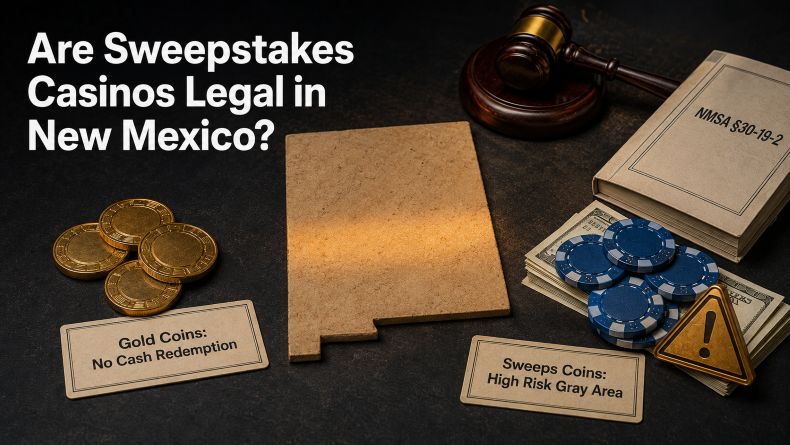
The New Mexico Gaming Control Board (NMGCB) publicly classifies sweepstakes casinos as illegal online gambling under NMSA §30-19-2. No dedicated ban statute exists. No New Mexico player has been prosecuted. New Mexico is a hostile-regulator gray area as of 2026.

Three facts anchor this verdict:

  • The NMGCB has issued a public notice declaring sweepstakes casinos, social casinos, and online real-money gaming illegal in New Mexico.
  • NMSA §30-19-2 defines gambling broadly, and the NMGCB applies that definition to sweepstakes platforms.
  • The default minimum age on New Mexico-facing sweepstakes platforms is 21+.

The legal risk is real on paper. Enforcement in New Mexico has targeted operators, not individual players. No player prosecution under §30-19-2 has been recorded as of mid-2026. The NMGCB’s stance shapes how NM financial institutions treat sweepstakes platform transactions.

Redeeming Sweeps Coins (SC) is the action most directly within the NMGCB’s reading of the statute. Playing in Gold Coin (GC) mode only, without SC redemptions, is the most defensible option for NM residents. Clovr covers the governing statute, dual-currency mechanics, consumer risks, tax rules, and a neutral platform reference throughout this guide.

Are Sweepstakes Casinos Legal in New Mexico?

The New Mexico Gaming Control Board regulates racinos and non-tribal gaming in New Mexico. Tribal gaming operates under separate federal compacts outside the NMGCB’s jurisdiction. The NMGCB has published a public notice stating online real-money gambling is illegal in New Mexico. That notice covers online casinos, poker sites, sweepstakes casinos, and social casinos explicitly.

The NMGCB notice cites NMSA §30-19-2 as the operative statute. It also references UIGEA, the federal Unlawful Internet Gambling Enforcement Act, as background law. The notice applies to both operator conduct and player participation in New Mexico. The board’s classification carries practical weight within its jurisdiction, even without a court order.

NMSA §30-19-2 sits within Section 30-19 of the New Mexico Statutes Annotated. It defines gambling as risking something of value on a chance outcome for a prize. The NMGCB applies this definition to sweepstakes casino participation. Section 30-19 does not include a broad carve-out for promotional gaming products.

No New Mexico court has ruled on whether sweepstakes casinos fall inside §30-19-2. The NMGCB’s administrative classification shapes how NM payment processors may treat sweepstakes transactions. NM residents may encounter payment processing friction when funding sweepstakes accounts. This friction is a direct consequence of the board’s public notice.

The federal Unlawful Internet Gambling Enforcement Act (31 USC §5361) restricts payment processing for unlawful internet gambling. UIGEA does not itself ban no-purchase promotional activities. UIGEA is not the operative New Mexico prohibition. The governing authority for NM residents is NMSA §30-19-2 as applied by the NMGCB.

New Mexico Attorney General Opinion 2025-07 addressed the Jackpocket lottery courier service. That opinion demonstrated the state’s willingness to issue formal legal positions on online gaming products. It signals that NM regulators treat new digital gaming formats as within their authority to evaluate. The NMGCB’s public notice on sweepstakes casinos reflects the same regulatory posture.

Sweepstakes casino operators accepting NM players have made a business decision. The NMGCB’s administrative notice does not function as an enforceable ban backed by court order. No operator has been formally prosecuted under §30-19-2 in New Mexico as of mid-2026. This gap is why NM residents can access these platforms while the regulator declares them illegal.

New Mexico has not passed a dedicated statute banning sweepstakes casinos. No targeted bill had been introduced in the NM legislature as of mid-2026. The NMGCB’s classification rests on §30-19-2’s broad gambling definition. The legal status could shift if a court adjudicates the conflict between §30-19-2 and the operators’ 12.2.2 NMAC defense.

The absence of dedicated legislation does not make sweepstakes casinos lawful in NM. The classification fight is happening at the regulatory level rather than through a targeted ban. NM players who access these platforms operate under a statute the NMGCB has already applied to their activity. Participants assume the legal risk described throughout this guide.

The Three-Element Gambling Test Under NMSA §30-19-2

NMSA §30-19-2 defines gambling using a three-element test. All three elements must be present for an activity to qualify as gambling under the statute:

  • Prize: a reward of value is available to participants
  • Chance: the outcome is determined by random means
  • Consideration: the participant provides something of value to enter

Sweepstakes platforms satisfy the first two elements without dispute. Casino-style games produce prizes. Random number generators determine results. The entire legal contest focuses on the third element, consideration.

Operators attack consideration through the alternate method of entry (AMOE). AMOE is a free entry route that distributes Sweeps Coins without any purchase. If a player enters through AMOE without spending money, no consideration exists, operators argue.

The NMGCB’s public notice implies it does not accept the AMOE argument as dispositive. The board treats sweepstakes casino participation as satisfying all three elements of §30-19-2. The NMGCB reads the availability of a paid entry path as preserving the consideration element.

This position has not been tested in a New Mexico court. It remains an administrative interpretation pending judicial review. A court ruling either way would resolve the conflict between §30-19-2 and the operators’ game-promotion theory.

Why Operators Claim They Are Legal in New Mexico

Sweepstakes casino operators cite New Mexico’s consumer protection framework, 12.2.2 NMAC, as their legal basis. That regulation governs “game promotions” requiring no consideration to enter. Operators structure their platforms around 12.2.2 NMAC by making AMOE a functional free-entry path, not a nominal option.

The operators’ argument runs on two tracks. First, AMOE removes consideration from the three-element test. A player who enters through AMOE provides nothing of value. On this reading, no gambling has occurred under §30-19-2.

Second, the product qualifies as a “game promotion” under 12.2.2 NMAC. This classification places it outside §30-19-2 and outside the NMGCB’s gambling jurisdiction entirely. Operators maintain that consumer law governs their products, not gaming law.

The NMGCB’s public notice rejects this framing. The board classifies sweepstakes platforms as online gambling regardless of how they structure their entry routes. The conflict between 12.2.2 NMAC and §30-19-2 has not been resolved by a New Mexico court. Neither interpretation constitutes settled law as of mid-2026.

Players cannot rely on the operators’ legal argument as personal protection. The NMGCB’s administrative position determines how New Mexico enforces its gaming laws. Until a court rules otherwise, the board’s reading governs for NM residents.

Gold Coins vs. Sweeps Coins | How the Model Works

Sweepstakes casinos use a dual-currency system. Two separate virtual currencies govern every platform. Their separation is the legal architecture operators use to argue their product is a promotional game, not gambling.

Gold Coins (GC) are free entertainment currency with no cash value and no redemption path. Players acquire GC through welcome bonuses, daily login rewards, social media follow promotions, and optional purchase bundles. GC play produces no prize and no taxable event.

Most platforms award a GC welcome package on registration without any purchase required. Daily login bonuses add GC to player balances automatically. Platforms may also award GC for email verification, social media engagement, or referral activity.

GC bundles sold for real money include SC as a bonus component. The GC portion itself has no cash value.

Sweeps Coins (SC) are promotional prize currency redeemable for cash or gift card prizes. SC cannot be directly purchased. Players receive SC through AMOE free-entry routes, as bonus allocations bundled with GC purchases, and through platform promotions. The redeemability of SC is the step that most directly implicates §30-19-2 under the NMGCB’s reading.

SC redemptions require identity verification before payout is processed. Most platforms set a minimum redemption threshold, often around 100 SC. Redemptions are processed as ACH bank transfers or gift card disbursements. The redemption step is where the NMGCB’s prize element analysis most clearly applies.

SC appear under different branded names across different platforms. WOW Vegas uses Wow Coins, Stake.us uses Stake Cash, and Pulsz uses Pulsz Coins. These branded SC variants are functionally equivalent to Sweeps Coins under a different label.

The same dual-currency mechanics and the same NM legal considerations apply regardless of what each platform calls its redeemable currency. A Stake.us player holding Stake Cash is in the same legal position as any SC holder on another sweepstakes platform. Recognizing these aliases prevents confusion about which currency carries redeemable value.

AttributeGold Coins (GC)Sweeps Coins (SC)
Cash valueNoneYes, redeemable for cash or gift cards
How acquiredPurchase bundles, daily login, bonuses, social followsAMOE (free), bundled with GC purchases, promotions
Redeemable for cashNoYes
Purchasable directlyYesNo
NM legal exposure under §30-19-2Minimal (no prize element)Elevated (triggers prize element reading)

No Purchase Necessary and the AMOE Route

The alternate method of entry (AMOE) is the mechanism operators use to remove consideration from the three-element test. AMOE allows players to request free SC by mail. Players can also claim a small free daily SC allocation without any purchase.

Mail-in AMOE requests involve sending a handwritten postcard or letter to the operator’s designated address. The operator processes the request and credits SC to the player’s account. The mail-in route is slower than the daily free-credit option. Both routes deliver SC without requiring a financial transaction.

AMOE must be a genuine, functional option to support the operators’ game-promotion argument under 12.2.2 NMAC. A nominal or difficult-to-access AMOE route weakens the “no consideration” defense. Most major platforms maintain a working AMOE route to preserve their promotional-game classification.

The NMGCB’s position implies AMOE does not cure the §30-19-2 classification. The board applies the statute to the sweepstakes model as a whole. The presence of a free entry route does not, in the board’s reading, remove consideration from the overall product.

Gold Coin-Only Mode as the Safe-Harbor Option

Gold Coin-only play means using GC exclusively with no SC accumulation or redemption. GC carry no cash value and no prize redemption path. GC play removes the prize element from the three-element test. Without a prize element, the NMGCB’s §30-19-2 analysis has less direct application.

Most sweepstakes platforms allow players to operate in GC-only mode by simply ignoring SC allocations. Players can accept GC daily bonuses and login rewards without engaging the SC system. This eliminates the SC redemption step that most directly implicates §30-19-2. No financial transaction is required to access GC-mode play.

Players who want social casino entertainment without SC exposure can treat sweepstakes platforms as pure free-play apps. No purchase is required for GC play on any major platform. GC-mode participation does not trigger NM tax withholding.

Clovr’s guidance for New Mexico residents who choose to access these platforms is to use GC-only mode. This is the most defensible approach available under the NM regulatory framework as of 2026. GC-only mode does not guarantee legal protection, but it substantially reduces the exposure the NMGCB’s notice creates.

What Gambling Is Actually Legal in New Mexico

New Mexico has an authorized set of gambling activities operating under state and federal law. Sweepstakes casinos are not part of this authorized set. Understanding what is legal clarifies why sweepstakes platforms occupy contested territory. The gap between NM’s authorized and unauthorized gambling is central to the NMGCB’s enforcement posture.

Authorized gambling activities in New Mexico include:

  • Tribal casinos operating under tribal-state gaming compacts
  • Racetrack casinos (racinos) regulated by the NMGCB
  • The New Mexico State Lottery
  • Charitable bingo and raffle events licensed by the state
  • Pari-mutuel horse racing and simulcast wagering
  • Online advance-deposit horse and greyhound race wagering
  • Daily fantasy sports (DFS) operating under skill-game theory

Tribal Gaming and the Compact Structure

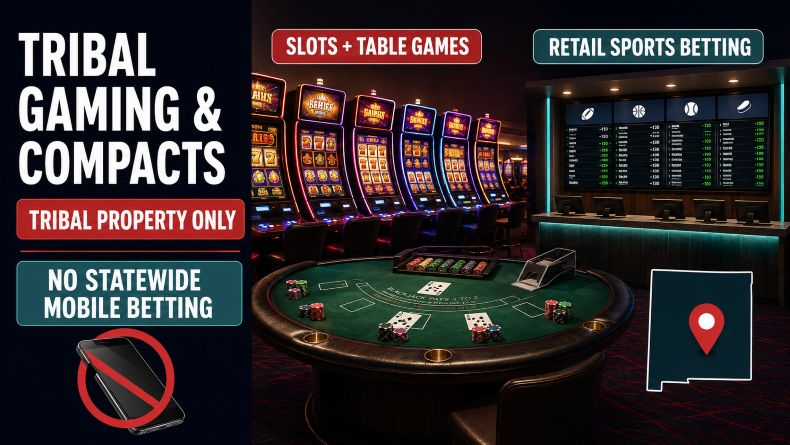
New Mexico’s casino sector is dominated by tribal gaming. Native American tribes operate Class III gaming under tribal-state gaming compacts. This covers slot machines, table games, and retail sportsbooks. These compacts are authorized by the Indian Gaming Regulatory Act (IGRA), the federal framework governing gaming on tribal lands.

IGRA requires tribes and states to negotiate compacts for Class III gaming. New Mexico’s compacts grant tribes significant exclusivity over casino-style gaming within the state. That exclusivity is the primary reason NM has not moved to regulate commercial online casino gaming. Authorizing online casinos would compete directly with tribal operations the compacts protect.

The Pueblo of Isleta, the Navajo Nation, and other NM tribes operate gaming facilities under state compacts. Each compact specifies authorized game types, revenue sharing terms, and exclusivity zones. The exclusivity provisions mean any NM legislative effort to authorize commercial online gaming would face tribal opposition. State legislative action would likely require compact renegotiation with tribal consent.

Retail sports betting at tribal facilities is the only form of sports wagering legally available to NM residents. No mobile or online sports wagering is authorized for NM residents outside a tribal property. NM tribal casinos generally require players to be 21+.

Racinos and NMGCB Jurisdiction

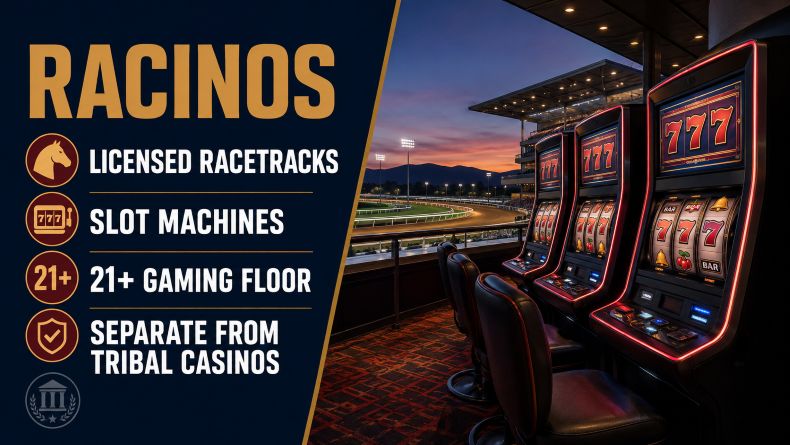
Racetrack casinos, called racinos, operate slot machines at licensed horse-racing tracks under state gaming statutes. The NMGCB regulates racinos directly. This gives the board direct authority to define and enforce gambling law in its regulated space. Racinos represent the primary non-tribal slot gaming authorized in New Mexico.

NM racinos operate at tracks in Albuquerque, Santa Fe, Raton, and other locations across the state. Players must be 21+ to access racino gaming floors. Racino slot gaming operates under a separate authorization from tribal compact gaming. The NMGCB’s regulatory oversight of racinos is distinct from its role in classifying unregulated platforms like sweepstakes casinos.

The New Mexico State Lottery and Charitable Gaming

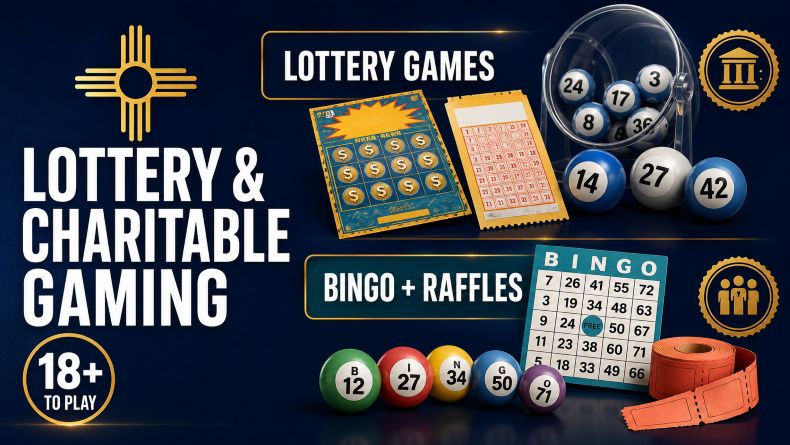
The New Mexico State Lottery operates under state statute and offers draw games, instant scratch tickets, and multi-state lottery games. NM Lottery players must be 18+. Lottery proceeds fund educational programs under NM law. The Lottery operates under a separate state agency, not the NMGCB.

Charitable gaming in New Mexico covers bingo and raffle activities conducted by licensed nonprofit organizations. These events operate under separate charitable gaming regulations, not NMGCB jurisdiction. Qualifying charities obtain licenses from the NM Regulation and Licensing Department. Prize limits and conduct requirements apply under NM charitable gaming law.

Horse Racing and Daily Fantasy Sports

Pari-mutuel horse racing and simulcast wagering are authorized in New Mexico under the Horse Racing Act. NM racing facilities offer live and simulcast wagering on thoroughbred, quarter horse, and other races. Online advance-deposit wagering platforms allow NM residents to fund accounts and wager on horse races remotely. These platforms are licensed at the federal or state level depending on their structure.

Daily fantasy sports (DFS) operators have accepted NM players under a skill-game legal theory. NM has not enacted legislation specifically legalizing or banning DFS. The legal status of DFS in New Mexico is not formally resolved by statute or court ruling. DFS operators treat NM as an accessible state pending any legislative or judicial clarification.

Risks New Mexico Players Should Understand

New Mexico residents who access sweepstakes casino platforms face several concrete risks beyond the NMGCB’s general classification. These risks are specific to NM law and the sweepstakes model. Understanding them before deciding whether or how to participate is essential. Each risk category is covered in its own subsection below.

Petty Misdemeanor Exposure

Participating in gambling prohibited under NMSA §30-19-2 is classified as a petty misdemeanor in New Mexico. The theoretical penalty is up to 15 days in jail or a $500 fine. This exposure applies to the player’s participation, not only to operator conduct.

No player enforcement action under this theory has been recorded as of mid-2026. Enforcement in New Mexico has targeted operators and payment processors, not individual players. The absence of player prosecutions does not create a legal exemption. NMSA §30-19-2 carries no player carve-out.

NM residents who redeem SC remain within the statute’s scope under the NMGCB’s reading. SC redemption is the step that most directly satisfies the prize element of §30-19-2. Players who limit activity to GC-only mode reduce their exposure significantly.

The NMGCB’s enforcement history shows no formal action against individual sweepstakes players. State resources have focused on unlicensed operators rather than consumer participants. This enforcement pattern reflects practical prioritization, not a legal safe harbor for players.

Void Contracts and No Legal Recourse

New Mexico treats gambling contracts as void under state law. A sweepstakes platform the NMGCB classifies as illegal operates outside any enforceable legal arrangement with NM participants. If an operator withholds a redemption, the player has no state regulatory remedy. The NMGCB does not license sweepstakes platforms and does not handle complaints against them.

No NM court will enforce a void gambling contract. Players cannot sue in NM state court to recover withheld redemptions from a platform the NMGCB classifies as illegal. This is a concrete consumer risk with no current legal remedy in New Mexico.

Platform operators may also close NM accounts if their legal team determines that NM regulatory risk has increased. An operator account closure before redemption leaves the player with no path to recover SC balances. This risk is distinct from the misdemeanor exposure described above.

Players should maintain records of all SC redemptions completed. Documentation supports any informal dispute process with a platform. No formal legal remedy exists in NM, but complete records improve the chance of an informal resolution.

Age Requirement | 21+

The default minimum age on New Mexico-facing sweepstakes platforms is 21+. This aligns with NM tribal casino and racino age requirements. A minority of platforms list 18+ for some jurisdictions.

Players should confirm the minimum age applicable to their specific account at each platform before registering. Age verification occurs at account creation on most platforms. Platforms permitting 18+ accounts in other states may still apply a 21+ gate in NM given the NMGCB’s notice.

KYC and Identity Verification

Sweepstakes platforms require KYC (know your customer) identity verification before processing a first SC redemption. KYC typically involves submitting a government-issued photo ID, confirming age, and confirming residential address. Third-party identity verification vendors process these submissions on behalf of the platforms. KYC gates the redemption step and enforces the 21+ age minimum.

New Mexico is not on most platforms’ standard blocked-states list. Passing KYC in New Mexico does not create a legal exemption under §30-19-2. KYC confirms identity only. It does not alter the NMGCB’s classification of the underlying activity.

Players who provide fraudulent identity information during KYC expose themselves to additional legal risk beyond the §30-19-2 misdemeanor exposure. KYC documentation may also be subpoenaed if a regulatory action is ever initiated against an operator. Providing accurate information is the appropriate approach regardless of the state’s legal posture.

Responsible Gaming

Sweepstakes platforms offer responsible gaming tools including purchase limits, session time reminders, self-exclusion options, and cooling-off periods. These tools are available in both GC and SC modes. Players experiencing difficulty managing their play can activate these tools through the platform’s account settings. Setting purchase limits before problems arise is the most effective use of these tools.

Players experiencing difficulty managing play can contact the National Problem Gambling Helpline at 1-800-522-4700. The helpline is free, confidential, and available 24 hours a day.

Taxes on Sweepstakes Prize Redemptions in New Mexico

Sweeps Coin redemptions are the taxable event for NM sweepstakes players. GC play produces no tax obligation. GC have no cash value and are never redeemed for prizes.

A player does not need to accept the NMGCB’s classification to have a tax obligation. SC redemptions that constitute income are taxable under federal and NM law. This tax obligation exists regardless of how the underlying activity is classified.

Operators are responsible for collecting and remitting withholding on qualifying payouts. Players should confirm whether the platform they use is compliant with US tax reporting obligations before redeeming. Non-compliant operators may issue no forms and remit no withholding, leaving the full tax burden on the player.

New Mexico State Tax Withholding

New Mexico applies a 6% state withholding rate to reported gambling-type payouts above applicable thresholds. This withholding is credited against a player’s annual NM income tax return. Verify this rate with the NM Taxation and Revenue Department before publishing. The rate is subject to change by legislative action.

New Mexico taxes gambling income at individual income tax rates ranging from 1.5% to 5.9%, depending on income bracket. The withholding rate and the final tax liability may differ. Players who owe less than the withheld amount receive a credit on their NM state return.

NM residents who redeem SC in significant amounts should track cumulative redemption totals throughout the calendar year. A tax professional should be consulted if annual totals approach applicable NM reporting thresholds. GC play carries no parallel state tax obligation.

Federal Withholding and Reporting

The IRS requires 24% backup withholding on prize payouts above IRS reporting thresholds. Operators issue Form W-2G or Form 1099-MISC for qualifying cumulative SC redemptions in a calendar year. Players report this income on Form 1040 alongside their federal return.

The specific W-2G and 1099-MISC reporting thresholds are set by the IRS, not by New Mexico law. They vary by game type and prize amount. Players who receive either form should report the income accurately on both state and federal returns.

Federal withholding and NM state withholding apply simultaneously on the same SC redemption. Players receive credit for both withholding amounts when filing their respective returns. Combined withholding can reduce the net payout from a large SC redemption significantly.

Record Keeping for NM Players

NM players who redeem SC should maintain records of every redemption event. Records should include the date, the SC amount, the platform name, and the cash or gift card value received. These records support accurate tax reporting and any IRS or NM audit. Digital screenshots of redemption confirmations serve as adequate documentation.

Operators may not always issue a tax form for smaller redemptions that fall below IRS thresholds. Players remain responsible for reporting all taxable income regardless of whether a form is issued. Keeping personal records ensures no reportable income is missed.

How Sweepstakes Casinos Differ From Online Gambling

Sweepstakes casinos and real-money online casinos offer similar slot-style and card games. The game mechanics may look identical on screen. The legal classification depends on the currency model, not the game design. Understanding the distinction explains why sweepstakes platforms occupy contested legal ground rather than a clear exemption or a clear prohibition.

Real-money online casino operators require a state gaming license to serve players lawfully. Sweepstakes operators claim their products fall outside gaming law under the game-promotion theory. This licensing difference is the core of the dispute that NM regulators and operators are fighting over. The NMGCB’s position is that the distinction does not hold under §30-19-2.

FeatureSweepstakes CasinoReal-Money Online Casino
Currency modelGC (entertainment) + SC (promotional prize)Direct cash wager
Purchase-to-prize linkIndirect. SC cannot be purchased directlyDirect. Wager wins or loses cash
NM licensing requiredOperators claim none required under game-promotion theoryNM gaming license required for lawful operation
NM legal statusNMGCB classifies as illegal under §30-19-2Unlicensed operation is unambiguously illegal

Real-money online casinos operating without a New Mexico gaming license are unambiguously illegal in NM. No state has licensed real-money online casinos that serve NM residents as of 2026. Offshore online casinos operate without any US regulatory oversight. NM residents who use offshore operators face higher risk of non-payment, data exposure, and zero consumer protection recourse.

Clovr does not recommend or link to offshore casino operators. Offshore platforms are not subject to US consumer protection law. The void-contract risk is even more acute with offshore operators. These platforms have no US presence to pursue legally.

The sweepstakes legal theory rests on the argument that SC are promotional prizes, not gambling payouts. This distinction is meaningful in states where the theory has not been formally challenged. In New Mexico, the NMGCB has rejected this distinction at the administrative level. The theory remains unresolved in NM courts.

Progressive jackpot and blackjack-style games appear on both sweepstakes and real-money platforms. On sweepstakes platforms, these games pay SC as prizes. The NMGCB’s §30-19-2 classification applies to the SC-paying version of any casino-style game. The game format does not change the legal analysis.

NM residents may encounter marketing language calling sweepstakes casinos free-to-play or not gambling. This language reflects the operators’ legal theory, not the NMGCB’s position. NM players should evaluate these descriptions in light of the board’s public notice before participating.

New Mexico’s hostile-regulator posture makes it one of the more restrictive environments for sweepstakes platforms among US states. Players in states with affirmative authorization face significantly lower legal risk than NM residents. The legal distinction between sweepstakes and online gambling is contested in many states but is especially pronounced in New Mexico.

Which Platforms Accept New Mexico Players in 2026

New Mexico is absent from the standard restricted-states list maintained by most sweepstakes casino operators. NM residents can typically sign up and access these platforms without technical restriction. This technical availability is separate from the legal question of whether participation is permitted under NMSA §30-19-2.

Access does not equal legality. The NMGCB classifies these platforms as illegal under §30-19-2. NM residents who participate accept the legal and financial risks described throughout this guide. Clovr presents the table below as a neutral availability reference only, not a ranked recommendation.

Operator availability, minimum ages, and product features change without notice. Verify each operator’s restricted-states list in their live terms of service before acting on this table. The operator’s own terms supersede any aggregator data or third-party review.

PlatformOperator FamilyNM AccessibleMin AgeGC-Only Mode
Mega BonanzaLuminaryPlay / B2ServicesYes (not on blocked list)21+Yes
McLuckB2ServicesYes21+Yes
Play FameB2ServicesYes21+Yes
PulszPulsz GroupYes (not on blocked list)18+/21+ (verify)Yes
WOW VegasVGWYes21+Yes
Stake.usStakeYes21+Yes
NoLimitCoinsNoLimitCoinsVerify live21+Yes
Hello MillionsMillionsGamingVerify live21+Yes
SpinBlitzSpinBlitzVerify live21+Yes
LoneStarLoneStarVerify live21+Yes
Crown CoinsCrown CoinsVerify live19+ (verify)Yes

Table notes:

  • Stake.us: Killham v. Stake litigation is open as of mid-2026. Verify current case status before publishing this row.
  • Pulsz: The age gate may vary by jurisdiction. Confirm the NM-specific minimum age before publishing.
  • Crown Coins: Minimum age listed as 19+ pending individual verification. Crown Coins appears last per editorial policy.
  • NoLimitCoins, Hello Millions, SpinBlitz, LoneStar: Include only after individual live NM verification against each operator’s ToS.
  • Excluded per editorial policy: Spree, Legendz.

Mega Bonanza, McLuck, and Play Fame share the B2Services operator infrastructure. WOW Vegas operates under VGW, one of the largest sweepstakes platform operators globally. These operator relationships matter for NM residents. A policy change at one brand may affect access across the operator family.

NM residents who choose to use these platforms should verify current terms of service independently. Using GC-only mode reduces legal exposure given the NMGCB’s notice. SC redemptions trigger NM tax withholding and the void-contract risk described above. Each operator row marked “Verify live” requires independent confirmation before relying on this table.

Clovr updates its operator reference tables when verified changes are confirmed. The table above reflects available information as of mid-2026. Players should treat this as a starting point for due diligence, not a guarantee of access or legality.

Frequently Asked Questions

  • Are sweepstakes casinos legal in New Mexico?

    No. The New Mexico Gaming Control Board classifies sweepstakes casinos as illegal online gambling under NMSA §30-19-2. No dedicated ban statute exists and no NM player has been prosecuted. Residents who access these platforms are in a hostile-regulator gray area and assume the associated legal risk.

  • What does the New Mexico Gaming Control Board say about sweepstakes casinos?

    The NMGCB has published a public notice stating online real-money gambling is illegal in New Mexico. The notice covers sweepstakes casinos and social casinos explicitly. The board cites NMSA §30-19-2 as the governing statute and references UIGEA as federal background law. The notice applies to both operator conduct and NM player participation.

  • Can I get in legal trouble for playing sweepstakes casino games in New Mexico?

    Theoretically yes. Participating in gambling under §30-19-2 is a petty misdemeanor with a maximum penalty of 15 days or $500. No player enforcement action has been recorded in New Mexico as of mid-2026. GC-only play with no SC redemptions reduces exposure.

  • Can New Mexico residents access these sites?

    Yes. New Mexico is absent from most operators’ standard blocked-states lists. NM residents can sign up and play on most major sweepstakes platforms. Access does not constitute legal authorization under NMSA §30-19-2.

  • How are sweepstakes winnings taxed in New Mexico?

    SC redemptions are subject to New Mexico’s 6% state withholding on reported payouts above applicable thresholds. Federal 24% backup withholding applies above IRS thresholds. Operators may issue Form W-2G or Form 1099-MISC for qualifying redemptions. Players report this income on their NM state return and federal Form 1040.

  • Has New Mexico taken enforcement action against sweepstakes operators or players?

    No recorded enforcement action against sweepstakes operators or players in New Mexico exists as of mid-2026. The NMGCB has issued a public warning notice. The NM Attorney General issued a formal opinion on a related online gaming product in 2025. The absence of enforcement does not create a legal exemption under NMSA §30-19-2.

Related reading:

Think You’ve Got a Gambling Problem? Call or text the National Council on Problem Gambling helpline: 1-800-522-4700 (24/7, confidential).

Last updated: July 2026 | Clovr.com

Casino of the Month

Star Rating Icon
80% Star Rating
  • Registration Bonus
  • 175,000 GC + 3 SC
  • No purchase necessary
  • 100% First Purchase Boost
  • Massive Refer a Friend Bonus
  • Exclusive VIP Offers
  • 10K+ Social Casino Games
Star Rating Icon
100% Star Rating
  • 100% Extra Coins
  • 750,000 GC + 40 SC
  • for $19.99
  • Sign-up, get 750,000 GC
  • Progressive Daily Prizes
  • Referral Bonus: 900K GC + 20 SC
  • Unlock VIP Levels
Star Rating Icon
100% Star Rating
  • First Purchase Offer
  • 2,000,000 GC and 100 SC
  • + 10 Free Plays for $49.99
  • Sign-up, Get 160,000 GC + 2 SC
  • Free Coins + 60 Free Plays Daily
  • Earn SC in Fortune Quests
  • 5,000 GC + 20 SC Referral Bonus
© Copyright 2026 Clovr.com