21+ to participate. This page is an informational legal explainer. It is not legal or tax advice.

Editorial disclosure: Oklahoma SB 1589 extends Class C2 felony liability to promoters and media affiliates who “deal or provide support” to dual-currency sweepstakes platforms in Oklahoma. Clovr, a sweepstakes casino and crypto casino affiliate review platform, lists no operator recommendations, rankings, or affiliate links for Oklahoma readers on this page. That is a direct consequence of SB 1589’s affiliate liability clause.

Key Takeaways

  • Dual-currency sweepstakes casinos are banned in Oklahoma under SB 1589, effective November 1, 2026.
  • SB 1589 amends Oklahoma Statutes Title 21 to reclassify dual-currency sweepstakes platforms as illegal gambling.
  • Criminal liability reaches operators, employees, geolocation providers, suppliers, platform providers, promoters, and media affiliates.
  • Oklahoma’s no-purchase-necessary (AMOE) defense does not apply. SB 1589’s “representative of value” redefinition neutralizes it.
  • IGRA-compliant tribal casinos and licensed charitable gaming are expressly carved out of the ban.
  • Players with active Sweeps Coin balances should redeem before operators exit the market.
  • Bypassing geo-restrictions after an operator withdraws risks account closure and permanent balance forfeiture.

Are Sweepstakes Casinos Legal in Oklahoma

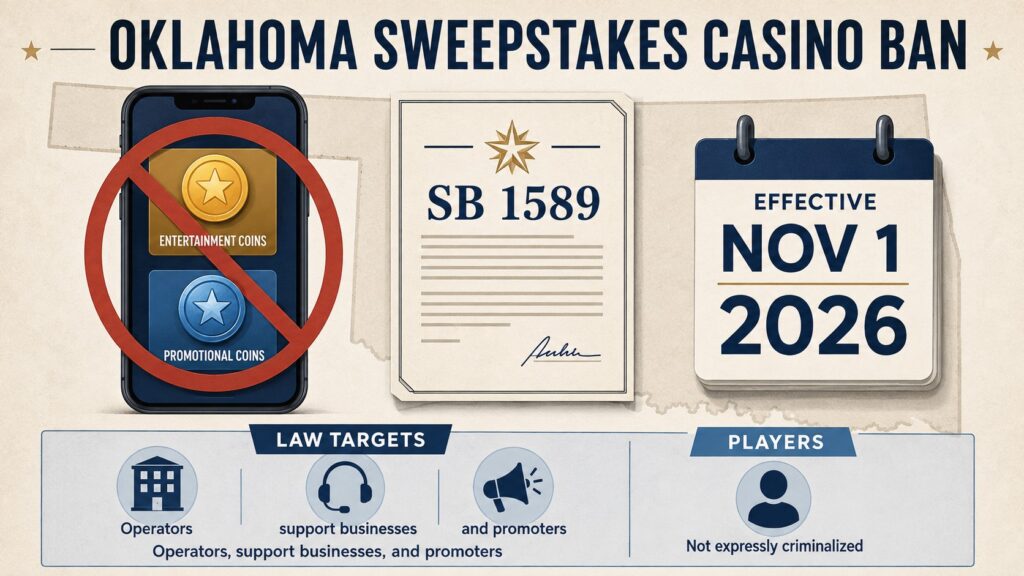
No. Dual-currency sweepstakes casinos are banned in Oklahoma under SB 1589. The ban takes effect November 1, 2026.

SB 1589 amends Oklahoma Statutes Title 21, the state’s criminal gambling code. The bill creates a statutory definition of online casino game. SB 1589 also expands the definition of representative of value to capture redeemable sweepstakes coins.

Criminal liability under SB 1589 reaches operators, promoters, platform providers, and media affiliates. Any entity that operates, supplies, or promotes a dual-currency platform in Oklahoma faces Class C2 felony exposure. That exposure begins November 1, 2026.

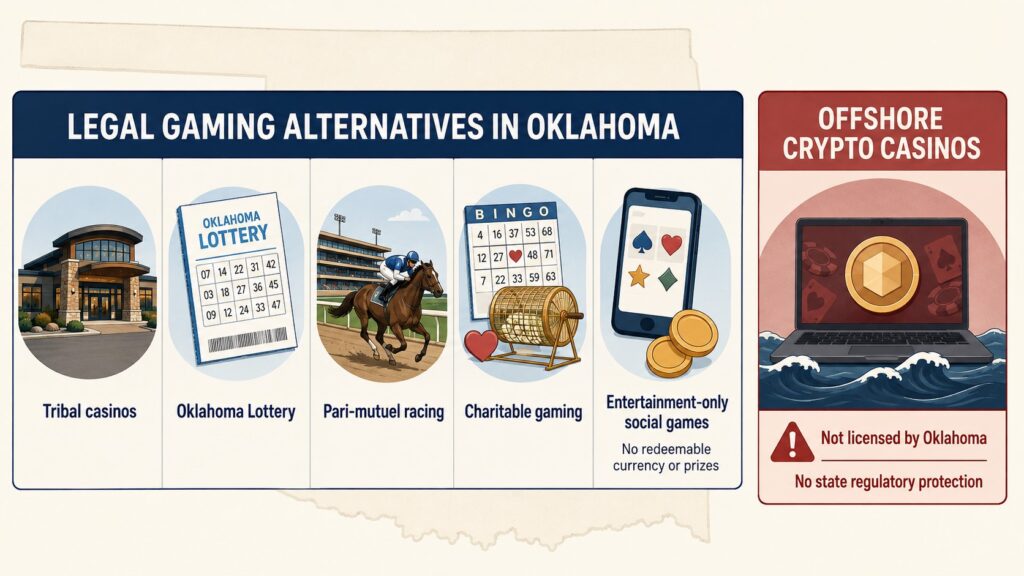
IGRA-compliant tribal casinos and licensed charitable gaming are expressly carved out of the ban. SB 1589 targets commercial dual-currency platforms exclusively. Oklahoma’s tribal gaming facilities, state lottery, and licensed charity gaming operations are unaffected.

Clovr does not list, rank, or link to sweepstakes casino operators for Oklahoma readers. SB 1589 names media affiliates as criminally liable parties alongside operators. Promotional content routing Oklahoma traffic to dual-currency platforms carries felony exposure under the statute.

Inside SB 1589 | What Oklahoma’s Ban Actually Does

Oklahoma SB 1589 amends Oklahoma Statutes Title 21, the criminal code that governs gambling, lotteries, and slot machines. The bill makes three structural changes to Oklahoma gambling law:

  • It creates a statutory category called online casino game.
  • It expands the definition of representative of value.
  • It attaches a Class C2 felony to anyone who operates or supports these platforms.

The legislative path proceeded with near-unanimous support on first passage.

DateEvent
March 2026Oklahoma Senate passes SB 1589, 48-0
May 4, 2026Oklahoma House passes SB 1589, 65-21
May 7, 2026Governor Kevin Stitt vetoes SB 1589
May 2026 (final session day)Senate overrides veto, 34-10; House overrides, 68-19
November 1, 2026SB 1589 takes effect statewide

Governor Stitt vetoed SB 1589 on May 7, 2026. He called the bill vague and overbroad. The Oklahoma Legislature overrode the veto on the final day of the session.

The Senate override vote was 34-10. The House vote was 68-19.

The “online casino game” definition is the first structural change SB 1589 makes to Title 21. Named game formats under this definition include slot machine-style games and roulette. Oklahoma Statutes Title 21, §964 defines slot machine; §1051 governs lottery-related provisions. SB 1589 connects its “online casino game” category to these statutory references.

Before SB 1589, no Oklahoma statute defined dual-currency platforms as a category. Operators used that absence to argue their platforms fell outside the gambling code. The “online casino game” definition closes that gap. It names the relevant game types and ties them to existing statutory definitions.

The online casino game definition draws directly on existing Title 21 provisions. Slot machine-style games are addressed in Oklahoma Statutes Title 21, §964. Lottery-related gaming is addressed in §1051. These existing definitions carry decades of enforcement history.

Prosecutors can apply that enforcement history directly to the new online casino game classification. No novel legal theory is required.

Oklahoma did not create an administrative regulatory scheme for dual-currency platforms. The state chose a direct criminal classification instead. Civil enforcement requires ongoing administrative proceedings. A criminal statute triggers liability without a regulator first issuing an order.

Dual-currency operators are typically headquartered outside Oklahoma’s jurisdiction. The criminal reach into the promotional chain is the enforcement mechanism that matters.

The “representative of value” redefinition is SB 1589’s enforcement mechanism for the dual-currency architecture. Oklahoma Statutes Title 21 defines gambling through a three-element test: consideration, chance, and prize. All three must be present for an activity to constitute illegal gambling under Oklahoma law.

The sweepstakes casino industry’s legal defense rested on removing the “consideration” element. Operators did this through the no-purchase-necessary (AMOE) rule. SB 1589 directly forecloses that defense.

Under the amended statute, any redeemable dual-currency coin qualifies as a representative of value. This includes coins exchangeable for prizes, cash, cash equivalents, or a chance to win. The definition applies regardless of how the coin was distributed.

A Sweeps Coin obtained through AMOE still qualifies as a representative of value under the amended statute. A Sweeps Coin gifted through a promotion still qualifies. Redeemability alone is the trigger. The method of distribution is irrelevant.

This redefinition was written specifically to close the AMOE loophole. The dual-currency model was engineered to avoid three-element gambling tests by eliminating “consideration” through free entry. SB 1589’s drafters identified that gap and wrote a definition that captures it directly. The law names dual-currency systems as the target and uses redeemability as the legal test.

What Are the Penalties and Who Is Liable

SB 1589 classifies operating or supporting a dual-currency sweepstakes platform in Oklahoma as a Class C2 felony.

Penalty exposure per violation:

  • Fine: $500 to $2,000
  • Jail: Up to 30 days (verify against enrolled SB 1589 text before publish)

Named liable parties under SB 1589:

  • Owners
  • Employees
  • Geolocation providers
  • Suppliers
  • Platform providers
  • Promoters
  • Media affiliates

The inclusion of geolocation providers in the liable-parties list is significant. An operator cannot delegate location-blocking to a third-party vendor and claim it did not personally serve Oklahoma players. SB 1589 reaches the full operational stack.

Oklahoma’s enforcement model is criminal, not civil. Most 2025-2026 state-level sweepstakes bans relied on attorney general civil action or regulatory orders. Oklahoma’s felony classification exposes promoters and media affiliates to criminal charges directly.

Civil enforcement against out-of-state operators is slow and jurisdictionally difficult. Criminal liability for promotional activities within Oklahoma’s reach does not face those obstacles. Oklahoma’s criminal statute reaches anyone in the promotional chain. This includes websites and affiliate networks that route traffic to these platforms.

The criminal reach of SB 1589 is the principal reason Clovr carries no operator links or rankings on this page. Any platform that supports dual-currency sweepstakes access for Oklahoma readers is within the statute’s scope.

Oklahoma’s decision to use criminal law rather than civil enforcement reflects the state’s judgment about operator accountability. Civil enforcement against out-of-state operators requires serving process in foreign jurisdictions. Resulting judgments may not be collectible.

The criminal statute reaches any US-based party promoting or supporting these platforms in Oklahoma’s jurisdiction. That includes affiliate networks, comparison sites, content publishers, and advertising platforms that route Oklahoma residents to dual-currency platforms.

How Sweepstakes Casinos Work and Why Oklahoma Calls It Gambling

Sweepstakes casinos use a dual-currency model. This model was designed to operate outside traditional gambling law in most US states. Understanding its mechanics is essential to understanding why SB 1589 was written the way it was.

Players on these platforms receive two distinct currencies. Gold Coins are free-play entertainment credits. Sweeps Coins are promotional credits redeemable for prizes or cash equivalents.

Both currencies can be obtained without a purchase. Only Sweeps Coins carry real-world value.

Gold Coins carry no cash value and cannot be redeemed. They exist for entertainment play only. Players accumulate Gold Coins through purchases of Gold Coin packages, login bonuses, and daily promotions. Gold Coin balances cannot be converted into Sweeps Coins and cannot be cashed out for any prize.

Oklahoma’s ban does not target Gold Coin-only social gameplay. Gold-Coin-only play is the sole conceptually defensible format under SB 1589. No major operator has committed to offering this as a standalone product for Oklahoma accounts. No Clovr listing reflects this framing.

Sweeps Coins are the legal trigger under SB 1589. They are redeemable for prizes or cash equivalents. Players obtain Sweeps Coins through Gold Coin package purchases, through operator promotions, or through the alternate method of entry (AMOE). The fact that a player did not pay for a Sweeps Coin does not change its redeemability. Redeemability is what SB 1589 identifies as the “representative of value.”

Oklahoma Statutes Title 21 has applied a three-element gambling test since the original drafting of the criminal code. An activity constitutes illegal gambling when all three elements are present: consideration, chance, and prize. Remove any one element and the activity falls outside the gambling definition.

ElementStandard Sweepstakes ModelOklahoma Under SB 1589
ConsiderationAMOE removes this element in approximately 40 statesRedefined: any redeemable dual-currency coin satisfies consideration regardless of how it was obtained
ChancePresent (slot mechanics, card outcomes, roulette)Present
PrizePresent (Sweeps Coins are redeemable for cash)Present
ResultNot gambling under most state codesIllegal gambling under Oklahoma Statutes Title 21

How AMOE works in most states:

The alternate method of entry (AMOE) removes the “consideration” element from the gambling test. This is the rule that lets the model operate in approximately 40 states. The core logic is simple. Consideration means something of value was risked in exchange for a chance to win.

If a player can enter without paying anything, no value was risked. Without consideration, the activity is not gambling.

Sweepstakes casinos operationalized this by providing a free entry route, typically a mail-in request for Sweeps Coins. Courts and regulators in most US states accepted this reasoning.

The legal theory behind AMOE is not new. Sweepstakes promotions have operated in the United States for decades under this framework. Publishers Clearing House-style sweepstakes relied on the same no-purchase-necessary principle. Regulators accepted that free-entry mail sweepstakes were not gambling because consideration was absent.

The sweepstakes casino model applied this established legal framework to interactive digital gameplay. Most state codes had not been updated to address the resulting dual-currency architecture.

The scale difference between traditional sweepstakes and the sweepstakes casino model is significant. A mail-in sweepstakes entry for a prize drawing does not replicate the experience of persistent, real-time digital gameplay. Sweepstakes casino platforms deliver slot machine-style sessions with paylines, session balances, volatility mechanics, and progressive features. States that examined the model after 2022 increasingly concluded the traditional sweepstakes legal framework did not contemplate this type of gameplay.

The AMOE route was documented, operational, and available. As long as entry was genuinely free and redemption was accessible, operators could argue consideration was absent. Most state codes did not explicitly address dual-currency architecture.

The strength of the AMOE defense varied by state. Some states allowed the model to operate without challenge. Others flagged concerns but did not act legislatively. A number of states moved to restrict the model through attorney general civil action in 2022-2025.

Oklahoma’s 2026 response was different in two concrete ways. The Legislature chose a criminal statute over a civil regulatory approach. It wrote the statute to reach affiliates and promoters explicitly as named liable parties.

Why AMOE fails in Oklahoma:

SB 1589 rewrites the consideration analysis from the ground up. The “representative of value” definition says that any redeemable dual-currency coin satisfies consideration.

The coin does not need to have been purchased. It does not need to have been earned through gameplay. Its redeemability alone makes it a thing of value under the amended statute.

A player who entered entirely through AMOE still holds redeemable Sweeps Coins. Those coins satisfy the “consideration” element under SB 1589.

Chance is present through gameplay mechanics. Prize is present through redemption. All three elements exist. The platform constitutes illegal gambling under Oklahoma law.

Oklahoma’s legislators studied the legal architecture of the dual-currency model before drafting SB 1589. The “representative of value” definition was written to capture that specific architecture. The statute names dual-currency systems directly and ties redeemability to the existing Title 21 consideration standard. No AMOE filing reverses the redeemability of a coin that is already in a player’s account.

What Stays Legal | Tribal Casinos and Charitable Gaming

SB 1589 targets commercial dual-currency sweepstakes platforms. Oklahoma’s existing legal gaming framework is not affected by the ban. The law includes express carve-outs for IGRA-compliant tribal gaming and licensed charitable gaming.

Gaming ActivityStatus After November 1, 2026Governing Authority
Tribal casino gaming, Class IILegalNational Indian Gaming Commission (NIGC)
Tribal casino gaming, Class IIILegalNIGC + Oklahoma tribal-state compacts
Licensed charitable gaming (bingo, raffles, pull tabs)LegalOklahoma Charity Games Act
Oklahoma State LotteryLegalOklahoma Lottery Commission
Horse racing (pari-mutuel wagering)LegalOklahoma Horse Racing Commission
Dual-currency sweepstakes casinosBanned effective November 1, 2026SB 1589

Oklahoma has approximately 33 tribal gaming nations. These nations operate more than 140 gaming facilities across the state. Tribal gaming in Oklahoma is governed federally by the Indian Gaming Regulatory Act (IGRA). IGRA-compliant tribal gaming on tribal land is expressly preserved under SB 1589.

Oklahoma tribal-state compacts give tribes exclusivity over Class III gaming. Tribes pay exclusivity fees to the state in exchange. These compacts follow the State Question 712 framework.

The Oklahoma Management and Enterprise Services Gaming Compliance Unit (OMES GCU) maintains them at the state level. The National Indian Gaming Commission (NIGC) provides federal oversight.

Neither the OMES GCU nor the NIGC is referenced in SB 1589 as an enforcement body. Both bodies operate independently of the sweepstakes ban. Their authority over tribal gaming is untouched by SB 1589.

The political context of the ban is directly connected to tribal gaming exclusivity. Commercial dual-currency platforms compete with tribal casinos for Oklahoma players. They pay no exclusivity fees and operate outside compact obligations.

The 48-0 Senate vote on first passage reflects broad legislative agreement. Legislators agreed this competitive imbalance warranted a criminal remedy.

The Oklahoma Charity Games Act preserves licensed charitable gaming. This includes bingo, pull tabs, raffles, and similar activities conducted by qualified nonprofit organizations.

The Oklahoma Charity Games Act is administered through the Oklahoma Department of Agriculture, Food, and Forestry. Qualified nonprofit organizations apply for an annual gaming license to conduct events. Licensed game types include bingo, pull tabs, pickle cards, and charity auction games.

These activities are excluded from Oklahoma’s criminal gambling code. The online casino game definition in SB 1589 does not reach them. All remain fully legal after November 1, 2026.

Oklahoma’s tribal gaming footprint is one of the largest in the United States by facility count. The tribal-state compact framework traces back to State Question 712, which Oklahoma voters approved in 2004. Tribal nations pay exclusivity fees to the state in exchange for the right to offer Class III games. Those games include slot machine-style devices, poker, and house-banked card games.

These compacts are federal agreements governed by IGRA. They operate entirely outside Oklahoma’s commercial gambling code.

The Oklahoma State Lottery and pari-mutuel horse racing each operate under separate regulatory frameworks. SB 1589 does not address or affect either. Both remain available to Oklahoma residents after the sweepstakes ban takes effect.

Players who lose access to sweepstakes platforms after November 1, 2026 retain other legal gaming options. Oklahoma tribal casino gaming, charitable gaming, the state lottery, and pari-mutuel racing all remain available. The ban removes one category of entertainment platform. It does not restrict Oklahoma residents’ access to the broader legal gaming framework.

What Oklahoma Players Should Do Before November 1, 2026

Sweepstakes casino operators are expected to exit Oklahoma before SB 1589 takes effect. November 1, 2026 is the deadline operators must meet to avoid Class C2 felony exposure. Most operators will implement geo-restrictions in the weeks before that date as they wind down Oklahoma account access.

The table below lists operators expected to withdraw from Oklahoma. No affiliate links, bonus data, or play CTAs appear in this table. Operators are named for informational awareness only. Verify each operator’s actual exit date or geo-block status before acting.

Operator market exit status in Oklahoma:

OperatorExpected Oklahoma Status
Mega BonanzaExpected to exit before November 1, 2026
McLuckExpected to exit before November 1, 2026
Play FameExpected to exit before November 1, 2026
PulszExpected to exit before November 1, 2026
Crown CoinsExpected to exit before November 1, 2026

Verify each operator’s actual exit or geo-block status before this page goes live. Operator exit timelines may not align with the November 1, 2026 legal effective date.

Redeem Sweeps Coin balances before operators withdraw. Redemption access ends when an operator implements geo-restrictions. Players with active Sweeps Coin balances should redeem while the operator is still actively serving Oklahoma accounts. Operators do not hold redemption access open after geo-blocking takes effect. Do not wait until close to the November 1 deadline to act.

Contact operator support if you have a significant balance. Operators may set their own Oklahoma wind-down timeline earlier than November 1, 2026. Players with large unredeemed balances should ask the operator directly when Oklahoma access will end. Ask specifically about the redemption window and how to ensure access before that point.

Oklahoma players: a practical action checklist

Operators will not announce their Oklahoma exit dates uniformly. Some platforms may geo-block the state months before November 1, 2026. Others may operate until close to the deadline. Treat your own access window as unknown and act early.

Steps to take now:

  • Log into each active account and record the current Sweeps Coin balance.
  • Initiate any redemption that meets the platform’s minimum threshold. Most platforms support PayPal or bank transfer for eligible Sweeps Coin redemptions.
  • Ask operator support directly about the Oklahoma wind-down date and whether minimum redemption thresholds will be waived for players in exiting states.
  • Save the redemption confirmation number and any transaction receipt. This documentation is important if you need to dispute a balance after geo-blocking takes effect.
  • Do not purchase additional Gold Coin packages after the operator announces its Oklahoma exit date.
  • Do not attempt to access the platform through a VPN or spoofed device location after geo-blocking takes effect.

Gold Coin balances carry no cash value and cannot be redeemed. If an operator exits before you spend your Gold Coin balance, that balance will not be compensated.

Bypassing geo-restrictions is not a safe strategy. Operators detect bypass attempts including VPN use, device spoofing, and location masking. Oklahoma players who access a platform after it has geo-blocked the state face account closure for policy violations. Account closures under these circumstances result in permanent balance forfeiture. Oklahoma law provides no recourse for losses tied to geo-restriction bypass.

Age requirements differ across platform types. Oklahoma tribal casinos set the minimum participation age at 21. Some sweepstakes platforms used an 18+ age gate under a social gaming framework. Players should not assume a single age standard applies across all gaming categories. The applicable minimum age depends on the platform type, not a uniform statewide rule.

Sweeps Coin redemptions may be taxable income. Federal law requires a 1099 form for prizes of $600 or more. Oklahoma residents report state-taxable gaming winnings on Form 511 (residents) or Form 511-NR (non-residents). Prize winnings may affect state tax liability. This is a factual summary only and is not tax advice. Consult a qualified tax professional for guidance specific to your situation and redemption history.

Oklahoma in Context | The 2026 State Ban Wave

Oklahoma joined a growing list of states that banned dual-currency sweepstakes casinos in 2025 and 2026. The table below places SB 1589 alongside the other major 2026 enactments.

StateBillEffective DateLiability Scope
OklahomaSB 1589November 1, 2026Criminal (Class C2 felony); operators, employees, geolocation providers, suppliers, platform providers, promoters, media affiliates
IndianaHB 1052July 1, 2026The law applies broadly to online sweepstakes operators that own, operate, manage, or control platforms accessible to players in Indiana. It covers websites and mobile apps offering casino-style games that use a dual- or multi-currency system
MaineLD 2007July 29, 2026The law prohibits a person or entity from operating, conducting, or promoting online sweepstakes games in Maine. It applies to operators, platform providers, and others involved in offering prohibited online sweepstakes casino games to individuals in the state.
TennesseeSB 2136May 22, 2026The law makes it unlawful to operate, conduct, or commercially promote online sweepstakes games or other online/app-based gambling covered by the statute.

2025 state bans for reference: California (AB 831), Connecticut (Public Act 25-112), Montana (SB 555), Nevada (SB 256), New Jersey (A5447), New York (S5935A).

Oklahoma’s approach differs from most 2025-2026 bans in two concrete ways. First, SB 1589 uses a felony classification rather than a civil penalty or regulatory order. Second, it names promoters and media affiliates explicitly as criminally liable parties.

Most 2025 bans relied on attorney general civil enforcement or regulatory action from gaming commissions. Civil enforcement requires an AG to identify, investigate, and pursue an operator through court.

The operator is often headquartered outside US jurisdiction. That process is slow and jurisdictionally complicated. Oklahoma’s criminal statute reaches anyone in the promotional chain without requiring a cross-jurisdictional civil suit.

Oklahoma’s SB 1589 is the most expansive enforcement model in the 2026 wave. It explicitly criminalizes the affiliate and promotional layer, not just the platform operators.

The sweepstakes casino market is contracting across the United States. The combination of 2025 civil enforcement bans and 2026 criminal bans has reduced the accessible US market for dual-currency operators. Oklahoma’s 2026 ban accelerates that contraction.

Operators have not publicly announced uniform responses to the shrinking US market. Some platforms have reduced Oklahoma-targeted promotions and shifted marketing budgets toward states where the model remains legal. Others have exited banned states quietly with geo-blocks that predate the statutory effective date. No operator has publicly committed to offering a Gold-Coin-only alternative product for Oklahoma accounts.

The accessible US market for dual-currency sweepstakes casinos is smaller in 2026 than in 2025. California, New York, New Jersey, and Nevada were among the largest population states to restrict or ban these platforms in 2025. Oklahoma, Indiana, Maine, and Tennessee form the 2026 wave.

The remaining eligible US market still includes tens of millions of adults in states where the model operates legally. The trend since 2025 has been toward restriction, not expansion.

The Bottom Line

Oklahoma SB 1589 is a criminal prohibition on dual-currency sweepstakes casinos. It is not a regulatory gray area or a pending enforcement action. The law was passed over a gubernatorial veto. It takes effect November 1, 2026 and attaches felony liability to operators, promoters, and media affiliates.

The “representative of value” redefinition is the law’s most consequential provision. It closes the AMOE defense that has allowed the sweepstakes casino model to function in approximately 40 states. In Oklahoma, no distribution method changes the legal status of Sweeps Coins. Free mail-in entry does not change their status as a thing of value.

Oklahoma players should treat the November 1, 2026 effective date as a hard deadline. Redeem active balances before operators implement geo-restrictions. Do not attempt to bypass geo-blocks after an operator exits. Oklahoma tribal casinos, charitable gaming, and the state lottery remain available after the ban takes effect.

The national sweepstakes casino market has contracted significantly since 2025. States representing a large share of the US adult population have restricted or banned the dual-currency model. Oklahoma’s SB 1589 adds to that contraction with one of the strictest enforcement frameworks enacted so far.

Players in legal states should verify their state’s current legal status before assuming continued access. No state that has banned sweepstakes casinos has reversed that decision since 2025. The 2026 trend has been toward restriction, not re-legalization. Clovr tracks state legal status for US sweepstakes casino readers and updates pages as laws change.

Frequently Asked Questions

  • Do Oklahoma sweepstakes players face criminal penalties under SB 1589?

    No, SB 1589’s liable parties are operators and their support ecosystem. Named parties include owners, employees, geolocation providers, suppliers, platform providers, promoters, and media affiliates. The statute targets those who run and support these platforms, not individual players. Oklahoma players should expect account access to end as operators exit before November 1, 2026.

  • When does the Oklahoma sweepstakes casino ban take effect?

    SB 1589 takes effect November 1, 2026. Governor Stitt vetoed the bill on May 7, 2026. The Legislature overrode the veto on the final session day. Operators must exit or geo-block Oklahoma players before that date to avoid Class C2 felony exposure.

  • Why did Governor Stitt veto SB 1589 if it still became law?

    Governor Stitt vetoed SB 1589 on May 7, 2026. He called the bill “vague and overbroad.” The Legislature overrode the veto on the final day of the May 2026 session.

    The Senate voted 34-10 to override. The House voted 68-19 to override. The bill became law over the governor’s objection.

  • Are Oklahoma tribal casinos affected by SB 1589?

    No, SB 1589 expressly preserves IGRA-compliant tribal gaming and licensed charitable gaming. The ban targets commercial dual-currency sweepstakes platforms only. Oklahoma’s tribal gaming nations and their more than 140 facilities operate under federal IGRA authority. The statute does not capture them.

  • Can I still redeem my Sweeps Coins before the ban takes effect?

    Yes, redemption may remain available while operators are still active in Oklahoma before November 1, 2026. Access winds down as operators implement geo-restrictions approaching the effective date. Attempting to bypass geo-blocks after an operator withdraws risks account closure and balance forfeiture. Oklahoma law provides no recourse for losses associated with geo-restriction bypass.

  • How does Oklahoma's sweepstakes ban differ from other states?

    Oklahoma pairs a felony classification with criminal liability that explicitly reaches promoters and media affiliates. Most other 2025-2026 state bans use civil or regulatory enforcement mechanisms. SB 1589 is among the most expansive of the 2026 bans. It criminalizes the entire promotional layer, not just the platform operators.

Related reading:

Think You’ve Got a Gambling Problem? Call or text the National Council on Problem Gambling helpline: 1-800-522-4700 (24/7, confidential).

Last updated: July 2026 | Clovr.com

Casino of the Month

Star Rating Icon
80% Star Rating
  • Registration Bonus
  • 175,000 GC + 3 SC
  • No purchase necessary
  • 100% First Purchase Boost
  • Massive Refer a Friend Bonus
  • Exclusive VIP Offers
  • 10K+ Social Casino Games
Star Rating Icon
100% Star Rating
  • 100% Extra Coins
  • 750,000 GC + 40 SC
  • for $19.99
  • Sign-up, get 750,000 GC
  • Progressive Daily Prizes
  • Referral Bonus: 900K GC + 20 SC
  • Unlock VIP Levels
Star Rating Icon
100% Star Rating
  • First Purchase Offer
  • 2,000,000 GC and 100 SC
  • + 10 Free Plays for $49.99
  • Sign-up, Get 160,000 GC + 2 SC
  • Free Coins + 60 Free Plays Daily
  • Earn SC in Fortune Quests
  • 5,000 GC + 20 SC Referral Bonus
© Copyright 2026 Clovr.com