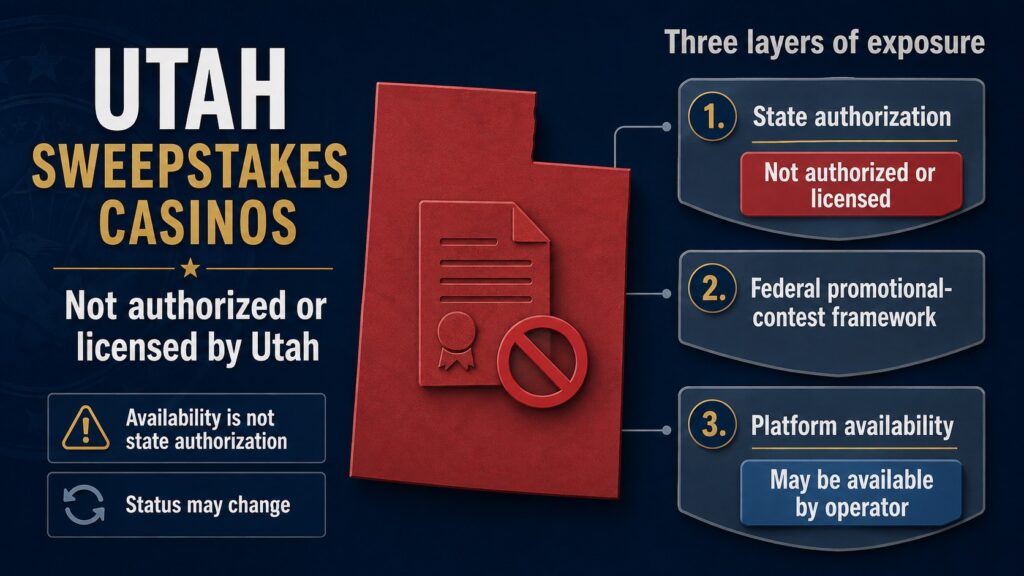
Sweepstakes casinos are not authorized or licensed by Utah. They operate for Utah residents under federal promotional-contest law rather than any state permission.
Utah is the hardest jurisdiction in the country for this model, and the reasons stack rather than overlap. There are three separate layers of exposure, each with a different mechanism and a different party at risk.
Platforms continue to accept Utah players as of August 2026. That is a description of the market, not a statement about its legal footing.
The Three Layers
| Layer | Source | Who it reaches |
|---|---|---|
| Constitutional | Utah Constitution, Article VI Section 27 | The legislature itself; gambling cannot be authorized by statute |
| Criminal | Utah Code § 76-9-1402 | Players and operators; internet gambling is named directly |
| Civil | Utah Code § 76-9-1412 | Operators and promoters; private suits with double damages |
Most states have one of these. Utah has all three, which is why it has become the country’s leading venue for class action litigation against sweepstakes operators.
Layer One | The Constitutional Ban
Article VI Section 27 prohibits any lottery or gift enterprise under any pretence or for any purpose. Utah and Hawaii are the only two states with a prohibition this absolute.
The practical consequence is that Utah’s legislature cannot authorize gambling even if it wanted to. No amount of lobbying, tax-revenue argument, or industry pressure changes the position without a constitutional amendment put to voters.
This is why Utah has no state lottery, no commercial casinos, no tribal gaming compacts, and no charitable gaming of consequence. The prohibition reaches church and charity raffles.
Layer Two | The Criminal Statute
Utah Code § 76-9-1401 defines gambling as risking anything of value on a chance-based outcome. The definition covers activities enterable with or without payment, which is broader than most states.
Section 76-9-1402 makes online gambling and fringe gambling class B misdemeanours. Utah is unusual in naming internet gambling explicitly in its criminal code rather than relying on general definitions.
The statute also provides that Utah would automatically opt out if federal law ever authorized internet gambling nationwide. That is a deliberate signal about legislative intent.
Why the Free Entry Defence Is Weaker Here
The sweepstakes model removes consideration from the three-element test by guaranteeing a free entry route. Prize and chance remain; consideration does not.
That argument works in states with active gaming markets, which have limited motivation to test it. Utah permits no legal gambling at all and has no comparable tolerance.
Utah’s statutory language covering activities enterable without payment is precisely the language that makes the free entry defence uncertain here. No Utah court has resolved it.
Layer Three | Private Lawsuits
Utah Code § 76-9-1412 creates a private right of action for gambling-related losses. A Utah resident can sue to recover them, with double damages available in qualifying cases.
This provision has made Utah a focal point for plaintiffs’ attorneys. The state has emerged as a class action hotspot for suits against sweepstakes operators, with plaintiffs arguing the platforms constitute illegal gambling under Utah’s strict statutes.
Unlike criminal enforcement, which requires a prosecutor to act, civil exposure requires only a plaintiff and a lawyer. That is a materially lower bar.
Why This Page Has No Rankings
Section 76-9-1412 exposure extends beyond platform operators to promoters. Clovr does not rank, rate, or link to sweepstakes operators on this page for that reason.
The status table below exists so readers can see where platforms stand. It is not a recommendation list and carries no bonus figures or promotional data.
What HB 243 Actually Did
This is the most misreported part of Utah’s 2026 legislative session, so the sequence matters.
House Bill 243, sponsored by Rep. Joseph Elison, passed the Utah House 63-9 on February 10, 2026. As drafted, it would have rewritten Utah’s gambling definitions in ways that directly captured sweepstakes platforms.
The Fringe Gambling Provisions
The House version defined fringe gambling as any de facto form of gambling, lottery, or gaming device offered by a business in exchange for anything of value or incident to the purchase of another good or service.
It then narrowed the two exceptions the dual-currency model relied on. An amusement device would have to bar sweepstakes or lottery entry entirely, and a lawful promotional activity would be limited to an appropriate reward.
The bill would also have banned any system simulating casino-style games or using slot, poker, bingo, or chance-based video game mechanics. Under those provisions, sweepstakes casinos would have been neither lawful promotions nor amusement devices.
What Happened Next
HB 243 stalled in the Senate Rules Committee on February 11, one day after clearing the House. The obstacle was federal preemption concerns arising from prediction markets rather than opposition to the sweepstakes provisions.
A Senate Substitute was developed. Governor Spencer Cox signed HB 243, effective May 6, 2026.
The enacted law is consistently described as criminalising proposition bets and targeting daily fantasy sports and prediction market apps. Prediction market operator Kalshi filed a federal lawsuit against Utah in April 2026, arguing its event contracts are federally regulated and the state law is preempted.
What This Means for Sweepstakes Platforms
Whether the fringe gambling provisions survived the Senate Substitute in the form the House passed is not clearly established in public reporting.
What is clear is that sweepstakes platforms continued serving Utah players after May 6, 2026, and that no operator has been named in a Utah enforcement action under the new law.
What is also clear is legislative intent. A 63-9 House vote on language explicitly designed to capture this model is not an ambiguous signal, and the drafting now exists whether or not it is currently in force.
Critics during the session argued the fringe gambling definition was expansive enough to reach legitimate promotional sweepstakes run by Utah businesses and technology startups. That breadth is part of why the bill met resistance.
SB 38 and Consumer Protection
Senate Bill 38, sponsored by Sen. Todd Weiler, expanded the Utah Division of Consumer Protection’s authority over prize-based promotions and consumer-facing digital platforms.
The Division can now administer and enforce a group of statutes covering consumer promotions and prize offers, including the Prize Notices Regulation Act, the Ticket Website Sales Act, and the Automatic Renewal Contracts Act.
SB 38 operates on a different axis to HB 243. Where the gambling code addresses whether an activity is lawful, SB 38 addresses disclosure and delivery obligations regardless of that question.
How the Model Works
Gold Coins are free entertainment currency with no cash value and no redemption path. Platforms distribute them at registration, through daily bonuses, and alongside optional purchases.
Sweeps Coins are the prize currency. They cannot be bought directly. Players receive them as a bonus accompanying Gold Coin purchases or through the free mail-in entry route.
That free route is what the entire legal argument rests on. Its existence removes consideration from the three-element test, and its absence would collapse the model immediately.
Operator Status in Utah
The table below reflects status as researched by Clovr’s editorial team. It is not a ranking or endorsement, and it includes no bonus figures.
| Operator | Utah status | Age requirement |
|---|---|---|
| Mega Bonanza | Accepting Utah players | 21+ |
| McLuck | Accepting Utah players | 21+ |
| Play Fame | Accepting Utah players | 21+ |
| Crown Coins | Accepting Utah players | 19+ |
Availability can change within days without public notice. Verify directly with each operator before registering.
No operator holds a Utah gaming licence, because no licensing body exists to issue one. Any claim that a platform is Utah-licensed or state-regulated is false.
Card Crush | A Single-Currency Alternative
Card Crush is a single-currency platform available to Utah players aged 21 and older. It is operated by Vision NL Limited and launched in December 2025.
There is no separate free-play coin. Mystery Coins are the only currency with redemption value, at 1 MC to $1.00 USD. Cards power player-versus-player battles and carry no monetary value.
Mystery Coins must be played through once to become Eligible Mystery Coins. Gift cards redeem from 10 Eligible Mystery Coins and cash from 75, so the gift card route is the cheaper way to test a first payout.
| Detail | Terms |
|---|---|
| Operator | Vision NL Limited |
| Currency | Mystery Coins, 1 MC = $1.00 USD |
| Playthrough | 1x |
| Minimum redemption | 10 Eligible MC gift card; 75 Eligible MC cash |
| Payout methods | Visa and Mastercard |
| Welcome offer | 2 Mystery Coins and 5 Cards, plus 66% off the first Mystery Box |
| Minimum age | 21+ |
| Games | 250+ titles including live dealer |
Card Crush runs in a mobile browser with no dedicated app. It is not structured as a sweepstakes promotion, so there is no mail-in entry route. Free Mystery Coins come from the welcome offer, daily bonuses, and leaderboard placement.
The single-currency design is why Card Crush operates in states that have restricted the dual-currency model, including California and New York. Confirm Utah eligibility at the sign-up screen before entering payment details.
What Utah Prohibits
The prohibition is total rather than partial, which is the context that makes everything above coherent.
- Tribal gaming. Utah has no gaming compacts and no tribal casinos, unlike most US states.
- Sports betting. Prohibited constitutionally. HB 243 extended statutory restrictions to proposition bets and certain fantasy sports products.
- State lottery. None exists and none can be authorized without a constitutional amendment.
- Commercial casinos. None, and no pathway to any.
- Online gambling. Named explicitly as a criminal offence in § 76-9-1402.
Utah has no gaming commission or control board. Enforcement falls to the Attorney General and local prosecutors.
Tax and Disclosure
Sweeps Coins redeemed for prizes are taxable income under federal law. Platforms issue Form 1099-MISC for prize winnings exceeding $600 in a calendar year and do not typically withhold at redemption.
Utah applies a flat state income tax to all taxable income including prize winnings. The rate has been reduced in successive legislative sessions, so confirm the current-year figure with the Utah State Tax Commission before filing.
Separately, the Prize Notices Regulation Act requires sponsors to disclose prize details clearly and deliver prizes within 30 days of the award date. SB 38 expanded enforcement of that obligation, which applies independently of the gambling question.
This is informational only. Consult a qualified tax professional for guidance specific to your situation.
Playing Responsibly
Gold-Coin-only play is the lowest-risk way to engage with these platforms in Utah. Gold Coins carry no cash value and no redemption path, which removes the prize element that the entire legal question turns on.
Social casinos with no cash prizes are the clearest option for Utah residents who want casino-style entertainment online.
No sweepstakes platform is a reliable income source. Balances decrease as readily as they accumulate, and these products are designed for entertainment rather than as a financial strategy.
Frequently Asked Questions
-
Are sweepstakes casinos legal in Utah?
They are not authorized or licensed by Utah and operate under federal promotional-contest law. Platforms continue accepting Utah players, but the position is contested under a constitutional ban, a criminal statute naming internet gambling, and a civil statute allowing double-damages suits.
-
Did HB 243 ban sweepstakes casinos?
The version that passed the House 63-9 in February 2026 contained fringe gambling provisions that would have captured the model. The bill then stalled in Senate Rules over prediction market preemption concerns and a Senate Substitute was developed.
The enacted law, effective May 6, 2026, is reported as targeting proposition bets, daily fantasy sports, and prediction markets. Sweepstakes platforms continued operating in Utah afterwards and none has been named in an enforcement action under it.
-
Can I be sued for playing in Utah?
Section 76-9-1412 allows a Utah resident to sue to recover gambling-related losses, with double damages in qualifying cases. Most exposure falls on operators and promoters, but the statute does not exclude individual players.
Utah has become a class action hotspot for suits against sweepstakes operators. Consult a qualified attorney for guidance specific to your situation.
-
Why is Utah harder than other restrictive states?
Because the layers stack. A constitutional ban the legislature cannot override, a criminal code naming internet gambling directly, and a civil statute that lets private plaintiffs act without waiting for a prosecutor.
-
Who enforces gambling law in Utah?
The Attorney General and local prosecutors. Utah has no gaming commission and no licensing body, so no operator can hold a Utah gaming licence.
-
What is the minimum age at platforms serving Utah?
Mega Bonanza, McLuck, and Play Fame each require players to be 21 or older. Crown Coins requires 19. Verify the requirement on each platform’s terms before registering.
-
Are winnings taxable in Utah?
Yes. Federal reporting triggers at $600 in a calendar year via Form 1099-MISC. Utah applies its flat state income tax on top, and platforms typically do not withhold at redemption.
This page is an informational legal explainer for Utah residents. Utah Code § 76-9-1412 extends civil exposure to promoters, so Clovr carries no affiliate links, rankings, or sign-up CTAs on this page. This content is not legal or tax advice.
Related reading:
- Are Sweepstakes Casinos Legal?
- How Sweepstakes Casinos Work
- Sweepstakes Casinos in Michigan
- Sweepstakes Casinos in California
- Sweepstakes Casinos in Texas
Think You’ve Got a Gambling Problem? Call or text the National Council on Problem Gambling helpline: 1-800-522-4700 (24/7, confidential).
Last updated: August 2026 | Clovr.com