Sweepstakes casinos are illegal in Louisiana. The prohibition has been enforced since mid-2025 and is now written directly into Louisiana criminal statute.
Two laws took effect on August 1, 2026. Act 182 defines dual-currency online games as gambling by computer. Act 48 makes that offense a predicate act under Louisiana’s racketeering statute.
No sweepstakes casino operates legally in Louisiana. Any platform still accessible to Louisiana residents is operating unlawfully and without regulatory oversight.
Key Facts
- Attorney General Liz Murrill issued a formal opinion in July 2025 declaring dual-currency platforms illegal gambling under existing law.
- The Gaming Control Board and the Attorney General each issued more than 40 cease-and-desist letters in 2025.
- Governor Jeff Landry signed HB 883 and HB 53 in May 2026. They became Act 182 and Act 48 respectively.
- Both laws took effect August 1, 2026.
- Act 182 raises the operator fine for gambling by computer from $20,000 to $100,000, with up to five years imprisonment.
- Act 182 sets a separate, lower penalty tier for facilitators, including media affiliates and payment processors.
- Act 48 carries racketeering penalties up to $1 million and 50 years at hard labor.
The Legal Status Explained
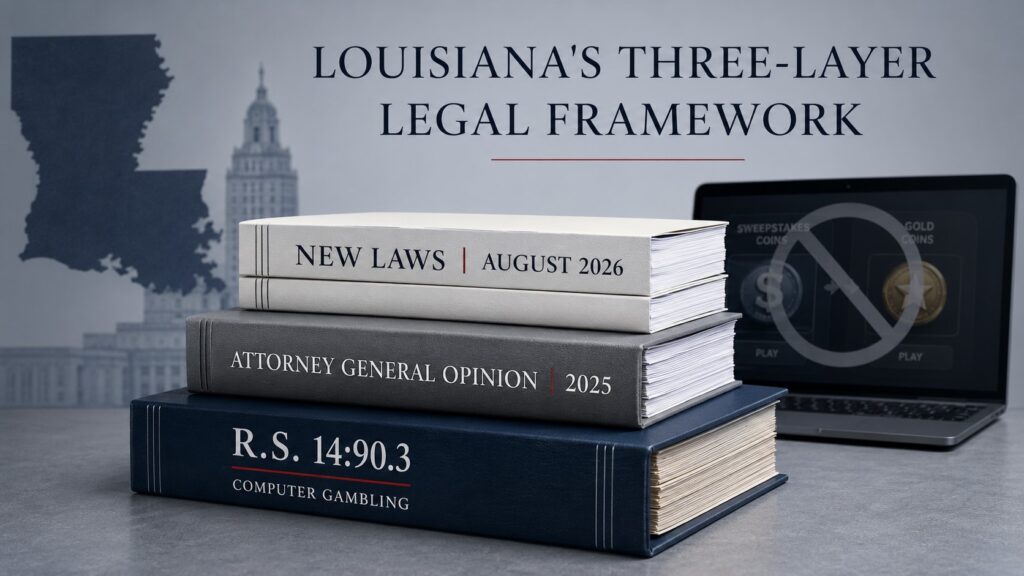
Louisiana’s prohibition rests on three layers. Those are the existing state gambling statutes, a formal attorney general opinion from 2025, and the two laws that took effect in August 2026.
Louisiana Revised Statute R.S. 14:90.3 criminalizes gambling conducted by computer. The statute predates the sweepstakes casino industry.
When dual-currency platforms expanded into Louisiana, the legal question was whether R.S. 14:90.3 reached them. The attorney general answered that question in 2025.
The Attorney General Opinion
Attorney General Liz Murrill issued a formal opinion in July 2025. It concluded that dual-currency prize platforms constitute illegal gambling under existing Louisiana law.
An attorney general opinion is not itself a statute. It carries authoritative interpretive weight and functions as a binding position for state agencies and enforcement bodies.
The opinion supported the enforcement actions that followed. The 2026 legislation later converted that interpretive position into codified statutory law.
How the Analysis Worked
The Louisiana Constitution vests the legislature with authority to define and suppress gambling. The R.S. 14:90 series provides the operational framework for that mandate.
Murrill’s analysis distinguished two categories of operator. Legitimate promotions run for a defined period without generating sustained commercial revenue from ongoing player engagement.
Dual-currency sweepstakes casinos operate year-round. They acquire customers for continuous engagement and derive commercial revenue from that engagement over time.
The opinion determined that this year-round profit model placed sweepstakes platforms outside the lawful promotional exemption.
How the Louisiana Laws Developed
The most common misconception is that Louisiana’s prohibition depends on a failed bill. It does not.
Senate Bill 181 passed the legislature in 2025. Governor Landry vetoed it, describing it as a solution in search of a problem already being solved.
His position was that existing enforcement mechanisms already addressed the issue. Enforcement then proceeded under existing law without SB 181.
Days after the veto, the Gaming Control Board began issuing cease-and-desist letters. The Attorney General issued a parallel set. Most major platforms exited the state in response.
The 2026 Dual-Track Strategy
Louisiana ran two bills against the same industry at the same time, using two different legal theories. That approach distinguishes it from other states.
HB 883 codified what the state had already asserted, writing the dual-currency prohibition explicitly into statute. It passed the House 99-0 and the Senate 35-0.
HB 53 escalated penalties without creating a new category of crime. It passed the House 86-11 and the Senate 27-9.
Landry signed both in May 2026. The same governor who vetoed SB 181 signed the two laws that achieved the same prohibition in statutory form.
Timeline
| Date | Action | Effect |
|---|---|---|
| June 2025 | Governor Landry vetoed SB 181 | Veto rejected the bill; conduct remained illegal under existing statutes |
| June 2025 | LGCB issued 40+ cease-and-desist letters | Operators directed to stop serving Louisiana residents |
| July 2025 | AG Murrill issued formal legal opinion and a parallel set of letters | Dual-currency platforms declared illegal under R.S. 14:90.3 |
| March 30, 2026 | House passed HB 53, 86-11 | Racketeering expansion advanced to the Senate |
| April 14, 2026 | House passed HB 883, 99-0 | Dual-currency ban advanced to the Senate |
| May 2026 | Senate passed HB 883, 35-0; Landry signed both bills | Enacted as Act 182 (HB 883) and Act 48 (HB 53) |
| August 1, 2026 | Both laws took effect | Criminal and racketeering penalties now enforceable |
What Act 182 Does
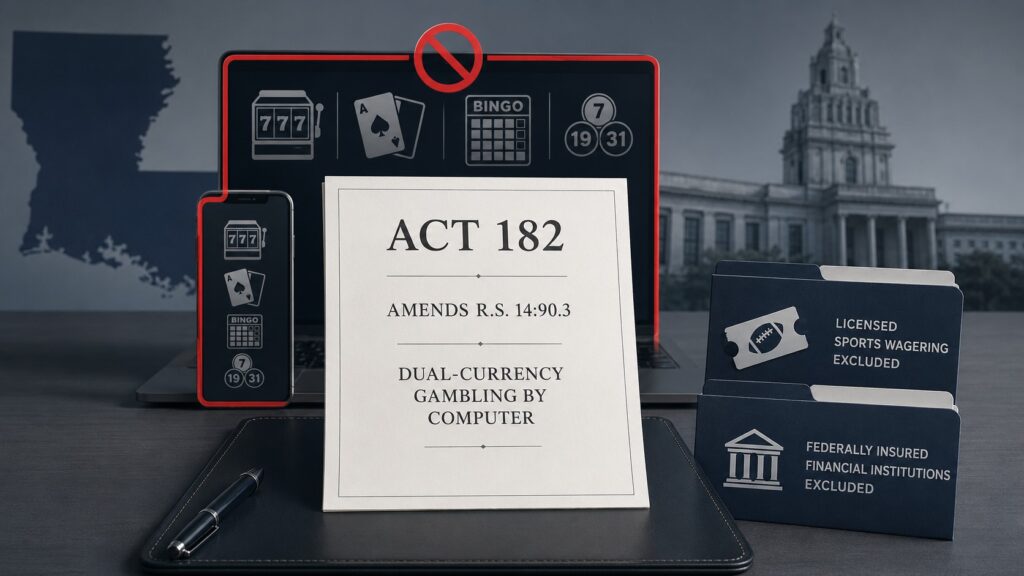
Act 182 defines dual-currency online and mobile games as illegal gambling by computer. It amends R.S. 14:90.3.
The law covers slots, table games, bingo, and lottery-style titles distributed through an app or browser. It reaches platforms where players purchase or earn virtual coins and redeem them for prizes.
Licensed sports wagering is explicitly excluded from the definition of gambling by computer. The statute also carves out federally insured financial institutions.
The Penalty Structure Has Two Tiers
Act 182 does not apply a single penalty to everyone. It separates operators from those who support or facilitate them.
| Party | Maximum fine | Imprisonment |
|---|---|---|
| Operators offering gambling by computer as a business | $100,000, raised from $20,000 | Up to 5 years, with or without hard labor |
| Facilitators, including platform providers, payment processors, promoters, and media affiliates | $20,000 | Up to 5 years, with or without hard labor |
| Facilitators where the violation involves a person under 21 | $40,000 | Up to 5 years, with or without hard labor |
| Platform providers or payment processors violating a court order | $50,000 first violation, $100,000 subsequent, per day the platform remains accessible | Applies per day |
The headline $100,000 figure applies to operators. Facilitators face a $20,000 penalty that doubles to $40,000 where an under-21 player is involved.
The court is required to order forfeiture of any profits made from gambling by computer. Forfeiture is mandatory rather than discretionary under this Act.
New Enforcement Powers
Act 182 enacts R.S. 27:19.1 and 19.2. These give the Attorney General authority to issue cease-and-desist notices directly.
Recipients have no more than 10 days after service to stop the activity. The Attorney General maintains a public list of notices issued.
The Attorney General may also seek a temporary restraining order, preliminary injunction, or ex parte injunction to halt access.
The statute reaches operators located outside Louisiana who maintain an internet platform serving people physically located in the state.
What Act 48 Does
Act 48 adds gambling by computer as a predicate act under Louisiana’s racketeering statute. This is a fundamentally different tier of legal exposure.
Racketeering penalties reach $1 million in fines and up to 50 years at hard labor. Courts may order forfeiture of up to three times the profits generated from the activity.
Because Act 182 defines dual-currency games as gambling by computer, it creates a direct link between sweepstakes platforms and the racketeering framework in Act 48.
A racketeering framework allows prosecutors to reach company executives, affiliates, software vendors, marketers, and payment processors alongside the operator itself.
Why Louisiana Rejected the Sweepstakes Model
Sweepstakes casinos use a dual-currency system to argue they operate as promotional platforms rather than gambling sites. Louisiana examined that argument and rejected it.
Gold Coins are a free-play currency with no monetary value. Sweeps Coins function as promotional entries redeemable for cash prizes.
Operators distribute Sweeps Coins free through alternative methods of entry that require no purchase. The no-purchase element is the cornerstone of the industry’s legal argument.
The Three-Element Test Applied
| Element | Operator position | Louisiana finding |
|---|---|---|
| Prize | Not disputed | Present; Sweeps Coins redeem for cash |
| Chance | Not disputed | Present; outcomes set by random number generation |
| Consideration | Removed by free entry | Present; year-round commercial model satisfies the element |
The analysis did not turn on whether an individual session could begin without payment. It turned on the year-round commercial structure of these platforms.
Operators derive sustained revenue from a customer base that engages continuously with redeemable virtual currency. Louisiana determined that this profit relationship satisfied consideration.
Why the Free Entry Defense Failed
The defense works in a true one-off sweepstakes. A consumer product company running a contest for a defined period, with no ongoing commercial relationship, can credibly argue no consideration exists.
Dual-currency casino platforms operating year-round as commercial entertainment venues do not share those characteristics.
This determination targets the business model, not a technical feature. Modifying the entry mechanism does not address the underlying finding.
Louisiana’s reasoning inverts the usual framing. The dual-currency structure is normally presented as what keeps these platforms lawful. In Louisiana, it is what triggered the illegal gambling classification.
Enforcement Record
Enforcement in Louisiana began well before the 2026 laws took effect. Both the Gaming Control Board and the Attorney General acted in 2025.
Cease-and-Desist Letters
The Gaming Control Board issued more than 40 letters in June 2025. The Attorney General issued a parallel set alongside the formal opinion.
The volume shows enforcement was applied systematically. Regulators acted against the dual-currency operator category as a whole rather than selecting individual platforms.
Those enforcement actions led most major platforms to exit Louisiana during 2025, before any new statute existed.
The Louisiana State Police Gaming Enforcement Division provides investigative support to the Gaming Control Board and already conducts enforcement against illegal online gambling operators.
Who Faces Exposure
Act 182 reaches well beyond operators. Parties named in the statute include:
- Operators and platform providers
- Game and content suppliers
- Merchant payment processors and financial transaction providers
- Geolocation providers
- Promoters and marketing companies
- Media affiliates and publishers
- Anyone who knowingly supports or facilitates access to these platforms in Louisiana
The statute treats service of a cease-and-desist notice as prima facie evidence that anyone acting in support knew the activity was unlawful.
What This Means for Louisiana Players
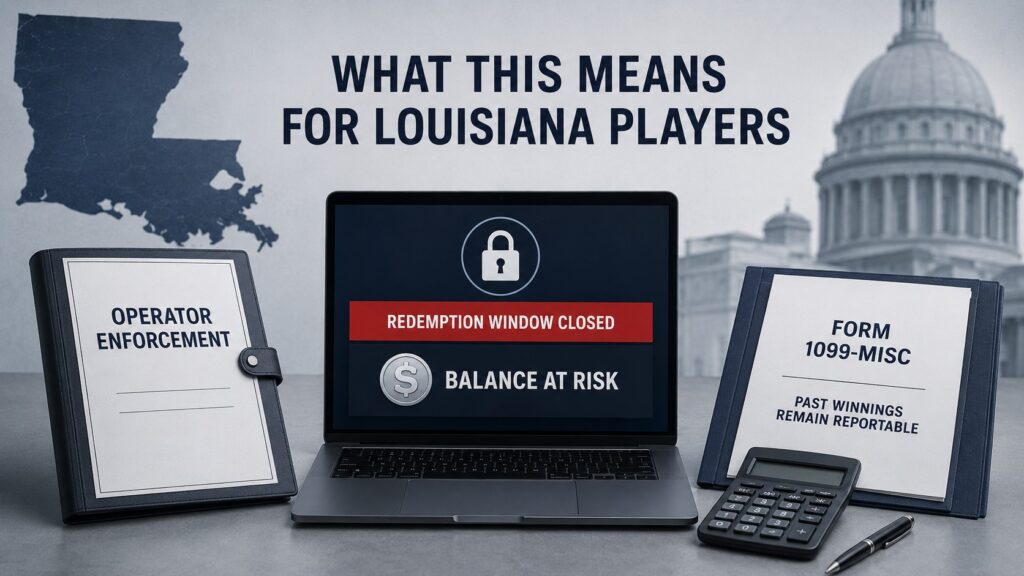
Individual players are not the primary enforcement target. The cease-and-desist letters and the statutory penalties are directed at operators and those who support them.
Louisiana residents who continue accessing sweepstakes platforms do so through services operating outside the law. There are no consumer protections and no recourse through state regulators.
Existing Sweeps Coins Balances
Redemptions by Louisiana residents are unlawful. Held balances carry forfeiture risk rather than guaranteed redemption rights.
Some operators communicated a redemption window ahead of the August 1, 2026 effective date. That window has now closed.
Tax Treatment of Past Winnings
Winnings redeemed before the prohibition remain reportable income under federal and Louisiana state law. IRS Form 1099-MISC applies to sweepstakes redemptions of $600 or more.
Taxability does not depend on the current legal status of the operator. Confirm treatment with the Louisiana Department of Revenue or a qualified tax professional.
What Louisiana Players Can Legally Do
Louisiana prohibits online sweepstakes casinos and online real-money casino gaming entirely. The state does permit several forms of licensed, regulated gambling.
Louisiana sets the minimum gambling age at 21 for both casino gaming and sports wagering.
| Activity | Legal in Louisiana | Notes |
|---|---|---|
| Online sweepstakes casinos | No | Prohibited since mid-2025; codified by Acts 182 and 48 |
| Online real-money casino gaming | No | Not licensed or permitted under Louisiana law |
| Licensed online sports betting | Yes | Legal since 2022; explicitly excluded from the gambling-by-computer definition |
| Land-based riverboat casinos and racinos | Yes | LGCB-regulated since 1996 |
| Daily fantasy sports | Yes, in participating parishes | Not available statewide; confirm your parish |
| Louisiana Lottery and horse racing | Yes | State-regulated |
Sports wagering carries an express carve-out in Act 182. The statute states that sports wagering shall not be considered gambling by computer.
Louisiana’s land-based gaming sector is well established. The Gaming Control Board has regulated riverboat casinos and racino venues since the 1990s.
Daily fantasy sports and online sports betting are both parish-dependent. Confirm availability in your parish before participating.
Louisiana in the National Picture
Sweeps Coin gameplay became illegal in Tennessee, Indiana, and Maine earlier in 2026. Louisiana is the fourth state where a ban took effect this year.
Oklahoma follows on November 1, 2026. Iowa took a different route, granting its regulator enforcement authority rather than enacting a ban.
What separates Louisiana is the racketeering layer. Other states rely on civil penalties or standard criminal gambling charges.
Routing sweepstakes offenses through an organized crime statute, combined with a codified ban, gives Louisiana one of the most severe frameworks in the country.
Frequently Asked Questions
-
Are sweepstakes casinos legal in Louisiana?
No. Sweepstakes casinos are illegal and not legally accessible in Louisiana. The prohibition has been enforced since mid-2025.
Acts 182 and 48 took effect on August 1, 2026, writing the ban explicitly into Louisiana criminal statute.
-
Why are sweepstakes casinos illegal if SB 181 was vetoed?
The veto rejected one legislative bill but did not affect the underlying prohibition. The 2025 attorney general opinion determined that existing statutes already covered dual-currency platforms.
The 2026 laws converted that interpretation into explicit statutory language.
-
What are the penalties under Act 182?
Operators offering gambling by computer as a business face fines up to $100,000, raised from $20,000, plus up to five years imprisonment.
Facilitators such as platform providers, payment processors, and media affiliates face a separate $20,000 penalty. That doubles to $40,000 where the violation involves a person under 21.
-
Why does the racketeering classification matter?
Act 48 shifts enforcement from standard gambling charges to organized crime law. Standard gambling offenses carry fines and relatively short sentences.
Racketeering exposure reaches $1 million and 50 years at hard labor, with forfeiture of up to three times the profits generated.
-
Which sweepstakes casinos still accept Louisiana players?
None operate legally in Louisiana. Regulators required operators to withdraw in 2025 and most major platforms exited then.
Any platform still accepting Louisiana residents is operating unlawfully, without regulatory oversight, and outside consumer protection mechanisms.
-
Can Louisiana residents redeem existing Sweeps Coins?
No. Redemptions by Louisiana residents are unlawful. Held balances carry forfeiture risk and should not be relied upon.
Winnings redeemed before the prohibition remain reportable income and should be declared regardless of current redemption availability.
-
Do Louisiana players face criminal charges for playing?
Individual players have not been the enforcement target. Enforcement actions and statutory penalties are directed at operators and those who support them.
The practical risk to players is using an unregulated service with no consumer protections and no recourse if a balance is withheld.
This page is an informational legal explainer for Louisiana residents. Louisiana law names media affiliates and publishers as covered parties, so Clovr carries no affiliate links, operator recommendations, or sign-up CTAs for Louisiana traffic on this page. This content is not legal or tax advice.
Related reading:
- Are Sweepstakes Casinos Legal?
- How Sweepstakes Casinos Work
- Sweepstakes Casinos in Texas
- Sweepstakes Casinos in Florida
- Sweepstakes Casinos in Michigan
Think You’ve Got a Gambling Problem? Call or text the National Council on Problem Gambling helpline: 1-800-522-4700 (24/7, confidential).
Last updated: August 2026 | Clovr.com