Sweepstakes casinos are banned in Maine. LD 2007 took effect on July 29, 2026, and the prohibition is now in force.
Governor Janet Mills signed the bill on April 6, 2026. Operating, promoting, or supporting a dual-currency sweepstakes casino in Maine is now a civil violation carrying fines of $10,000 to $100,000.
The law targets the dual-currency model specifically. Social casino platforms offering Gold Coin entertainment with no cash-prize redemption fall outside its scope and remain legal.
Maine paired the ban with a licensed alternative. LD 1164 authorizes the four Wabanaki Nations to operate real-money online casinos, and that law took effect on the same date.
Key Facts
- LD 2007 was enrolled as Maine Public Law 2025, chapter 645.
- Governor Mills signed it on April 6, 2026. The Legislature passed it on April 2, 2026.
- The law took effect July 29, 2026, which is 90 days after the 132nd Legislature adjourned sine die on April 29.
- Civil penalties run from $10,000 to $100,000 per violation under 8 M.R.S.A. §1352.
- The conduct is also criminal unlawful gambling under 17-A M.R.S.A. §954(1-B).
- Fine revenue goes to Maine’s Gambling Addiction Prevention and Treatment Fund.
- Licensed entities found in violation face mandatory license revocation.
- The statute reaches operators, promoters, and supporting parties, not operators alone.
Why the Effective Date Is July 29 and Not July 14
Several industry outlets reported a mid-July effective date. That reporting was based on an estimated adjournment that did not hold.
LD 2007 contains no emergency clause. Under Maine practice, non-emergency legislation takes effect 90 days after the Legislature adjourns rather than 90 days after signing.
The 132nd Legislature was originally scheduled to adjourn on April 15, 2026. It actually adjourned sine die on April 29, which moved the effective date to July 29.
Anyone working from the earlier July 14 or July 15 estimate is using a date that never became operative.
What LD 2007 Bans
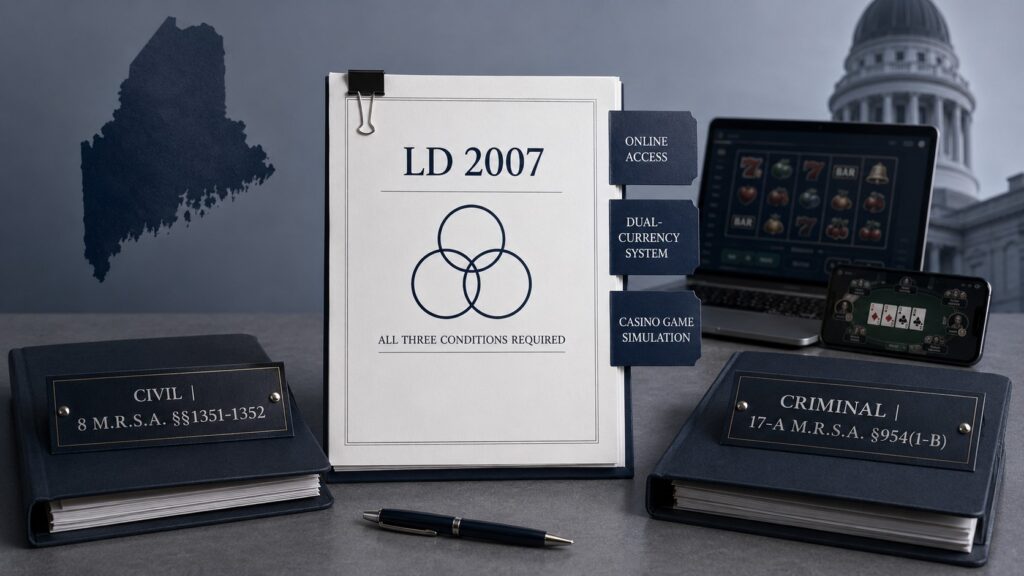
LD 2007 bans platforms that satisfy three conditions at the same time. The platform must be accessible online, operate a dual-currency system, and simulate casino games.
A platform meeting all three elements is classified as conducting unlawful gambling in Maine. Covered formats include slots, poker, table games, bingo, and sports wagering simulations.
The law creates a new civil prohibition at 8 M.R.S.A. §§1351 to 1352, titled Online Sweepstakes Games Prohibited. It also amends the criminal code at 17-A M.R.S.A. §954(1-B).
That dual codification is why the same conduct can carry both a civil fine and criminal exposure.
LD 2007 at a Glance
| Detail | Information |
|---|---|
| Bill number | LD 2007 / S.P. 825 |
| Enrolled as | Maine Public Law 2025, chapter 645 |
| Senate sponsor | Sen. Craig Hickman |
| Committee vote | 8-2 to advance, February 18, 2026 |
| Passed Legislature | April 2, 2026 |
| Signed by Governor | April 6, 2026, Gov. Janet Mills |
| Legislature adjourned sine die | April 29, 2026 |
| Effective date | July 29, 2026 |
| Civil penalty | $10,000 to $100,000 per violation, 8 M.R.S.A. §1352 |
| Criminal exposure | Unlawful gambling, 17-A M.R.S.A. §954(1-B) |
| Fine destination | Gambling Addiction Prevention and Treatment Fund |
| Enforcement body | Maine Gambling Control Unit |
| License impact | Mandatory revocation for licensed entities |
Each prohibited action directed at a Maine resident can constitute a separate violation. The penalty structure is therefore cumulative rather than capped at a single fine.
Routing fine revenue to the Gambling Addiction Prevention and Treatment Fund builds a public-health mechanism directly into the enforcement structure.
How the Dual-Currency Model Triggered the Ban
Every sweepstakes casino runs on two virtual currencies with separate functions and separate legal significance.
Gold Coins are the free-play currency. They carry no cash value and cannot be redeemed for prizes. Gold-Coin-only gameplay falls outside the statute.
Sweeps Coins are the prize-track currency. They can be redeemed for cash or gift cards once a player meets the platform minimum. That redemption feature is the legal trigger.
The Three-Element Test
Maine classifies an activity as unlawful gambling when three elements are present at once. Those are a prize, an element of chance, and consideration.
Sweepstakes operators historically managed the consideration element through the no-purchase-necessary rule. A player could obtain Sweeps Coins by mail without buying anything.
| Element | Traditional sweepstakes | Dual-currency platform under LD 2007 |
|---|---|---|
| Prize | Promotional item | Sweeps Coins redeemable for cash |
| Chance | Random drawing | Random game outcomes |
| Consideration | Direct purchase | Direct or indirect, including registration and engagement |
| Free entry defense | Defeats consideration | Does not defeat indirect consideration |
How Maine Closed the Free Entry Defense
LD 2007 expands the definition of consideration to capture both direct and indirect forms. Direct consideration means coins a player purchases outright.
Indirect consideration includes free Sweeps Coins awarded through promotions or bundled alongside Gold Coin purchases. It also reaches the value a player provides through account registration, personal data, and sustained engagement.
Maine’s legislature determined that this value satisfies the consideration prong even when no money changes hands. The free entry route does not defeat indirect consideration.
With all three elements satisfied, the dual-currency platform is unlawful gambling under Maine law. This is the mechanism that connects the business model to the statute.
What Remains Outside the Ban
Gold-Coin-only social casino platforms present no prize-redeemable currency. Without the prize element, the three-element test cannot be satisfied.
Those platforms remain legal and accessible in Maine. Licensed retail gaming and the authorized tribal iGaming framework are also outside the ban’s scope.
Who Enforces the Ban
The Maine Gambling Control Unit is the primary enforcement authority. It operates as a division of the Maine Department of Public Safety, which submitted LD 2007 to the Legislature.
The unit established its position before the statute existed. It issued a consumer advisory in 2025 stating that no online gambling or sweepstakes platform is authorized to operate in Maine.
That advisory gave operators formal notice roughly a year before the statutory ban took effect.
The Scope Reaches Beyond Operators
LD 2007 defines prohibited activity in three parts. It reaches anyone who operates a dual-currency platform targeting Maine residents.
It also reaches anyone who promotes that platform, and anyone who supports its Maine-facing operations through technical, financial, or promotional assistance.
That three-part definition places affiliate marketers and content publishers within the statute’s reach. Promotional content directing Maine players to these platforms falls within the promoting or supporting definition.
What Happened at the Effective Date
Most major operators completed their exits from Maine after the ban took effect. Several had already restricted Maine for months in response to earlier enforcement pressure.
Because so many platforms had withdrawn in advance, the July 29 date triggered fewer sudden changes than a hard cutoff might suggest.
Operators that exited Maine and Indiana during this period include McLuck and Jackpota. The wider withdrawal covered most brands that had been serving Maine players.
Maine players who still hold an unresolved Sweeps Coins balance should contact operator support directly about redemption windows.
What Maine Players Can Legally Do
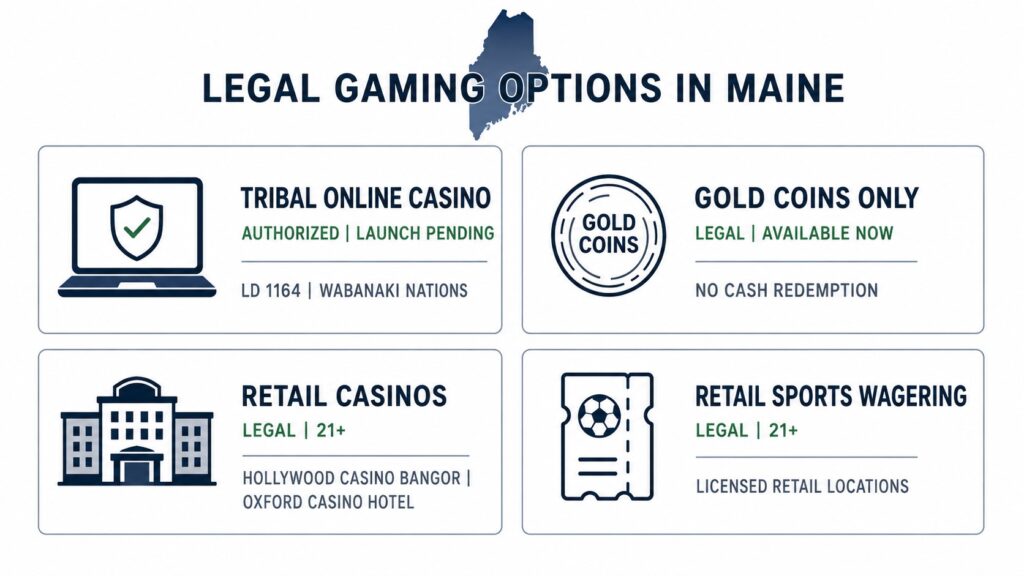
Maine residents have several categories of legal gaming now that LD 2007 is in force.
| Option | Status | Legal basis | Availability |
|---|---|---|---|
| Tribal online casino | Authorized | LD 1164, Wabanaki Nations | Law effective July 29, 2026; platforms pending launch |
| Social casino, Gold Coins only | Legal | Outside LD 2007 scope | Available now |
| Retail casino | Legal, 21+ | State license | Hollywood Casino Bangor; Oxford Casino Hotel |
| Retail sports wagering | Legal, 21+ | Maine law | Licensed retail locations |
Licensed Tribal Online Casinos
Governor Mills signed LD 1164 on January 9, 2026. The law grants the four federally recognized Wabanaki Nations exclusive rights to operate licensed online casinos in Maine.
Those nations are the Penobscot Indian Nation, the Passamaquoddy Tribe, the Aroostook Band of Micmacs, and the Houlton Band of Maliseet Indians.
LD 1164 took effect on July 29, 2026, the same date as the sweepstakes ban. Both were non-emergency bills tied to the same adjournment date.
Caesars Entertainment has signed an agreement with three of the four Wabanaki Nations to launch Maine’s first licensed online casinos. Platform launches are expected to follow.
Maine became the eighth state to authorize real-money iGaming under this framework.
Social Casinos and Retail Gaming
Social casinos operating on Gold Coins only remain legal and immediately accessible. They carry no prize-redeemable currency and fall outside the statute.
Maine’s two licensed retail casinos continue to operate for players aged 21 and older. Hollywood Casino Bangor and Oxford Casino Hotel are both state-licensed venues.
Maine also permits retail sports wagering at licensed locations for players aged 21 and older.
The 21 and over threshold is the operating standard for casino-style gaming in Maine. Confirm the minimum age directly with any licensed tribal platform when it launches.
A Related Restriction
Three days before signing LD 2007, Governor Mills signed LD 2080. That law bans credit card funding for online sports betting and online casino games in Maine.
Maine already prohibited credit card use at land-based casinos. LD 2080 extends the restriction to the online market.
Tax Treatment of Past Redemptions
Sweeps Coins redemptions completed before the ban remain reportable income. Redemptions of $600 or more may trigger an IRS Form 1099-MISC from the operator.
Taxability does not depend on the current legal status of the platform. Keep dated records of redemption amounts and methods.
Confirm treatment with Maine Revenue Services or a qualified tax professional. This is general information and does not constitute tax advice.
Maine in the National Crackdown
Maine was the second state to enact a sweepstakes casino ban in 2026, following Indiana. It became the eighth state overall with an outright prohibition.
The 2026 wave built on significant state action in 2025. California, Connecticut, New York, New Jersey, Nevada, and Montana each restricted dual-currency operations that year.
Washington, Idaho, and Michigan had excluded the category well before the 2025 wave.
The 2026 Sequence
| State | Mechanism | Effective |
|---|---|---|
| Tennessee | SB 2136, direct ban | In effect during 2026 |
| Indiana | HB 1052, direct ban | July 1, 2026 |
| Iowa | SF 2289, regulator enforcement authority | July 1, 2026 |
| Maine | LD 2007, direct ban | July 29, 2026 |
| Louisiana | Acts 182 and 48, ban plus racketeering | August 1, 2026 |
| Oklahoma | SB 1589, direct ban | November 1, 2026 |
Iowa is the outlier in that group. It granted its regulator cease-and-desist authority rather than enacting a prohibition on the model itself.
Maine’s Distinct Approach
Maine paired prohibition with authorization. The same legislative session that banned sweepstakes casinos also opened a licensed real-money online casino market.
The Social Gaming Leadership Alliance opposed LD 2007 and similar bans. It argues that a regulated sweepstakes industry would generate state revenue while maintaining consumer protections.
Maine’s position, reflected in LD 1164, is that regulated iGaming through a licensed tribal framework is the preferable outcome. Whether that produces better consumer results depends on how the Wabanaki Nations platforms roll out.
Frequently Asked Questions
-
Are sweepstakes casinos legal in Maine?
No. LD 2007 took effect on July 29, 2026 and dual-currency sweepstakes casinos are now banned in Maine.
Operating, promoting, or supporting such a platform is a civil violation carrying fines of $10,000 to $100,000, with criminal exposure under the unlawful gambling statute.
-
When exactly did Maine's ban take effect?
July 29, 2026. LD 2007 had no emergency clause, so it took effect 90 days after the Legislature adjourned sine die on April 29.
Earlier reporting cited July 14 or July 15 based on a scheduled April 15 adjournment that did not occur.
-
What happened to my sweepstakes account balance in Maine?
Operators were required to stop serving Maine residents. Most completed their exits around the effective date, and several had restricted Maine months earlier.
If you still hold a balance, contact operator support directly about any remaining redemption window. Redemptions of $600 or more remain reportable income.
-
Can I still play Gold Coin games in Maine?
Yes. Social casino platforms that offer Gold Coin entertainment with no cash-prize redemption fall outside LD 2007.
Without a prize-redeemable currency, the three-element test cannot be satisfied. These platforms remain legal.
-
Why did the free entry defense fail in Maine?
LD 2007 expanded the definition of consideration to include indirect forms. Account registration, personal data, and sustained engagement all count.
Because indirect consideration is present regardless of whether a player pays, the mail-in free entry route does not defeat the consideration prong.
-
When will licensed online casinos launch in Maine?
LD 1164 took effect on July 29, 2026, the same day as the sweepstakes ban. It grants the four Wabanaki Nations exclusive rights to operate online casinos.
Caesars Entertainment has signed an agreement with three of the four nations. Launch timing has not been publicly confirmed.
-
What penalties apply under LD 2007?
Civil fines run from $10,000 to $100,000 per violation under 8 M.R.S.A. §1352. Each prohibited action directed at a Maine resident can count separately.
The conduct is also criminal unlawful gambling under 17-A M.R.S.A. §954(1-B). Licensed entities face mandatory license revocation, and fine revenue funds gambling addiction treatment.
This page is an informational legal explainer for Maine residents. LD 2007 reaches parties who promote or support dual-currency platforms, so Clovr carries no affiliate links, operator recommendations, or sign-up CTAs for Maine traffic on this page. This content is not legal or tax advice.
Related reading:
- Are Sweepstakes Casinos Legal?
- How Sweepstakes Casinos Work
- Sweepstakes Casinos in Michigan
- Sweepstakes Casinos in New York
- Sweepstakes Casinos in Pennsylvania
Think You’ve Got a Gambling Problem? Call or text the National Council on Problem Gambling helpline: 1-800-522-4700 (24/7, confidential).
Last updated: August 2026 | Clovr.com