

No Utah license covers a sweepstakes casino, because the state constitution bars the Legislature from authorizing any game of chance. Utah’s criminal code also defines a sweepstakes as a chance promotion entered “with or without payment.” That wording weakens the free mail-in entry that sweepstakes casinos rely on in other states.
Utah adds a civil route on top of the criminal code. Under Section 76-9-1412, a person who loses money to a covered chance device can sue for twice the loss. Clovr carries no offers, rankings or sign-up links on this page.
This guide covers the options that carry no cash prize, the statutes, the 2025 lawsuits and the 2026 bills. Verify current laws in your jurisdiction before playing.

Alternatives to Sweepstakes Casinos for Utah Players
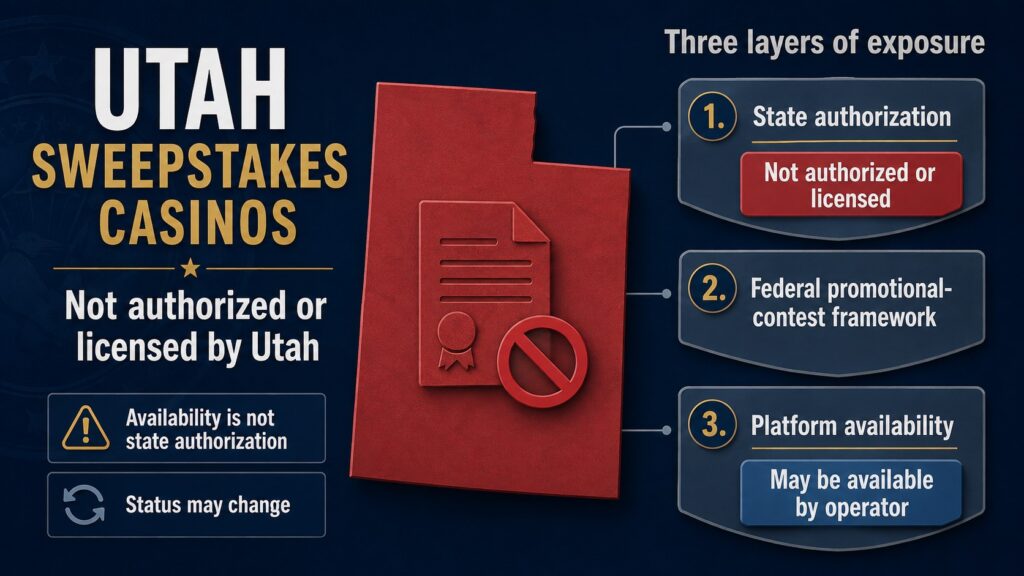
Utah has no state lottery, licensed casino or licensed sportsbook to point to. The constitution bars the Legislature from authorizing any of them. The three options below either award nothing of cash value or help you research a paid product before you buy.
| Option | Cost to use | What you can receive | Utah point to know |
|---|
| 1. Gold Coin only play | Free, with optional Gold Coin purchases | Nothing with cash value | Utah’s definition requires that someone receive anything of value |
|---|
| 2. Mystery box research at mistery-boxes.com | Free to read; boxes cost money | A physical item of random value | The code covers chance outcomes regardless of any pre-reveal feature |
|---|
| 3. Card-rip app research at MyCardRips | Free to read; digital packs cost money | A real graded trading card | A paid random pack raises the same chance question |
|---|
Single-currency card sweepstakes are left out, because their coins redeem for cash after chance-based play. Offshore crypto casinos are also left out, since Section 76-9-1402 makes taking part in online chance play an offense.
1. Gold Coin Only Play
Gold Coin only play removes the prize from the Gold Coin and Sweeps Coin model. Gold Coins have no cash value, so play with them cannot end in a redeemable prize.
Utah’s code covers risking value where someone will receive “anything of value” for an outcome. Clovr found no Utah ruling on Gold Coin only play. Treat it as the lowest-risk option, not as a cleared one.
2. Mystery Box Research at Mistery-Boxes.com
Mistery-boxes.com rates mystery box sites, where a paid box reveals a physical item of random value. Its reviews cover provably fair checks, house edges and which US states each site serves.
Utah’s code covers chance outcomes regardless of a preview or pre-reveal feature. Read the site’s US legality guide and each box site’s terms before you buy from Utah.
3. Card-Rip App Research at MyCardRips
MyCardRips reviews card-rip apps, where you open digital packs and receive real, professionally graded cards. It tracks 33 apps and reports buyback offers, such as one app paying 84.6% of its own stated market value.
A paid pack with a random card is a chance purchase. Under Utah’s broad definition, read each app’s terms for Utah residents before you open a pack.
How to Pick an Alternative
- Choose Gold Coin only play if you want casino-style games with no money at stake.
- Choose a paid box or pack only after you read its terms for Utah residents.
- Compare the price of a box or pack with the average item value the research site reports.
- Set a monthly spending limit before your first purchase and keep to it.
What to Check Before You Buy
- The terms name Utah as an eligible state, or at least do not exclude it.
- The site states the odds or the expected item value for each box or pack.
- A buyback policy explains how you can sell an item back and at what rate.
- The minimum age is listed, and you meet it.
- Spending limits or a self-exclusion tool are available in the account settings.
Utah Law on Sweepstakes Casinos
Article VI, Section 27 of Utah’s constitution governs every game of chance in the state. It says the Legislature “shall not authorize any game of chance, lottery or gift enterprise.” The Utah Supreme Court held in a 1913 case, Salt Lake City versus Doran, that the Legislature cannot legalize any such game.
Section 76-9-1401 defines the prohibited activity as risking anything of value on a chance outcome for a return. The same section defines a sweepstakes as a chance promotion entered “with or without payment of any consideration.” Play by internet or mobile device has its own defined term.
Clovr’s guide to sweepstakes casino legality explains how other states treat the same model. Verify current laws in your jurisdiction before playing.
Offenses and Who They Reach
Utah’s code reaches players, providers and promoters through separate sections. The table lists each offense as the code states it.
| Offense | Section | Who it reaches | Class or fine |
|---|
| Taking part in prohibited chance play, fringe gaming or online play | 76-9-1402 | Any participant | Class B misdemeanor; class A after a prior conviction |
|---|
| Offering online chance play to a person in Utah | 76-9-1404 | Any provider, except neutral internet, hosting and ad services | Third degree felony |
|---|
| Profiting while inducing or aiding others to play | 76-9-1405 | Promoters, investors and managers | Class A misdemeanor; third degree felony after a prior conviction |
|---|
| Advertising a lottery | 76-9-1409 | Anyone who distributes the ad | $2,500 fine; $10,000 after a prior conviction |
|---|
The advertising fine does not apply when “Void in Utah” is conspicuously printed in the ad. Section 76-9-1402 also commits Utah to opt out if federal law ever authorizes online play nationwide.
Why Free Mail-In Entry Carries Less Weight in Utah
In other states, sweepstakes casinos argue that free mail-in entry removes consideration, meaning payment to take part. Utah defines a sweepstakes as entered “with or without payment.” Free entry alone does not move a promotion outside that defined term.
The code exempts a promotion “clearly ancillary” to a business only if it meets several conditions. The promotion must run for a limited period and require no purchase. It must not, through a machine or device, simulate a casino or reveal a prize as a game is played.
Clovr found no Utah court ruling that applies these conditions to an online sweepstakes casino. The question remains open in the lawsuits described below.
Private Lawsuits and Double Damages in Utah
Section 76-9-1412 lets a person with an economic loss from a covered device sue for damages, costs and attorney fees. The suit can target anyone who operates the device or receives revenue from it. A winning plaintiff can recover twice the economic loss.
Covered devices are fringe gaming devices, video gaming devices and devices or records used for prohibited chance play. The 2025 complaints argue that online sweepstakes casinos break Utah’s laws on games of chance.
The November 2025 Lawsuit Wave
Plaintiffs filed 12 class actions against sweepstakes operators in Utah federal court on a single day in early November 2025. CDC Gaming reported the filings on November 4, 2025, and counted 15 Utah suits that week.
The report says the suits target nearly every major operator of Gold Coin and Sweeps Coin sites. More than 100 similar suits had been filed nationwide by then, according to the same report.
What HB 243 Changed in 2026
HB 243 did not ban sweepstakes casinos. The enrolled bill adds statistic-based proposition stakes, such as a player’s touchdown count, to Utah’s definition of prohibited chance play.
Representative Joseph Elison sponsored the bill, and Senator Brady Brammer carried it in the Senate. It passed the House 63 to 9 on February 10, 2026, and the Senate passed it by February 27. The law took effect on May 6, 2026.
Several trade reports in early 2026 described HB 243 as a sweepstakes crackdown that stalled in the Senate. The fringe gaming and promotion language they cited was already in Section 76-9-1401. The 2025 version of that section, effective May 7, 2025, contains the same text.
The Kalshi Ruling
Prediction market Kalshi sued Utah in federal court in February 2026. It argued that federal commodities law overrides the state’s ban. On August 4, 2026, Judge Robert Shelby granted Utah summary judgment and rejected that argument.
Kalshi said it would appeal. Attorney General Derek Brown said his office will enforce the constitutional ban, whatever a company calls its product.
SB 38 and Consumer Protection
SB 38, sponsored by Senator Todd Weiler, reorganized Utah’s consumer protection laws effective May 6, 2026. The Division of Consumer Protection still enforces the Prize Notices Regulation Act among other statutes.
The enrolled bill contains no provision aimed at online sweepstakes casinos. Its only use of the word “sweepstakes” sits in a clause on changing telephone providers.
Utah Sweepstakes Law Timeline
Utah’s position rests on a 1913 ruling and statutes recodified in 2025. The dates below show how the law and the litigation have moved since.
| Date | Event |
|---|
| 1913 | The Utah Supreme Court rules in Salt Lake City versus Doran that the Legislature cannot legalize any game of chance |
|---|
| May 7, 2025 | Recodified chance-play statutes take effect at Sections 76-9-1401 to 76-9-1412 |
|---|
| Early November 2025 | Plaintiffs file 12 class actions against sweepstakes operators in Utah federal court in one day |
|---|
| February 10, 2026 | The House passes HB 243 by 63 to 9 |
|---|
| February 2026 | Kalshi sues Utah in federal court |
|---|
| February 27, 2026 | The Senate passes HB 243 |
|---|
| May 6, 2026 | HB 243 and SB 38 take effect |
|---|
| August 4, 2026 | Judge Shelby rules for Utah in the Kalshi case |
|---|
What Utah’s Laws Mean for Players
Utah’s participation offense applies to players, not only to operators. If a court treats sweepstakes casino play as prohibited chance play, taking part is a class B misdemeanor.
Each operator sets its own Utah eligibility in its terms, and those terms can change. Clovr does not list or rank operators for Utah, so read the eligibility clause in any site’s terms yourself.
The 2025 lawsuits had produced no published Utah ruling on the merits in Clovr’s research. Clovr’s state-by-state sweepstakes guide compares Utah with every other state.
How Gold Coins and Sweeps Coins Work
Sweepstakes casinos run two virtual currencies. Gold Coins are for play only and have no cash value. Sweeps Coins are redeemable for cash prizes after playthrough, meaning coins must be played a set number of times first.
Sweeps Coins usually come as a bonus with Gold Coin purchases, not as a direct purchase. No purchase necessary is the rule, so operators also give Sweeps Coins through a free mail-in entry, called the AMOE.
The free entry is meant to remove consideration from the promotion. Utah’s “with or without payment” wording weakens that argument here. Clovr’s guides on how sweepstakes casinos work and Sweeps Coins explain the model in more depth.
Taxes on Sweepstakes Prizes in Utah
Federal law treats prizes and awards as taxable income under 26 U.S.C. 74(a). Report every prize you redeem, whether or not an operator sends you a tax form.
Utah taxes individual income at a flat 4.45% for tax year 2026. SB 60 cut the rate from 4.5%, retroactive to January 1, 2026. Ask a tax professional about your own return.
Frequently Asked Questions
-
Are sweepstakes casinos legal in Utah?
They are not authorized or licensed by Utah and operate under federal promotional-contest law. Platforms continue accepting Utah players, but the position is contested under a constitutional ban, a criminal statute naming internet gambling, and a civil statute allowing double-damages suits.
-
Did HB 243 ban sweepstakes casinos?
The version that passed the House 63-9 in February 2026 contained fringe gambling provisions that would have captured the model. The bill then stalled in Senate Rules over prediction market preemption concerns and a Senate Substitute was developed.
The enacted law, effective May 6, 2026, is reported as targeting proposition bets, daily fantasy sports, and prediction markets. Sweepstakes platforms continued operating in Utah afterwards and none has been named in an enforcement action under it.
-
Can I be sued for playing in Utah?
Section 76-9-1412 allows a Utah resident to sue to recover gambling-related losses, with double damages in qualifying cases. Most exposure falls on operators and promoters, but the statute does not exclude individual players.
Utah has become a class action hotspot for suits against sweepstakes operators. Consult a qualified attorney for guidance specific to your situation.
-
Why is Utah harder than other restrictive states?
Because the layers stack. A constitutional ban the legislature cannot override, a criminal code naming internet gambling directly, and a civil statute that lets private plaintiffs act without waiting for a prosecutor.
-
Who enforces gambling law in Utah?
The Attorney General and local prosecutors. Utah has no gaming commission and no licensing body, so no operator can hold a Utah gaming licence.
-
What is the minimum age at platforms serving Utah?
Mega Bonanza, McLuck, and Play Fame each require players to be 21 or older. Crown Coins requires 19. Verify the requirement on each platform’s terms before registering.
-
Are winnings taxable in Utah?
Yes. Federal reporting triggers at $600 in a calendar year via Form 1099-MISC. Utah applies its flat state income tax on top, and platforms typically do not withhold at redemption.
These Clovr guides cover other states with strict rules and the basics of safer play.
- Sweepstakes Casinos in Idaho explains how Idaho’s constitution and criminal code block sweepstakes prize redemption.
- Sweepstakes Casinos in Tennessee covers the 2026 law that ended dual-currency sweepstakes in that state.
- Clovr’s Washington guide sets out that state’s rules for sweepstakes casinos.
- Sweepstakes Casinos in Montana sets out Montana’s rules for sweepstakes casinos.
- Clovr’s responsible gaming page lists tools and support for keeping play under control.
Clovr may earn a commission when you sign up through affiliate links on this page. This never affects our reviews, which stay independent and unbiased.
Sweepstakes play should stay fun. If you or someone you know needs support, visit the National Council on Problem Gambling at ncpgambling.org or call 1-800-GAMBLER.


